
You spent a small fortune on a fish finder with a glowing screen, but out on the salt, it’s showing you nothing but noise. You drift over a school of stripers, and the display looks like static. The problem is rarely the head unit. It’s almost always the transducer bolted to your hull.
The transducer is the part that actually sends sound waves into the water and listens for the echo. Get it wrong, and your expensive electronics are just a fancy clock. Get it right, and you’ll see fish, structure, and bottom contours with remarkable clarity. Saltwater punishes transducers with corrosion, vibration, and electrolysis, so the choice matters more here than in any freshwater lake.
We tested five units that handle the salt without falling apart. The picks range from a pocket-sized castable for kayak anglers to a dual-beam workhorse for bay boats. Each one earned its spot for a specific reason. The details below will help you match the right transducer to your boat and your fishing style.
Here is a quick look at how the top five compare on the specs that actually matter.
| Features | LUCKY Portable | LUCKY MT-202 | Humminbird PiranhaMAX | LUCKY FF168-T | LUCKY Sonar 818 |
|---|---|---|---|---|---|
| Best Use Case | Bank & kayak | Long-range casting | Small boats | Deep water | All-season |
| Sonar Type | Wireless probe | Wireless probe | Dual Beam | Wired 200kHz | Wired 200kHz |
| Max Depth | Not specified | 147 feet | Not specified | 328 feet | 328 feet |
| Display Size | Handheld LCD | 3.5 inch LCD | 4 inch LCD | Handheld LCD | Handheld LCD |
| Mounting Style | Castable | Castable | Transom mount | Cast or bracket | Castable |

LUCKY Kayak Portable

LUCKY
LUCKY Kayak Portable Fish Depth Finder for Boats and Bank | Wireless Handheld Fish Finders with Transducer Castable Fishing Sonar for Pole Freshwater Saltwater Fishing
- Pocket-sized portable fish finder : Designed for anglers on the move, this small fish finder fits comfortably in your hand or pock…
- Fish and water depth readout: The vibrant LCD display of the portable fish finder provides clear, real-time data under various lig…
- Wireless freedom and precision: This portable fish finder is equipped with a wireless fishing sonar transducer probe, eliminating…
This is the grab-and-go option for anglers who don’t want to drill holes in a kayak or haul a heavy battery. The LUCKY Kayak Portable is a handheld display paired with a wireless sonar probe that you cast into the water like a lure. It’s built for shore fishing, kayaks, and ice fishing, but it handles saltwater piers and jetties just as well.
The wireless design is the main draw. You tie the sensor to your line, cast it out, and the display shows depth, temperature, and fish icons in real time. There are no cables to route through a scupper hole or a transducer bracket to mount. For a kayak angler who moves between spots constantly, this eliminates the biggest installation headache.
The trade-off is that a castable transducer won’t give you continuous readings while you’re moving. You get a snapshot of where you cast, not a live view of the water under your boat. Also, the wireless range is solid for most kayak fishing, but you’ll want to keep the sensor within a reasonable distance of the display. It’s not a replacement for a fixed mount on a center console.
- Wireless sonar probe with no cables to manage
- Handheld display with neck strap for easy carrying
- Shows water depth, temperature, air pressure, and fish depth
- Multiple modes for shallow water, slopes, and general use
- Compact enough to fit in a tackle box or jacket pocket
Best for: Kayak and shore anglers who want a portable depth finder without any installation work.
LUCKY MT-202
LUCKY
LUCKY Kayak Portable Fish Finder Transducer Wireless Sonar Fish Finders Boat Rechargeable Handheld Fish Depth Finder Fishing MT-202
- Wireless Control & Operation : Experience the ultimate freedom with the LUCKY portable fish finder, featuring a MASSIVE 853FT OPER…
- Precise Fish Depth & Location : Unlock the underwater world with the LUCKY portable fish finder. It doesn't just tell you the wate…
- Readouts on a 3.5" Horizontal LCD Display : You could get a lot of fishing information by the LUCKY portable fish finder. The fish…
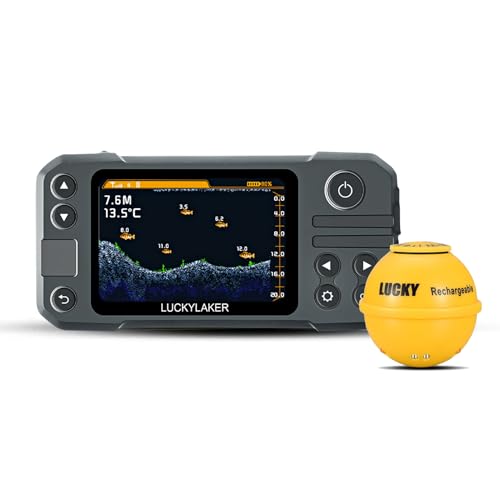
The LUCKY MT-202 takes the portable concept and pushes the wireless range to an extreme. With an advertised 853-foot operation distance, you can cast this sensor far from a pier or a boat and still get a reliable signal. That’s a huge advantage when fish are holding beyond casting range.
This unit stands out for its 90-degree wide beam. That wide cone gives you a much bigger picture of what’s below, which helps you find scattered fish over structure. The 3.5-inch horizontal LCD is larger than most handhelds, and the scrolling display shows a history of what you’ve passed over. You can see fish movement and track bottom contours without staring at a tiny screen.
It’s not perfect. The wide beam is great for coverage, but it sacrifices some detail compared to a narrow 20-degree cone. You’ll see fish, but separating two fish sitting close together on the bottom is harder. Also, the sensor is lightweight, so casting it into a strong wind takes some practice.
- 853-foot wireless operation range, among the longest available
- Wide 90-degree beam scans a large area quickly
- 3.5-inch horizontal LCD with fish depth icons
- Scrolling screen shows a continuous sonar history
- Works for shore, kayak, boat, and ice fishing
Best for: Anglers who fish from shore or large kayaks and need maximum wireless range.
Humminbird PiranhaMAX 4

Humminbird
Humminbird PiranhaMAX 4 Fish Finder with Transducer, Dual Beam Sonar
- Dual Beam Sonar: Choose from a narrow and a wide beam for great detail or a generous coverage area, helping you identify fish, str…
- Tilt and Swivel Mount: Quickly adjust your viewing area angle.
- 1-Year Limited Warranty
The Humminbird PiranhaMAX 4 is the traditional choice for small boats. It’s a fixed-mount unit with a transom transducer, which means it’s always reading the water below you while you’re on plane or drifting. This is the kind of setup you want if you’re running a 14-foot aluminum boat or a small bay skiff.
Dual Beam sonar is the key feature here. You can switch between a narrow beam for high detail and a wide beam for more coverage. In saltwater, that narrow beam helps you pick out individual fish holding on a drop-off, while the wide beam shows you the overall structure. Having both options in one transducer gives you flexibility without changing hardware.
The trade-off is that this is a wired unit, so installation takes more effort. You’ll need to mount the transducer on the transom, route the cable, and connect it to the head unit. The 4-inch display is also smaller than modern chartplotters, so don’t expect high-resolution imaging. It’s a reliable workhorse, not a flagship model.
- Dual Beam sonar with narrow and wide options
- Tilt and swivel mount for adjusting the viewing angle
- Includes XNT 9 28 T transom-mount transducer
- 1-year limited warranty from Humminbird
- Simple, proven design for small boats
Best for: Boat owners who want a dependable, fixed-mount fish finder with dual beam flexibility.
LUCKY FF168-T

LUCKY
LUCKY Kayak Portable Fish Finder Transducer Handheld LCD Fishing Depth Finders Water Castable Boat Fish Sonar Boat Bank Ice Fishing FF168-T
- Accurate Sonar & Wide Depth Range: Enhance underwater detection with precision. This portable fish finder features a high-performa…
- Clear LCD Display & Real-Time Tracking: Equipped with an intuitive handheld LCD screen, this fishing depth finder displays essenti…
- Versatile for Multiple Fishing Environments: Designed for various angling scenarios, this castable kayak fish finder provides reli…
The LUCKY FF168-T is the deep-water specialist in this group. Its wired transducer pushes a 200kHz single beam down to 328 feet, which covers most inshore and nearshore saltwater applications. If you’re fishing reefs, wrecks, or deep channels, this unit gives you the range you need.
What makes this one versatile is the mounting flexibility. The transducer can be cast directly into the water, or you can mount it to a boat hull or kayak transom using the included bracket. That means you can use it as a portable unit for shore fishing, then bolt it on for a day on the boat. Few options in this price range offer that kind of adaptability.
The single beam is a limitation. A 45-degree cone gives you a good balance of coverage and detail, but you won’t get the target separation of a CHIRP unit. Also, the wired connection means you have to manage the cable carefully, especially if you’re switching between castable and mounted modes frequently.
- 200kHz single beam with a 45-degree cone angle
- Depth range from 2 feet down to 328 feet
- Displays water depth, temperature, battery level, and bottom contour
- Castable transducer or mountable with a bracket
- Compact handheld display fits in a vest or backpack
Best for: Anglers who need deep-water capability and want the option to cast or mount the transducer.
LUCKY Sonar 818
LUCKY
LUCKY Sonar Portable Fish Finder Transducer Wired Water Depth Finders Boat Kayak Transducer Fish Finder Handheld Fishing Gifts for Men
- Lucky portable fish finder 818 is the newest model of lucky fish finder. Unlike most rectangular portable fish finder on the marke…
- Functions of handheld depth finder: ①Real-time display water depth, fish location rock and weed.②5 levels adjustable sensitivity f…
- Wide detection range: The max detection depth of portable fish finder 818 is 328ft (100m) with 45°detecting degree. And sonar tran…
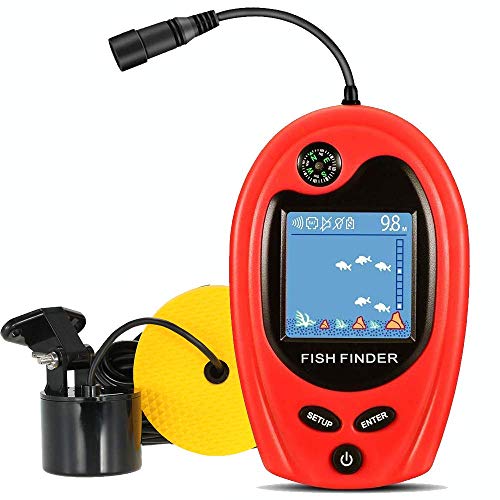
The LUCKY Sonar 818 is the ergonomic pick. Its streamlined shape fits the hand naturally, so you can hold it for hours without fatigue. That matters when you’re bouncing around a boat or standing on a jetty all day. It’s a thoughtful design that most rectangular units ignore.
This model has five adjustable sensitivity levels, which is a practical feature for saltwater. Turbid water and heavy plankton can scatter sonar signals, and being able to dial down the sensitivity helps clean up the display. There’s also a fish alarm and a backlight for night fishing, plus a power-saving mode that stretches battery life to at least six hours.
The 45-degree cone and 200kHz frequency are standard for this class. It works well for bass, crappie, and trout, and it handles saltwater bays and surf zones without issue. The main drawback is the castable design—you’re limited to spot checks rather than continuous bottom tracking.
- Ergonomic, streamlined body for comfortable one-hand use
- 5-level sensitivity adjustment for clear or turbid water
- Backlight and fish alarm for night and low-light conditions
- Power-saving mode provides at least 6 hours of use
- Operates in temperatures from 14°F to 122°F
Best for: Anglers who prioritize comfort and want adjustable sensitivity for varying water clarity.
How We Chose These Products
We started with the transducer, not the display. The selection process focused on how each unit handles the specific demands of saltwater: corrosion resistance, reliable sonar returns, and practical mounting options. We looked for products that solved a real problem for a specific type of angler, rather than a one-size-fits-all approach.
We also considered the installation reality. A transducer that requires a complex thru-hull mount is a poor fit for a kayak angler. Conversely, a castable sensor is useless for a center console running at 30 knots. Each pick here matches the hardware to the intended use case. We prioritized units with clear depth ratings, sensible beam angles, and features that improve real-world fishing, not just marketing specs.
Buying Guide: What Really Matters
The most important decision is the mounting style. Transom mounts are standard for small boats and are easy to install, but they can suffer from turbulence at high speeds. Thru-hull mounts give a cleaner reading at speed but require a hole in the hull and careful attention to the deadrise angle. Castable transducers are perfect for kayaks and shore fishing, but they only give you a snapshot of the water where you cast.
Cone angle and frequency go hand in hand. A narrow 20-degree cone at 200kHz gives you high detail in shallow water, ideal for spotting individual fish. A wide 90-degree cone covers more ground but loses separation. For saltwater, a 50/200kHz dual-frequency setup is a solid compromise, letting you switch between deep-water coverage and shallow-water detail. CHIRP sonar is better still, sweeping a range of frequencies to create a continuous slice of data, which improves target separation dramatically.
Corrosion is the silent killer. Saltwater eats away at exposed metal, and electrolysis can destroy a transducer if the boat’s grounding is off. Plastic housings resist corrosion but are less durable. Bronze transducers are the gold standard for saltwater thru-hull mounts, but they must be properly grounded to avoid galvanic corrosion. Stainless steel is an option, but it can cause issues if it reacts with other metals on the hull. Always check the material and the grounding requirements before you buy.
Our Top Recommendation
The LUCKY MT-202 is the best overall pick for most saltwater anglers. Its 853-foot wireless range is unmatched, and the wide 90-degree beam gives you a broad view of the underwater landscape. It’s portable, easy to use, and works across every fishing style from the surf to the kayak. The long-range capability solves the biggest problem with castable units, which is staying connected to the sensor.
If you need a fixed-mount unit for a small boat, the Humminbird PiranhaMAX 4 is the runner-up. It’s a proven, reliable transducer with dual beam flexibility, and the transom mount is straightforward for DIY installation. For deep-water anglers who want a castable option, the LUCKY FF168-T offers the best depth range at 328 feet. For pure comfort, the LUCKY Sonar 818 is the one to grab for long sessions on the water.
Frequently Asked Questions
What does CHIRP sonar do that a regular transducer can’t?
CHIRP sends a continuous sweep of frequencies, from low to high, instead of a single pulse. This creates a much cleaner sonar return with better target separation. You can distinguish between a fish and a rock, and you can see fish that are holding tight to the bottom. Traditional 2D sonar uses a fixed frequency like 200kHz, which gives a smaller, less detailed picture.
Can I use a freshwater transducer in saltwater?
You can, but it won’t last long. Saltwater is highly corrosive, and a transducer not designed for it will eventually fail. Look for units with plastic or bronze housings specifically rated for saltwater. Also, check the cable and connector materials. Even a small amount of saltwater intrusion into the cable can cause false readings or a complete failure.
How do I prevent electrolysis from destroying my transducer?
Electrolysis happens when two different metals are in contact with saltwater, creating an electrical current that eats away at the weaker metal. To prevent this, make sure your transducer is properly grounded to the boat’s bonding system. If you have a bronze transducer, it must be connected to the same ground as your other through-hull fittings. A sacrificial zinc anode can also help protect the transducer.
Should I mount the transducer on the transom or use a thru-hull?
It depends on your boat and speed. Transom mounts are easier to install and work well on boats under 25 feet that don’t exceed 30 knots. Thru-hull mounts provide a cleaner sonar return at high speeds because they sit flush with the hull, avoiding turbulence. However, thru-hull installation is more complex and requires access to the inside of the hull. For most recreational anglers, a well-installed transom mount is sufficient.
