Bass are the most popular freshwater game fish in America. Largemouth live in warm, weedy lakes; smallmouth live in clear rivers and rocky lakes. Both eat frogs, crawfish, shad and soft plastics — and both fight hard. This guide shows you the lures, gear and seasons for bass.
| Species | Water | Best bait | Best season |
|---|---|---|---|
| Largemouth | Warm weedy lakes | Frog, jig, soft plastic worm | Spring & summer |
| Smallmouth | Clear rivers, rocky lakes | Crankbait, tube, spinnerbait | Spring & fall |
Largemouth vs smallmouth bass — comparison chart
Use this chart to tell the two bass apart and to pick the right lure, depth and season for each. Sizes and temperatures are approximate and vary by lake, river and region.
| Feature | Largemouth bass | Smallmouth bass |
|---|---|---|
| Typical adult size (approximate) | 1–3 lb (0.5–1.4 kg); 12–16 in long | 1–3 lb (0.5–1.4 kg); 12–16 in long |
| Large fish (approximate) | 5 lb and over; record over 22 lb | 4 lb and over; record about 12 lb |
| Habitat | Warm, weedy lakes, ponds, slow rivers, docks and lily pads | Clear, cool rivers and rocky lakes, gravel bars and current breaks |
| Preferred depth | 2–12 ft in weeds and cover; deeper in summer heat | 3–20 ft on rock, ledges and drop-offs; shallower in spring |
| Best water temperature (approximate) | 65–80°F (18–27°C) | 60–70°F (16–21°C) |
| Best lures | Frog, jig, Texas-rigged worm, spinnerbait, topwater popper | Crankbait, tube jig, spinnerbait, Ned rig, jerkbait |
| Best season | Spring and summer, especially dawn and dusk | Spring and fall, especially in clear water |
| Fight | Strong runs into weeds and cover; big jumps | Hard, deep runs and jumps; pound for pound one of the hardest fighters |
What is the best lure for bass?
Short answer: there is no single best lure for bass — the best lure is the one that matches the water, the cover and the season. If you could own only three, start with a soft plastic worm, a spinnerbait and a topwater frog. Those three cover weeds, open water and the surface, and they catch both largemouth and smallmouth in most lakes and rivers.
A Texas-rigged soft plastic worm is the most reliable bass lure ever made, and it is the best place for a beginner to start. Rig a 5-inch green pumpkin or watermelon worm on a 3/0 offset worm hook with a 1/4-ounce bullet weight, cast it past a weed edge or a dock, and let it sink to the bottom. Then lift the rod tip slowly, reel in the slack, and let the worm fall again. Bass usually hit on the fall, so watch your line for a twitch or a sideways movement and set the hook with a firm upward sweep. The Texas rig is nearly weedless, so you can fish it straight through lily pads, brush and submerged timber where other lures snag. Fish it slowly in cold water and faster, with longer hops, in warm water. A common mistake is fishing it too fast: if you are not feeling the bottom, you are reeling too quickly.
Spinnerbaits are the best search lure for bass because they cover water quickly and trigger reaction strikes. A 3/8-ounce white or chartreuse spinnerbait with double willow blades works in clear water, while a Colorado blade version thumps harder and is better in stained water or low light. Cast along weed lines, reel steadily just fast enough to keep the blades spinning, and bump the lure off stumps and rocks — the deflection often triggers a strike. In spring, slow-roll a spinnerbait over shallow flats where bass are moving up to spawn. In summer, burn it just under the surface over weed tops early in the morning. The mistake most beginners make is reeling a spinnerbait at one speed all day; vary the retrieve with pauses and speed changes until the bass tell you what they want.
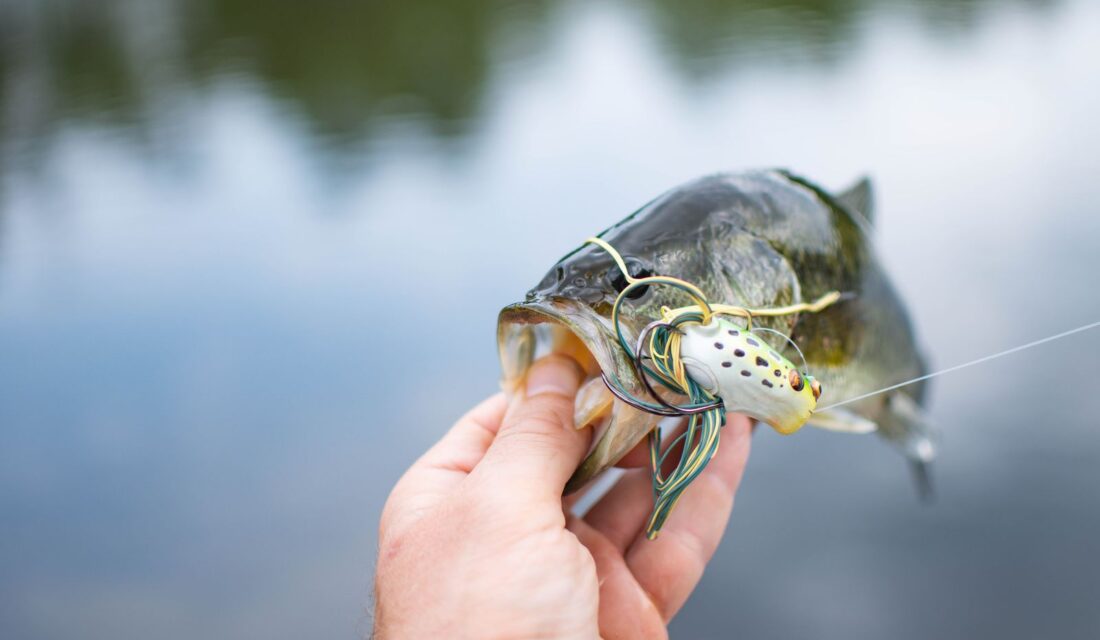
Topwater frogs and poppers are the most exciting way to catch largemouth bass, and they are deadly from late spring through early fall. A hollow-body frog in white or black works over matted weeds and lily pads where no other lure can go. Cast it onto the mat, let it sit for a few seconds, then walk it back with short twitches of the rod tip. When a bass explodes on it, wait until you feel the weight of the fish before setting the hook — setting too early is the number one reason anglers miss frog fish. Use heavy braided line (50 lb test) and a heavy rod so you can pull a big bass out of thick cover. Poppers work better on open water: cast near a dock or a point, pop the lure, pause, and repeat. Bass often hit on the pause. In fall, switch to crankbaits and jerkbaits that imitate dying shad, and in winter slow down with a jig or a Ned rig fished on the bottom. Carry lures in natural colours (green pumpkin, shad, crawfish) for clear water and brighter colours (chartreuse, firetiger) for stained water, and always match the size of your lure to the baitfish the bass are eating.
What rod and reel for bass?
Short answer: a 7-foot medium-heavy baitcasting rod with a low-profile baitcaster, or a 7-foot medium spinning rod with a 2500-size spinning reel, will handle almost all bass fishing. The baitcaster gives you accuracy and power for heavy lures and thick cover; the spinning rod is easier to learn and better for light lures and finesse techniques.
For a first bass setup, choose a 7-foot medium-heavy, fast-action baitcasting rod rated for 10–20 lb line and 1/4 to 3/4-ounce lures, paired with a 6.4:1 or 7.1:1 gear ratio baitcasting reel spooled with 12–15 lb fluorocarbon or 30–50 lb braid. A 7-foot rod gives you long casts and good hook-setting power, while the fast action — a tip that bends in the top third — gives you sensitivity to feel a worm dragging over a rock and the backbone to drive a hook home. A 6.4:1 reel picks up about 26 inches of line per handle turn, which is a good all-round speed; a 7.1:1 reel is better for frogs, jigs and techniques where you need to take up slack quickly. If you fish heavy cover, step up to a 7-foot 6-inch heavy rod and 50 lb braid so you can pull bass out of weeds and timber.
A spinning setup is the better choice for light lures, smallmouth and finesse fishing. Choose a 6-foot 6-inch to 7-foot medium, fast-action spinning rod with a 2500-size reel and 8–10 lb fluorocarbon or 10–15 lb braid with a fluorocarbon leader. This setup casts Ned rigs, drop shots, small tubes and weightless worms accurately, and the lighter line lets finicky smallmouth bite in clear water. Use the spinning rod for jerkbaits, crankbaits and topwater poppers too, and keep the baitcaster for jigs, frogs and Texas rigs. Two rods — one baitcaster and one spinning rod — cover nearly every bass situation a beginner will meet.
Line choice matters as much as the rod. Fluorocarbon sinks, is nearly invisible under water and has little stretch, which makes it the best choice for jigs, worms and crankbaits in clear water. Braid has no stretch, is very strong for its diameter and floats, which makes it the best choice for frogs, heavy cover and topwater lures. Monofilament floats and stretches, which makes it forgiving for topwater lures and a good budget choice for beginners. A common mistake is using line that is too heavy for the lure: 20 lb line on a small crankbait kills its action. Another mistake is using a rod that is too stiff for the technique — a heavy rod with a light lure will not cast well and will rip hooks out of a bass’s mouth. Set your drag so a strong bass can take line without breaking off, keep your hooks sharp, and re-tie after every fish or every snag. A dull hook and a nicked line lose more bass than any wrong lure choice.
Where do bass live?
Short answer: largemouth live in warm, weedy, shallow water with cover; smallmouth live in clear, rocky water with current. Find the cover and the depth change, and you will find the bass.
Largemouth bass are ambush predators, so they live where they can hide and wait for food to come to them. In a lake, start at weed edges, lily pad fields, fallen trees, docks, boat ramps and the shady side of points. Bass hold tight to the edge where weeds meet open water, facing out into the open water so they can rush out and grab a bluegill or a frog. In a pond, the same rule applies on a smaller scale: fish the dam, the deepest corner, any overhanging bush and the inlet where fresh water flows in. In a river, largemouth sit in backwaters, sloughs and eddies out of the main current. In spring, largemouth move into shallow bays and coves to spawn in water 2–5 feet deep, often on a hard bottom near a weed bed. A spawning bass guards its nest and will attack almost anything that comes close, which is why spring is the easiest time to catch a big largemouth — but handle spawning fish gently and release them quickly so they can return to the nest.
Smallmouth bass live in a different world: clear rivers with gravel and rock, and rocky lakes with ledges, points and drop-offs. In a river, smallmouth hold behind boulders, in the seam where fast water meets slow water, at the head and tail of pools, and along undercut banks. Cast upstream of a boulder and let a tube or a crankbait drift down past it; the smallmouth will be sitting in the slack water behind the rock, waiting for food the current brings. In a lake, smallmouth relate to rock: rocky points, offshore humps, gravel flats and the first drop-off from a shallow flat. In spring they move onto gravel flats in 3–8 feet of water to spawn. In summer they slide deeper, to 10–20 feet on ledges and humps, and they follow schools of shad in open water. A fish finder helps here: look for baitfish balls and the arches of bass holding just below them.
Step by step, fish a new lake like this. First, look at a map and mark the points, weed lines, docks and creek channels. Second, start shallow in the morning and work deeper as the sun rises — bass follow the shade and the baitfish. Third, make fan casts around each piece of cover instead of casting at it once: a bass often needs to see a lure twice before it strikes. Fourth, pay attention to wind: a breeze blowing into a bank pushes baitfish and warm water against it, and bass follow. The biggest mistake beginners make is fishing the middle of the lake with no cover or structure nearby — open, featureless water holds few bass. Another mistake is fishing the same depth all day: bass move up and down with light, temperature and baitfish, so change depth until you find them, and once you catch one, fish that spot thoroughly, because bass often school in the same place.

When do bass bite best?
Short answer: bass bite best in spring and early summer, at dawn and dusk, and on overcast days with a light wind. The best bite of the day is usually the first hour after sunrise and the last hour before sunset, when low light lets bass hunt in the shallows.
Season by season, spring is the best time for big bass. As water warms from about 55°F to 65°F (13–18°C), bass move shallow to feed before spawning, then spawn in water 60–70°F (16–21°C). Pre-spawn bass are aggressive and feed heavily, so fish jerkbaits, spinnerbaits and jigs on points and flats near spawning bays. During the spawn, bass are on nests in shallow water and are easy to find but should be released quickly. After the spawn, bass are tired and hungry; fish topwater lures and soft plastics around the same bays. Summer brings the classic dawn and dusk bite: bass feed in the shallows early, then move to deeper weed edges, ledges and shade during the heat of the day. Night fishing is also excellent in summer — a black buzzbait or a big worm fished slowly after dark catches bass that will not bite in daylight. Fall is the second-best season: as water cools, baitfish school up, and bass feed heavily to prepare for winter. Fish crankbaits, spinnerbaits and topwater lures that imitate shad, and follow the baitfish. Winter is the hardest season: bass go deep and slow, so fish a jig, a Ned rig or a suspending jerkbait very slowly on deep structure, and expect fewer but sometimes bigger bites.
Time of day matters as much as season. At dawn, bass move into the shallows to feed, and topwater lures, spinnerbaits and shallow crankbaits work best. At midday, especially on bright, calm days, bass hold deeper or under thick cover; switch to a Texas rig, a jig or a drop shot and fish slowly. At dusk, the bite picks up again as the light fades, and topwater fishing can be spectacular. Overcast days extend the morning bite: clouds cut the light, bass stay shallow longer, and a spinnerbait or a crankbait fished over a flat can produce all day. A light wind is your friend — it breaks up the surface, hides your line and pushes baitfish to the windward bank. The worst conditions are a bright, calm midday after a cold front: the sky is clear, the wind is gone and the bass go tight to cover and stop feeding. On those days, fish slowly, downsize your lure, and fish the thickest cover you can find. Check the water temperature if you can: bass feed best when the water is 65–80°F (18–27°C) for largemouth and 60–70°F (16–21°C) for smallmouth, and they slow down sharply below 50°F (10°C).
Largemouth vs smallmouth — what is the difference?
Short answer: largemouth have a bigger mouth that extends past the eye, live in warm weedy water and grow larger; smallmouth have a smaller mouth that ends at the eye, live in clear rocky water and fight harder for their size. The mouth is the quickest way to tell them apart.
Look at the mouth first. On a largemouth, the upper jaw extends past the back of the eye when the mouth is closed; on a smallmouth, the jaw ends at or before the middle of the eye. The largemouth also has a dark horizontal stripe along its side and a more green, mottled back, while the smallmouth is browner or bronze with dark vertical bars on its sides and often has red eyes. Largemouth grow bigger — a 5 lb largemouth is a good fish and the record is over 22 lb — while smallmouth rarely pass 7 lb and the record is about 12 lb. But pound for pound, smallmouth are the stronger fighters: a 3 lb smallmouth in a river will pull harder, run deeper and jump more than a largemouth of the same size, which is why many anglers call the smallmouth the best fighting freshwater fish in North America.
The two species also live and feed differently, which changes how you fish for them. Largemouth are ambush feeders that sit in weeds and cover and rush out to grab prey, so you fish slowly and precisely, casting to visible cover and working a lure through it. Smallmouth are roamers that chase baitfish in open water and current, so you cover more water with crankbaits, spinnerbaits and jerkbaits, and you fish rock and current breaks rather than weeds. Largemouth tolerate warm, murky water down to low oxygen levels; smallmouth need cooler, clearer, better-oxygenated water, which is why smallmouth dominate northern lakes and rivers while largemouth dominate southern lakes and ponds. Where their ranges overlap, you can catch both in the same lake — largemouth in the weedy bays and smallmouth on the rocky points — and learning to tell them apart will tell you which lure and which spot to try next. A common beginner mistake is fishing for smallmouth with largemouth tactics: casting a frog into weeds on a rocky smallmouth lake will catch nothing, just as fishing a tube on a deep ledge in a weedy largemouth pond will go quiet. Match the fish to the water, use the chart at the top of this guide to compare them, and fish each species where it actually lives.
