
A fishing kayak gets you to fish a boat cannot reach — shallow water, small lakes, quiet rivers. Pedal kayaks are fastest, paddle kayaks are cheapest, inflatables pack away. This guide compares them by type, with prices checked at publish time.
Best fishing kayaks at a glance
| Pick | Kayak | Price | Length | Weight capacity | Drive |
|---|---|---|---|---|---|
| Best overall | Old Town Sportsman PDL 120 | $2,499.98 sale (was $2,999.99) | 12 ft | 500 lb | Pedal |
| Best pedal | Hobie Mirage Compass | $2,599 | 12 ft | 400 lb | Pedal |
| Best budget paddle | Ascend Path 10 | $649.99 | 10 ft | 325 lb | Paddle |
| Best inflatable | Hobie iTrek Angler 10 | $2,799 | 10 ft | 400 lb | Pedal (inflatable) |
| Best for fly fishing | Hobie Mirage Passport 10.5 | $1,649 | 10.5 ft | 325 lb | Pedal |
Prices checked November 19, 2026 at Bass Pro Shops. Prices vary and change often — check the current price before you buy.
Fishing kayak comparison chart — type, price, capacity & best use
Price ranges and capacities below are approximate, drawn from the prices checked at Bass Pro Shops on November 19, 2026 and the makers’ published specifications. Weight capacity is the maximum load the maker rates the kayak for, including angler, gear and tackle.
| Kayak type | Price range (approx.) | Weight capacity (approx.) | Best use |
|---|---|---|---|
| Pedal sit-on-top | $1,600–$3,600 | 325–500 lb | Hands-free fishing, big water, wind |
| Paddle sit-on-top | $550–$1,100 | 325–450 lb | Budget, shallow water, rivers |
| Inflatable pedal | $2,800–$3,000 | 400 lb | Travel, storage, apartments |
| Motorised (trolling motor) | $3,300–$4,000 | 500 lb | Hands-free plus motor, big lakes |
| Sit-inside | $550–$850 | 325–400 lb | Cold water, rivers, staying dry |
Pedal vs paddle kayak — which is better?
Short answer: Pedal kayaks are better for fishing — your hands stay free to cast, your legs are stronger than your arms, and you can hold position in wind and current. Paddle kayaks are better for your wallet and for shallow, rocky water. If you can afford a pedal kayak, buy one; if you cannot, a paddle kayak still catches fish.
A pedal kayak is driven by your legs through a pedal system — Hobie’s MirageDrive uses fins that sweep back and forth, Old Town’s PDL uses a bicycle-style propeller. Your legs are far stronger than your arms, so you go faster for longer: a pedal kayak cruises at 3 to 4 mph all day, while a paddle kayak cruises at 2 to 3 mph and tires you out. The real advantage is not speed, though — it is hands-free fishing. With a pedal drive you hold position against the wind while you cast, you move to the next spot without putting the rod down, and you can fight a fish with both hands while your legs keep the kayak steady. That is why every serious kayak tournament angler fishes a pedal kayak.
A paddle kayak is simpler, cheaper and lighter. There is no drive to break, no hole in the hull to leak, and the kayak weighs 15 to 25 pounds less than the same hull with a pedal drive. You can drag it across rocks and gravel, float it in 6 inches of water, and carry it on your shoulder. The price difference is real: a good paddle fishing kayak costs about $650 to $1,100, while a pedal kayak starts around $1,650 and runs to $3,600. For small lakes, rivers and ponds, a paddle kayak is all you need — you are never far from the fish and you never need to hold position in heavy wind.
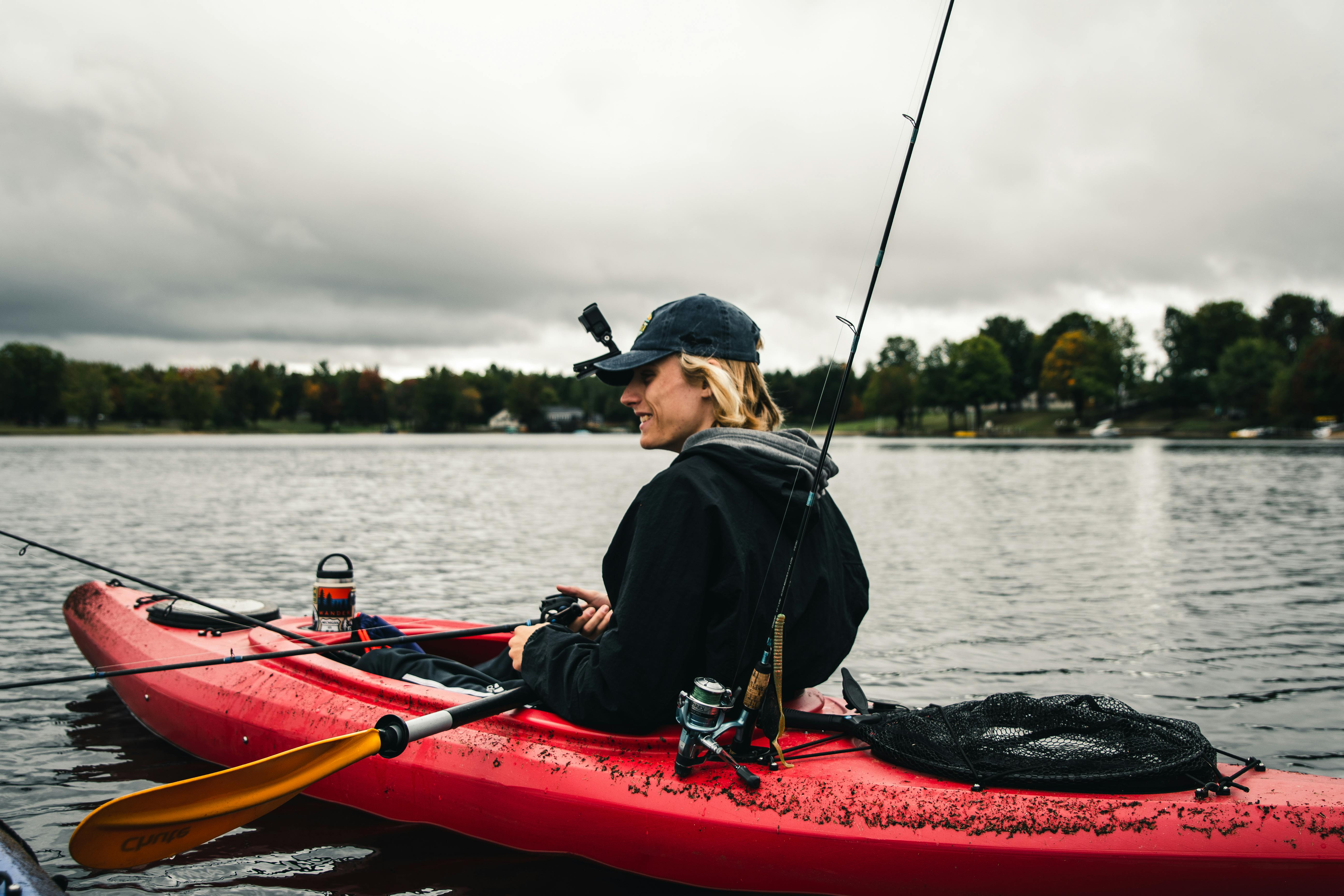
Choose a pedal kayak if you fish big lakes, windy water or current, if you fish tournaments, or if you want to cover water all day without tiring. Choose a paddle kayak if you fish small water, if you carry the kayak a long way to the water, if you fish shallow rocky rivers, or if the budget is tight. A third option is a motorised kayak — Old Town’s AutoPilot range has a trolling motor built in — which is the most hands-free of all, but it costs $3,300 to $4,000 and needs a battery and a trailer or a strong back. The mistakes to avoid: buying a pedal kayak for a rocky river (the drive will hit bottom and break), and buying a paddle kayak for a big windy lake and then fighting the wind all day with one hand on the paddle and one on the rod.
What size fishing kayak do I need?
Short answer: A 10-foot kayak is best for small water, rivers and carrying; a 12-foot kayak is best for big lakes, wind and standing to cast. Most anglers should buy a 12-footer if they fish lakes, and a 10-footer if they fish rivers and ponds.
Length decides three things: speed, stability and weight. A longer kayak is faster and tracks straighter — a 12-foot kayak cruises noticeably faster than a 10-foot one and holds a line in wind. A longer kayak is also more stable for standing: the extra length gives you room to stand and cast, which matters if you fly fish or sight fish. A shorter kayak is lighter, easier to carry and load on a car, and turns faster in tight rivers. A 10-foot kayak weighs about 55 to 65 pounds; a 12-foot kayak weighs about 70 to 85 pounds; a 13-foot or 14-foot kayak can weigh over 100 pounds with a pedal drive.
Width matters as much as length. A fishing kayak is 32 to 36 inches wide — much wider than a touring kayak — because width is stability. A 34-inch-wide kayak is stable enough to stand in; a 30-inch-wide kayak is not. The trade-off is speed: wider is slower. For standing and casting, buy 33 inches or wider. For paddling distance, buy narrower. And check the weight capacity: add your body weight, plus 50 pounds of gear, tackle, fish finder and battery, and make sure the total is well under the kayak’s rated capacity. A 200-pound angler with 50 pounds of gear needs a kayak rated for at least 325 pounds, and 400 pounds is more comfortable.
Here is the size guide by water. Small ponds and creeks: 10 feet, paddle, 32 inches wide. Medium lakes and rivers: 11 to 12 feet, pedal or paddle, 33 to 34 inches wide. Big lakes, bays and wind: 12 to 13 feet, pedal, 34 to 36 inches wide. Fly fishing: 12 feet with a wide, open deck so the line does not catch on anything. And a seasonal note: in summer, a longer kayak with a pedal drive lets you cover more water looking for fish; in winter, a shorter kayak is easier to load and launch when the ramps are icy. The mistake is buying the biggest kayak in the shop and then finding you cannot lift it onto your car alone — measure your roof rack and your strength before you buy.
Sit-on-top vs sit-inside?
Short answer: Sit-on-top is the right choice for almost every fishing kayak — it is stable, self-draining, easy to get on and off, and has room for gear. Sit-inside is better only for cold water and rivers, where staying dry matters more than standing.
A sit-on-top kayak has an open deck: you sit on top of the hull, not inside it. The deck is moulded with scupper holes that drain water away, so waves and splashes run out by themselves. That makes it the fishing standard for four reasons. First, it is stable — you can stand up to cast, turn around to reach the tackle behind you, and lean over the side to land a fish without tipping. Second, it is easy to get on and off — you slide on from a dock or a beach, and if you fall off, you climb back on without bailing water. Third, it has room: rod holders, gear tracks, a tank well for a crate, and space for a fish finder. Fourth, it is self-bailing, so a wave over the side is an inconvenience, not an emergency.
A sit-inside kayak has a cockpit you sit in, with the hull around your legs. It keeps you drier and warmer, because your lower body is inside the hull and out of the wind and spray, and it is usually lighter and faster than a sit-on-top of the same length. That makes it a good choice for cold water, for rivers where you want to stay dry, and for paddling distance. The trade-offs for fishing are real, though: you cannot stand up, you cannot turn around easily, getting back in after a capsize means bailing water, and there is less deck space for gear. The Ascend H10 and H12 are sit-inside hybrid kayaks that try to split the difference, with a large open cockpit that gives you more room than a traditional sit-inside.
Choose sit-on-top if you fish lakes, bays, ponds and warm water, if you want to stand and cast, or if you are new to kayaks — it is the forgiving choice. Choose sit-inside if you fish cold rivers and cold water, if you paddle long distances to the fish, or if staying dry is the priority. In winter, a sit-inside with a spray skirt is warmer than any sit-on-top; in summer, a sit-on-top is cooler and easier. The mistake is buying a sit-inside because it is cheaper and then discovering you cannot stand to cast or reach your tackle — for most fishing, the sit-on-top is worth the extra money.
Best kayak fish finder setup?
Short answer: The best kayak fish finder setup is a small 5-inch to 7-inch unit with GPS and side imaging, mounted on a gear track in front of you, with the transducer on a scupper-hole or arm mount and a small 12V battery in the hull. Keep it simple, keep it removable, and keep the wires short.
A fish finder on a kayak does the same job as on a boat — it shows you depth, structure and fish — but the kayak version has to be smaller, lighter and tougher. A 5-inch screen is the sweet spot: big enough to read at arm’s length, small enough not to eat your battery or block your cast. A 7-inch screen is better if you run side imaging or maps, but it needs a bigger battery and a sturdier mount. Look for a unit with GPS and a chart, so you can mark spots and find your way back, and with side imaging if you fish shallow water — side imaging shows you structure 50 feet to each side, which is how kayak anglers find brush piles and weed edges they would never see with down imaging alone.
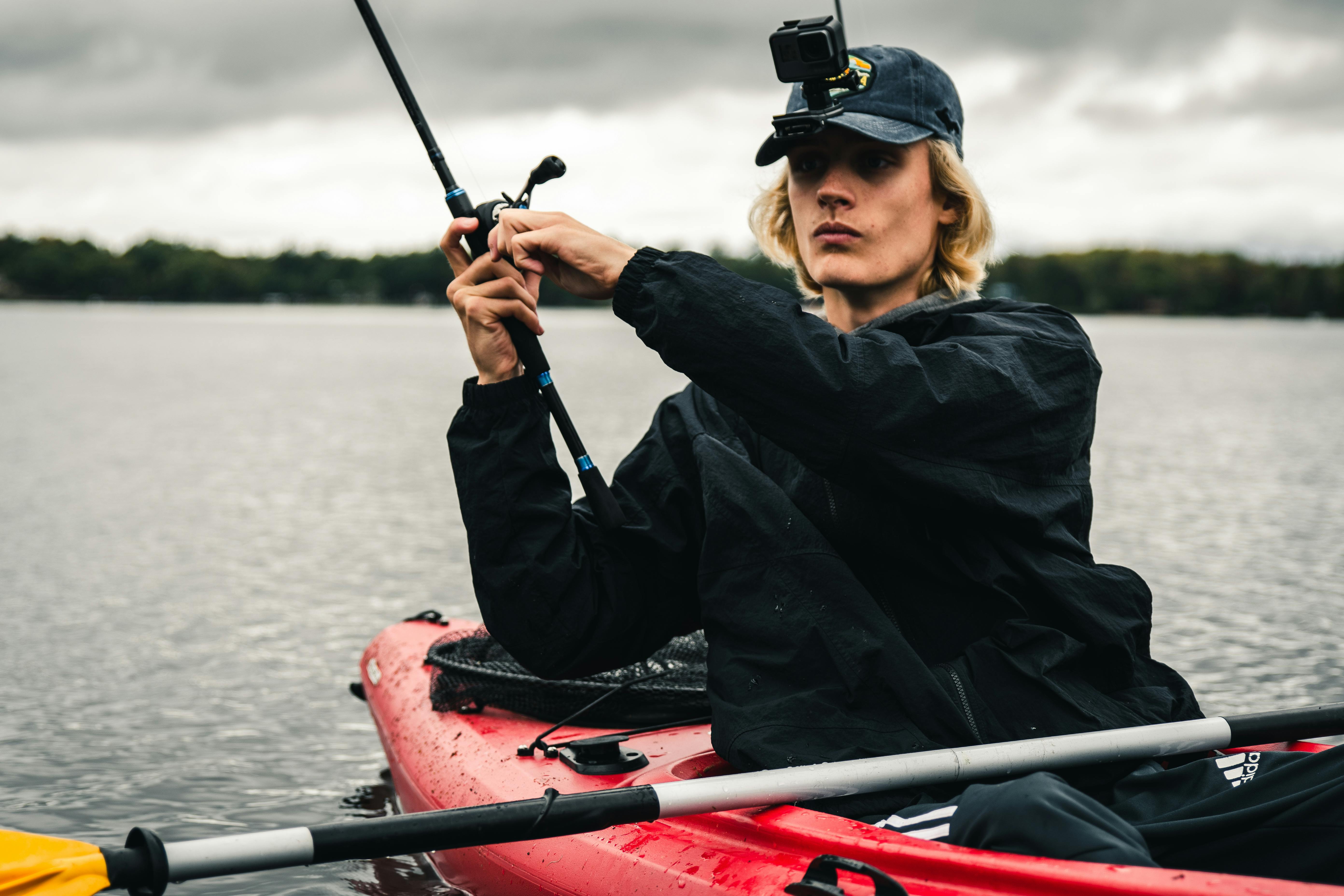
Mounting is where most kayak setups go wrong. The screen should sit on a gear track or a ball mount directly in front of you, low enough that it does not block your cast and high enough that you can read it without bending over. The transducer — the part that sends the sonar — has three good mounts: through a scupper hole (clean and protected), on a transducer arm over the side (easy to remove), or glued inside the hull with a shoot-through kit (no drag, but a weaker signal). For most anglers, a scupper mount or an arm mount is best, because you can take the transducer off for transport and for shallow water.
Power is a small 12-volt battery — a 7Ah to 12Ah sealed lead-acid or lithium battery is enough for a full day with a 5-inch unit. A 5-inch finder draws about 0.5 to 0.8 amps, so a 12Ah battery gives you 12 to 15 hours; a 7-inch unit with side imaging draws about 1 amp, so the same battery gives you 10 to 12 hours. Put the battery in a dry bag or a battery box in the hull, run the wires through a waterproof gland, and carry a spare fuse. The mistakes: mounting the screen where it blocks your cast, running wires across the deck where they snag the line, and buying a 9-inch screen that needs a battery too big for the kayak. Start with a 5-inch unit, a scupper transducer mount and a 12Ah battery, and add side imaging only when you know you need it.
How do I fish from a kayak safely?
Short answer: Wear a life jacket, always. Tell someone where you are going and when you will be back. Stay in water you can swim in, watch the weather, and practise getting back on the kayak in shallow water before you need to do it for real.
Kayak fishing is safe when you respect the water, and the first rule is the life jacket. Wear a proper paddling life jacket — not a bulky boat jacket — every time you are on the water, without exception. Most kayak fishing deaths involve an angler who was not wearing one. A paddling life jacket is cut short at the waist so it does not ride up when you sit, has pockets for tackle and pliers, and keeps you afloat even if you are cold or injured. Put it on before you launch, not after you are on the water.
The second rule is to plan like a paddler, not like a boater. A kayak is slow — you cover 2 to 4 miles an hour — so a spot that is a ten-minute run in a boat is an hour’s paddle in a kayak. Check the weather before you launch and watch it while you fish: wind is the biggest danger, because a 15 mph wind can push a kayak faster than you can paddle back. Tell someone your plan — where you are launching, where you are fishing, and when you expect to be back. Carry a whistle, a phone in a waterproof case, and a light if you might be out after dark. And never tie yourself to the kayak or to an anchor in moving water — a rope in current is the most dangerous thing on a kayak.
Step by step, a safe kayak trip looks like this. Check the weather and the wind forecast. Tell someone your plan. Wear your life jacket. Launch in shallow, calm water and get comfortable before you paddle out. Stay within swimming distance of shore until you know the kayak. Keep your weight low and centred — stand only in calm water, and sit down before you reach for a fish. If you capsize, stay with the kayak, flip it upright from the side, and climb back on from the stern — practise this in shallow water on a warm day, so you know you can do it. In cold water, the rules tighten: wear a dry suit or waders with a belt, stay closer to shore, and never fish alone.
The seasonal notes matter. In spring, the water is cold even when the air is warm — cold water shock can kill in minutes, so dress for the water temperature, not the air. In summer, heat and sun are the risk: carry water, wear a hat, and watch for afternoon thunderstorms, which can appear fast on a big lake. In fall, the fish are active but the days are short and the water is cooling — carry a light and a warm layer. In winter, only experienced kayakers should be out, and only with a dry suit and a partner. The mistakes are always the same: no life jacket, no plan, too far from shore, and ignoring the wind. A kayak is a small boat — treat it with the respect a small boat deserves, and it will take you to fish no boat can reach.