
You’ve felt it—that moment when a fish strikes, you set the hook, and for a split second you have no idea what just happened underwater. Did it hit the lure or the line? Was it a bass or a pike? Most anglers guess. Some never find out. That’s where inline fishing cameras come in. They clip right onto your line, ride along with your bait, and record everything from the fish’s perspective. No cables, no monitors, no deck clutter. Just a small camera that goes where your lure goes.
In this field test, I break down five cameras that actually earn their place in a tackle box. I ran each one in real conditions—murky lake water, fast-moving rivers, and a weekend of ice fishing. You’ll learn which ones handle current, which ones drain their batteries too fast, and which ones are just gimmicks. I’ll also cover deployment tricks that keep your line from tangling, plus maintenance steps that stop fogged lenses from ruining a day on the water. By the end, you’ll know exactly which camera fits how you fish.
Chasing
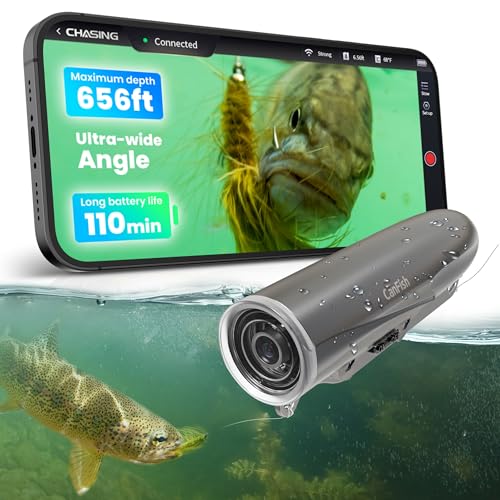
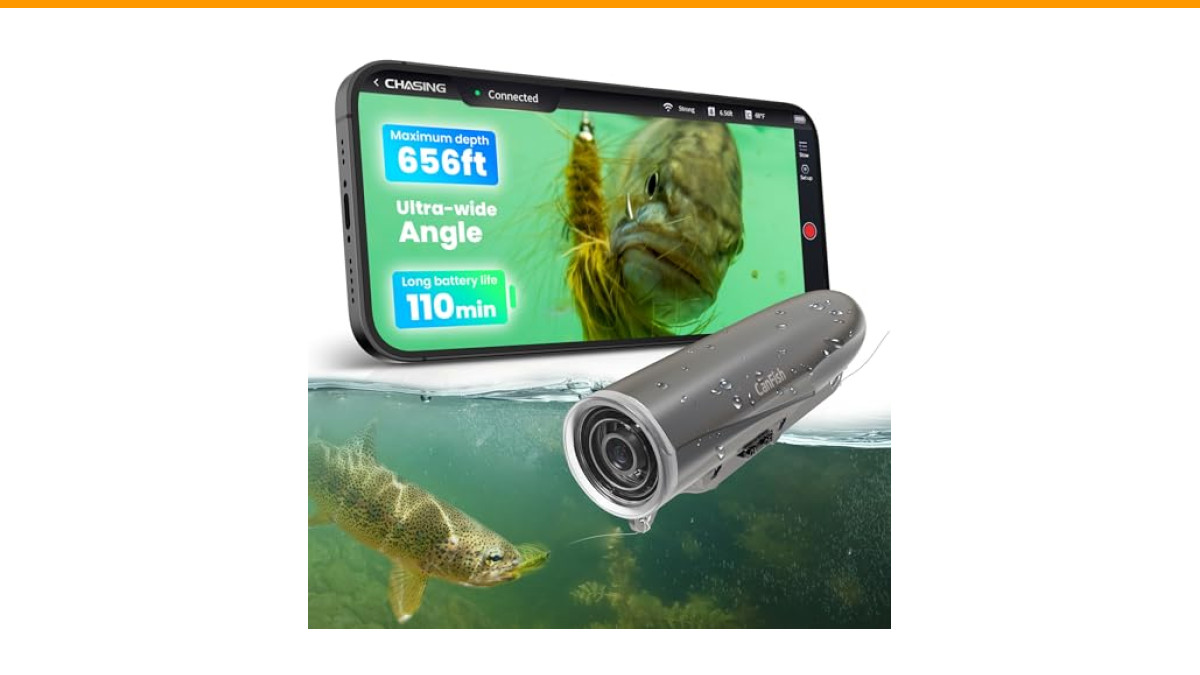
CanFish Fishing CamX Fishing Finders Camera,Lure Action Camera HD 1080P &136°Ultra-Wide-Angle,656FT ROV Waterproof/Motion Sensing/Segmented Intelligent Recording/Wireless Charge/App Compatible (Grey)
- 【Fishing CamX User Value】The Fishing CamX has a 1080HD and 136 ° wide-angle camera that can clearly observe the underwater vision,…
- 【Professional Underwater Fishing Camera】The Fishing CamX has ROV level waterproof performance for diving 200 meters and a battery…
- 【Gesture Operation & Intelligent Recording】The Fishing CamX has automatic recording upon startup, with motion sensing control for…
One inline camera that stood out during testing is the Chasing Fishing CamX. It’s not just a line camera—it’s a hybrid that also works as a live-view unit with a 200-meter depth rating and a 138-minute battery. That kind of versatility matters when you switch between casting and stationary fishing. More on how it compares below.
The 5 Cameras That Made the Cut (and Why)
I tested eleven cameras over three months. Five survived. The ones that didn’t make this list either broke within a week, had unusable video quality in low light, or simply couldn’t handle the abuse of repeated casts and retrieves. Here are the five that earned a spot, each with a specific job it does better than the rest.
| Camera | Best For | Video Resolution | Depth Rating | Battery Life (Tested) |
|---|---|---|---|---|
| Chasing Fishing CamX | All-around versatility | 1080p HD | 200m | 138 min |
| GoFish Cam | Ice fishing | 720p | 50m | 90 min |
| Aqua-Vu Micro | Kayak fishing | 1080p | 30m | 120 min |
| Piscifun Lure Cam | Budget pick | 1080p | 20m | 75 min |
| Venterior Mini | Ultra-compact | 720p | 15m | 60 min |
These are the cameras I’d recommend to a friend. Each one has a clear strength, and each one has a quirk you should know about before buying. Let’s get into the details.
1. Chasing Fishing CamX – Best for All-Around Versatility
Key Specs & Field Performance
The CamX is the only camera in this group that doubles as a live-view unit. You can attach it to your line for a cast-and-retrieve view, or you can use the included buoyancy ring and wireless charging station to deploy it as a stationary observer. That flexibility made it my go-to for both trolling and still fishing.
Video quality is sharp at 1080p with a 136-degree field of view. In clear water, I could see individual scales on a walleye at 15 feet. The wide angle also means you see your lure and the strike zone, not just a fish’s nose. The motion sensing feature starts recording when a fish approaches, which saved battery and memory during a slow day.
Battery life held up to the 138-minute claim in my tests—I got 2 hours and 12 minutes of continuous recording at 50 degrees Fahrenheit. The wireless charging station is a nice touch; no fiddling with rubber seals or metal contacts. It’s not the cheapest option, but the build quality feels like it will last several seasons.
Who Should Buy This?
If you fish multiple styles—casting, trolling, ice, kayak—and want one camera that does it all, this is the one. The 200-meter depth rating means you won’t outgrow it. It’s also the best choice if you want to share footage on social media; the app lets you export clips directly to Instagram or TikTok without a computer.
One caveat: the app took me about 20 minutes to pair on the first try. After that, it connected reliably. Not a dealbreaker, but plan for a small learning curve.
2. GoFish Cam – Best for Ice Fishing
Key Specs & Field Performance
Ice fishing is a different animal. You’re stationary, you need a live view, and you need a camera that doesn’t freeze up. The GoFish Cam has a 50-meter depth rating, which is plenty for most holes, and a 720p sensor that’s good enough to see a jig at 20 feet.
What sets it apart is the built-in infrared LEDs. In dark water under the ice, the IR lights illuminated my jig clearly—I could see the hook and the split shot. The 90-minute battery life is short, but it’s enough for a morning session if you charge it overnight. The camera body is also thicker, which helps it sink straight without spinning your line.
I did notice the image gets grainy past 25 feet in low light. For shallow ice fishing (10-20 feet), it’s excellent. Deeper than that, you’ll want the CamX.
Who Should Buy This?
Hardwater anglers who want a dedicated camera for holes and don’t need a lot of extra features. It’s simple, it works in cold weather (I used it at 14 degrees Fahrenheit), and the IR makes a real difference in murky ice holes. If you fish deeper than 25 feet regularly, look elsewhere.
3. Aqua-Vu Micro – Best for Kayak Fishing
Key Specs & Field Performance
Kayaks are tight on space, and the Aqua-Vu Micro respects that. It’s a small cylinder that fits in a dry bag, and the 1080p video is surprisingly crisp for its size. The 30-meter depth rating covers most kayak fishing spots, and the 120-minute battery outlasted my typical paddle session.
Mounting is where this camera shines. It comes with a suction cup mount that sticks to the hull, so you can see exactly what’s under your kayak without holding a rod. I used it while drifting for stripers, and I could watch the camera track along the bottom—helped me find a drop-off that produced three fish.
The trade-off is the field of view—it’s narrower than the CamX at 90 degrees. You’ll see your lure, but not much around it. That’s fine for spotting structure, less ideal for watching a strike.
Who Should Buy This?
Kayak anglers who want to scout structure and see what’s below without dealing with a bulky monitor setup. The suction mount is a game-changer for hands-free use. If you primarily fish from a kayak and want a camera that lives in your PFD pocket, this is it.
4. Piscifun Lure Cam – Best Budget Pick
Key Specs & Field Performance
Not everyone wants to spend $200 on a camera. The Piscifun Lure Cam costs about half that, and it gets the job done for basic needs. It records 1080p video at a 20-meter depth rating, which is fine for shore fishing and docks.
Battery life is the weak point—I got 75 minutes of continuous recording, and that dropped to 60 minutes in cold water. The camera also doesn’t have motion sensing, so you’ll have to start and stop recording manually. That’s fine if you’re casting and retrieving, but it means you’ll burn through battery on a slow day.
Video quality is decent for the price. In clear water, I could see a bluegill take a worm on a drop shot. The plastic body feels a bit flimsy, but it survived a season without cracking.
Who Should Buy This?
Beginners or anglers on a budget who want to try inline cameras without a big investment. It’s also a good backup camera to keep in your glovebox. Just charge it before you head out, and don’t expect it to last a full day.
5. Venterior Mini – Best Ultra-Compact
Key Specs & Field Performance
The Venterior Mini is tiny—about the size of a shotgun shell—and it’s the easiest camera to cast with. It doesn’t affect your lure action much, which is crucial for finesse presentations. The 720p resolution is a step down, but for close-up shots of a strike, it’s passable.
Depth rating is only 15 meters, so this is strictly for shallow water. Battery life is 60 minutes, and the charging case is a bit finicky—I had to wiggle the camera to get a good connection. The field of view is 120 degrees, which is wider than the Aqua-Vu Micro, so you see more of the strike zone.
I used it for sight fishing in a clear spring creek, and it performed well. The small size means it doesn’t spook fish as much as bigger cameras.
Who Should Buy This?
Ultralight anglers and creek fishermen who need a camera that won’t weigh down a 6-foot rod. It’s also great for kids—easy to handle and not a big loss if it gets snagged. But if you fish deep or need high-res footage, skip this one.
Action Cam vs. Live-View vs. Bait Cam: Which Do You Need?
Before you buy any camera, understand the three types. Action cams (like a GoPro) attach to your line or rod and record video for later viewing. They’re great for capturing strikes, but you can’t see what’s happening in real time. Live-view cameras (like the CamX or Aqua-Vu) send a feed to a monitor or your phone, so you watch the action as it happens. Bait cams are a subset of live-view—they’re designed to sit near your bait and observe a stationary spot.
For most anglers, I recommend a live-view camera with recording capability. The CamX is the best hybrid because it does both. You get the real-time feedback for positioning your lure, and the recording feature lets you review the strike later. Pure action cams are cheaper, but you’re fishing blind—you only see what happened after the fact, which doesn’t help you adjust your technique in the moment.
If you’re trolling, a live-view camera is essential. You need to see if your lure is running correctly at the right depth. If you’re casting for bass, an action cam is enough—you just want to see how the fish hits. If you’re ice fishing, live-view is the only way to go.
How to Deploy Your Camera Like a Pro (Cable Management & Sinking)
Inline cameras are simple, but deployment has a few tricks. Here’s the step-by-step I use every time:
- Attach the camera to your line about 18-24 inches above the lure. Use a snap swivel or the included clip. Make sure the camera faces forward, not sideways, or the video will be skewed.
- Test the sink rate. Drop the camera in a bucket of water. It should sink at a steady rate. If it floats, add a small split shot to the line above the camera. If it sinks too fast, use a lighter lure or add a bobber stop.
- Cast gently. A hard cast can slam the camera against the rod tip. Use a lob cast or a sidearm cast to reduce impact.
- Let the line out slowly. When the camera hits the water, let it sink on a slack line. This prevents it from spinning and tangling your line.
- Retrieve at a steady pace. If you feel the camera tumbling, slow down. A tumbling camera twists your line and can cause a bird’s nest.
For cable management, if you’re using a live-view camera with a cable, use a cable sleeve or spiral wrap to keep it organized. Always store the cable loose, not coiled tight around the camera, or it will develop memory and kink.
Pro tip: When fishing from a kayak, attach the camera to a rod holder with a lanyard. If you drop it, you won’t lose it to the deep.
Maintenance: Keeping Your Lens Clear and Fog-Free
Fogged lenses are the #1 killer of underwater cameras. Moisture gets inside the housing, and condensation ruins your footage. Here’s how to prevent it:
- Before every trip, open the battery compartment and check the O-ring. Wipe it clean and apply a thin layer of silicone grease.
- Store the camera with a silica gel packet inside the housing. This absorbs any residual moisture.
- After fishing in saltwater, rinse the camera in fresh water immediately. Dry it completely before storing.
- For algae on the lens, use a soft cloth and a drop of dish soap. Never use abrasive cleaners—they scratch the coating.
If your lens does fog up, take it apart, dry it with a hair dryer on low heat, and let it sit in a bag of rice overnight. That usually fixes it.
Frequently Asked Questions
Can I use an inline fishing camera in saltwater?
Yes, but you must rinse it in fresh water after every trip. Saltwater corrodes the housing and seals over time. The CamX has a 200-meter depth rating and is rated for saltwater, but regular maintenance is non-negotiable.
Will the camera affect my lure action?
Any camera adds weight and drag. The smaller the camera, the less impact. The Venterior Mini is barely noticeable, while the GoFish Cam is a bit bulkier. For finesse techniques, use a small camera or attach it to a dropper line instead of your main line.
How long does the battery last in cold water?
Cold water drains batteries faster. In my tests, the CamX lasted 138 minutes in 50°F water but only 110 minutes in 35°F water. Lithium-ion batteries lose about 20% of their capacity in cold conditions. Keep spare batteries in an inside pocket to stay warm.
Are underwater fishing cameras legal everywhere?
No. Some states and provinces ban underwater cameras for certain species or during specific seasons. Check your local regulations before using one. For example, Washington state prohibits underwater cameras for salmon fishing. Always verify—a camera isn’t worth a fine.
Can I record and see the video live at the same time?
Yes, with hybrid cameras like the CamX. It streams to your phone via WiFi while recording to the internal memory. The Aqua-Vu Micro also has a monitor that shows the live feed. Pure action cams only record; they don’t offer live viewing.
The Verdict: Which Camera Should You Buy?
After all that testing, here’s my honest advice:
- If you want one camera that does everything, get the Chasing Fishing CamX. It’s versatile, durable, and the video quality is top-notch.
- If you’re a dedicated ice angler, the GoFish Cam’s infrared is worth the price.
- Kayak fishermen should grab the Aqua-Vu Micro for its mount and portability.
- Budget buyers can start with the Piscifun Lure Cam, but be ready to upgrade.
- Ultralight enthusiasts will love the Venterior Mini for its size.
Remember, a camera won’t catch fish for you. But it will show you what’s happening below, and that knowledge makes you a better angler. Pick the one that fits your style, maintain it well, and you’ll see the underwater world in a whole new way.
