
You’ve watched the videos, you’ve seen the lures, and you’ve heard the stories about screaming drags and bent rods. You’re ready to move past the spinning gear and step up to a baitcaster. But here’s the thing: the learning curve is real. A bad backlash on a windy saltwater beach can turn a promising morning into a frustrating 20-minute untangling session. And if you buy the wrong combo, you’ll fight the gear as much as the fish.
The right saltwater baitcasting combo changes that. A good setup balances rod power with reel braking, uses corrosion-resistant components, and feels comfortable in your hands for hours. It lets you pitch lures with pinpoint accuracy into mangroves, cast heavy jigs into the surf, and muscle a big redfish out of structure. The combos on this list range from budget-friendly beginner kits to more serious tackle, but they all share one thing: they’re built for the unique demands of saltwater.
We picked four combos that cover different needs and budgets. The PROBEROS is a complete starter kit, the KastKing offers a twin-tip backup for versatility, the Sougayilang is a lightweight carbon option, and the BAIKALBASS is another solid beginner-friendly package. If you want our short answer: the KastKing Spartacus Defender is the pick for most anglers who want a serious, versatile combo. Keep reading to see why, and which one fits your specific situation.
Here is a quick comparison of the key specs for each combo.
| Features | PROBEROS Kit | KastKing Defender | Sougayilang Carbon | BAIKALBASS Kit |
|---|---|---|---|---|
| Rod Length | 6.9 ft telescopic | 7 ft two-piece | 5.9 or 6.9 ft | 6.9 ft telescopic |
| Reel Gear Ratio | 7.2:1 | Not specified | 6.3:1 | 7.2:1 |
| Braking System | Magnetic | DualBalance magnetic | Not specified | Magnetic |
| Included Extras | Lures, case, line | Extra rod tip | None | Lures, case, line |
| Best Use Case | Beginners | Versatile all-rounder | Light tackle | Beginners |
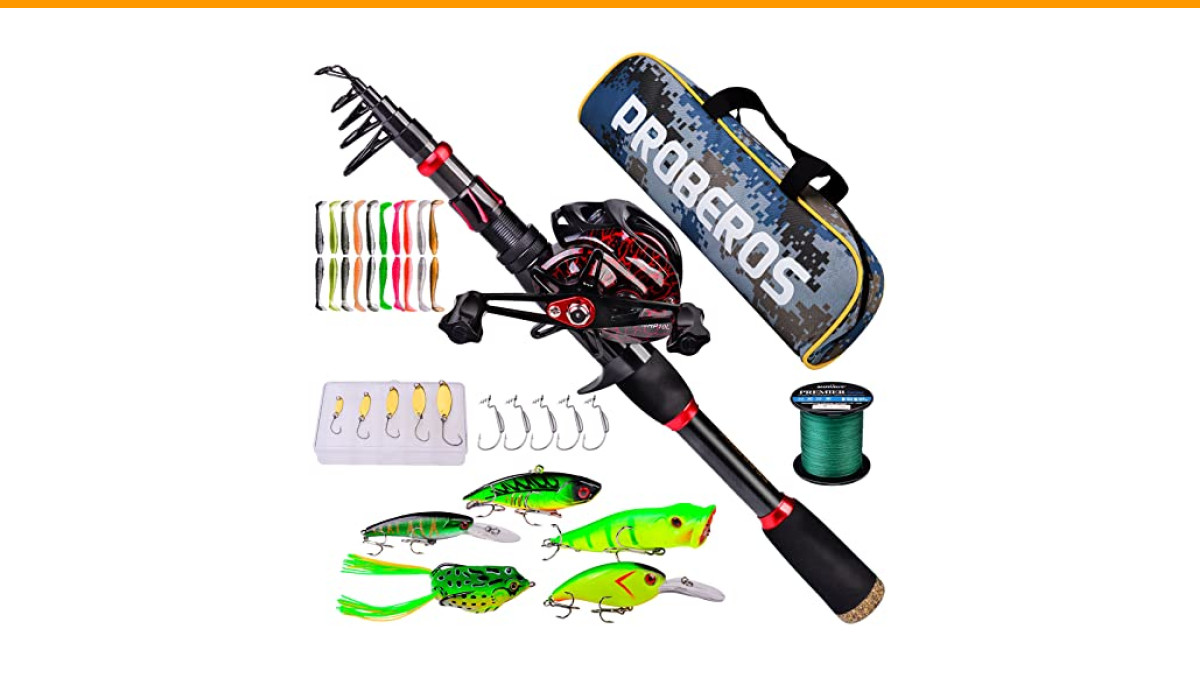
PROBEROS Fishing Combo

PROBEROS
Fishing Rod and Reel Combo, 6.9ft Telescopic Spincast Rod with Left Handed Baitcasting Reel Combos, Sea Saltwater Freshwater Ice Bass Fishing Tackle Set Fishing Rods Kit
- Fishing rod & reel combos with Carrier Case: 1 Fishing Rod + 1 Fishing Reel + Fishing Line + Various Fishing Lures + Fishing Hooks…
- Casting Fishing Rod: 1PCS Baitcasting Pole is light weight and perfectly balanced, thus less fatigue. Suitable variety of sea fish…
- Baitcasting Fishing Reel: Low Profile smooth Baitcast Fishing Reel, 7.2:1 GEAR RATIO. Super Compact Carbon Fiber Drag. Magnetic br…
This combo is a full tackle system in a bag. It’s designed for someone who wants to start fishing saltwater without buying a dozen separate items. The 6.9-foot telescopic rod collapses down for easy transport, and the kit includes a baitcasting reel, fishing line, a selection of hard lures, soft plastics, jig heads, hooks, and a carrier bag. You could essentially buy this, grab some bait, and head to the water.
The reel features a 7.2:1 gear ratio, which is fast. That speed helps when you need to quickly retrieve a lure to avoid snags or when you’re reeling in a fish that’s swimming straight at you. The magnetic braking system is a boon for newcomers. Magnetic brakes are generally easier to dial in than centrifugal systems because you can adjust them with a simple dial on the side plate. The rod itself is light at 6.3 ounces, which reduces arm fatigue on a long day of casting.
But there are honest trade-offs. A telescopic rod, while convenient, often has more flex and less sensitivity than a one-piece or two-piece rod. You might miss subtle bottom bites. The included lures are basic, and serious anglers will likely replace them quickly. The reel is left-hand retrieve only, which is fine for many, but right-handed casters who prefer reeling with their right hand will need to look elsewhere. This is a starter kit, not a lifetime investment.
- 6.9-foot telescopic rod weighs just 6.3 oz
- 7.2:1 gear ratio for fast lure retrieval
- Magnetic braking system helps reduce backlashes
- Includes lures, hooks, line, and a travel carrier bag
- Anti-corrosion silicon guide rings for saltwater use
Best for: The absolute beginner who wants one package with everything needed to start baitcasting in saltwater.
KastKing Spartacus Defender
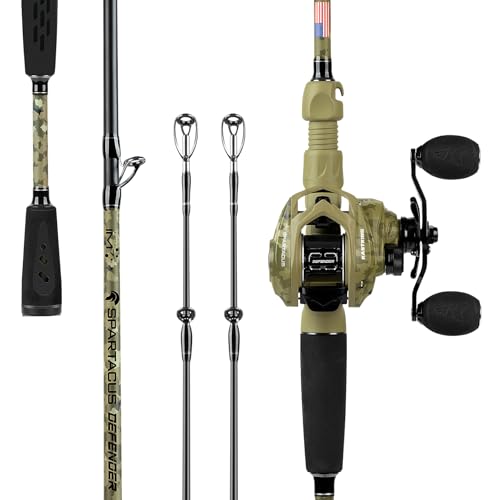
KastKing
KastKing Spartacus Defender Twin-tip Fishing Rod & Reel Combo, 7ft, M, Right Handed Reel
- Smooth & Comfortable Casting: Stainless steel guides with ultra-smooth zirconium oxide rings reduce line friction for longer, smoo…
- High-Performance Baitcasting Reel: Weighing just 6 oz, the KastKing Spartacus Defender Casting Reel delivers ultra-lightweight han…
- Tactical American Heritage Styling:The Spartacus Defender Combo features a rugged camouflage finish with subtle American flag-insp…
The KastKing Spartacus Defender stands out for a simple reason: it comes with two rod tips. The main tip and a spare tip are included, so if you snap the top section on a cast or in a car door, you can swap it out and keep fishing. That’s a practical feature that saves a trip to the tackle shop. The rod is a 7-foot, medium-power, two-piece model built from IM7 graphite, which gives it a light feel and good sensitivity.
The reel is a serious piece of hardware. It weighs just 6 ounces, which keeps the whole combo balanced. The 17.6-pound max drag gives you the muscle to handle bull reds or stripers. The 7+1 bearing system runs smooth, and the DualBalance magnetic braking system gives you fine-tuned control over your casts. The 80 HRB T6 aluminum main gear with a brass pinion gear is built to last, which matters when you’re fighting strong fish in saltwater.
This combo is not without its quirks. The tactical camouflage finish isn’t for everyone, and the ‘light saltwater’ designation in the product data means you should still rinse it thoroughly after every trip. The reel is right-hand retrieve, which is standard for many baitcasters but might feel odd if you switched from spinning gear. It’s also a step up in price from the beginner kits, so it’s an investment in gear that will last.
- 7-foot IM7 graphite rod with a spare tip section
- Reel weighs 6 oz with 17.6 lb max drag
- 7+1 MaxiDur bearing system for smooth operation
- DualBalance magnetic braking for backlash control
- Durable aluminum main gear and brass pinion gear
Best for: Anglers who want a versatile, high-performance combo for bass, trout, and light saltwater fishing and appreciate a backup tip.
Sougayilang Fishing Combo

Sougayilang
Sougayilang Fishing Rod and Reel Combo,Baitcaster Combo,5.9ft/6.9ft Carbon Fishing Pole,Lightweight Aluminum Spool Reel,Stainless-Steel Guides & Ergonomic Cork Grip-Purple
- The rod features 30-ton carbon construction—lighter than standard carbon while delivering exceptional rigidity to handle fights wi…
- Ergonomic cork grip offers a non-slip, comfortable hold—even with wet hands—reducing fatigue during extended fishing trips. The AB…
- The reel boasts a 6.3:1 gear ratio for fast line retrieval—ideal for quickly reeling in active fish or covering more water. Equipp…
Sougayilang offers a different take with a 30-ton carbon fiber rod. This material makes the rod exceptionally light and rigid. You can feel that lightness when you hold it, and it translates to less fatigue. You can choose between a 5.9-foot version for tight quarters like small creeks or kayak fishing, or a 6.9-foot version for longer casts in open water. The reel has a 6.3:1 gear ratio, which is a moderate speed that works well for a variety of techniques.
The cork grip is a nice touch. It provides a secure, non-slip hold even when wet, and it’s comfortable for long days. The titanium oxide guides are corrosion-resistant, which is a key feature for saltwater use. The reel uses a 4+1 bearing system. While not as many as the KastKing, it still provides smooth operation for the price point. The ABS reel seat keeps the reel locked in place, so you don’t have to worry about it wiggling loose during a fight.
The main limitation here is the lack of a sophisticated braking system. The product data doesn’t specify one, which suggests it might be a simpler system or possibly a fixed magnetic setup. That means you’ll need to rely more on your thumb for backlash control. This makes it a bit less forgiving for a raw beginner. It’s also a right-hand retrieve reel, which may be a deciding factor for some. This is a good, lightweight rod for the angler who already has some casting experience.
- 30-ton carbon fiber rod is lightweight and rigid
- Choose 5.9 ft or 6.9 ft length
- 6.3:1 gear ratio for versatile retrieval speed
- Ergonomic cork grip for a secure hold
- Titanium oxide guides resist corrosion
Best for: Anglers who prioritize a lightweight rod for finesse techniques and have some experience controlling a baitcaster without heavy reliance on brakes.
BAIKALBASS Fishing Combo

BAIKALBASS
Fishing Rod and Reel Combo - 6.9ft Telescopic Spincast Rod with Left Handed Baitcasting Reel Combos - Sea Saltwater Freshwater Ice Bass Fishing Tackle Set - Fishing Rods Kit
- Fishing rod & reel combos with Carrier Case: 1 Fishing Rod + 1 Fishing Reel + Fishing Line + Various Fishing Lures + Fishing Hooks…
- Casting Fishing Rod: 1PCS Baitcasting Pole is light weight and perfectly balanced, thus less fatigue. Suitable variety of sea fish…
- Baitcasting Fishing Reel: Low Profile smooth Baitcast Fishing Reel, 7.2:1 GEAR RATIO. Super Compact Carbon Fiber Drag. Magnetic br…
The BAIKALBASS combo is very similar in concept to the PROBEROS kit. It’s a complete starter package with a 6.9-foot telescopic rod, a low-profile baitcasting reel, and a full assortment of tackle. You get a crankbait, popper, jerkbait, minnow, soft lures, jig heads, and spoons. It’s all packed into a convenient travel bag. For a new angler, this is a low-stress way to get outfitted.
The standout spec here is the rod weight. At just 4.4 ounces, this is the lightest rod on our list. It’s incredibly easy to handle and cast all day without your arm getting tired. The reel weighs 7.3 ounces and features a 7.2:1 gear ratio, giving you that fast retrieve. The magnetic braking system is again present, which is the best feature for beginners because it’s simple to adjust and helps prevent those frustrating bird’s nests.
The trade-off for that ultra-light weight is a lack of backbone. This rod is rated as light power, so it’s not designed for throwing heavy lures or fighting large, powerful fish. It’s best suited for smaller species like trout, panfish, or small bass. The telescopic design, while convenient for storage, can also feel a bit whippy on the cast. If you hook into something big, you’ll be under-gunned. It’s a great learning tool, but you’ll likely outgrow it as your skills improve.
- Ultra-light 6.9-foot rod weighs only 4.4 oz
- 7.2:1 gear ratio for fast line retrieval
- Magnetic braking system for easier casting
- Full tackle kit with lures, hooks, and case
- Left-hand retrieve reel with EVA handles
Best for: Beginners, especially younger anglers or those targeting smaller fish, who want a complete, easy-to-carry kit that won’t wear them out.
How We Chose These Products
We focused on combos that are genuinely suited for saltwater, not just freshwater gear with a saltwater label. That means we looked for corrosion-resistant guides, sealed or reliable drag systems, and reels with braking systems that help manage the unique challenges of casting heavier lures into wind. We also considered the value of what’s in the box, especially for beginners who may not own a full tackle set.
We ranked them based on real-world usability. The KastKing earned the top spot because it offers the best combination of rod sensitivity, reel performance, and a practical feature (the spare tip) that you don’t often see at this price. The other three combos were chosen to fill specific niches: one for the absolute newbie who needs everything, one for the budget-conscious angler who wants a lightweight rod, and one for those who want a complete kit with a slightly different balance of specs. We did not include any gear that felt like a gimmick.
Baitcasting Reels: Braking Systems Explained
The biggest difference between a baitcaster and a spinning reel is the spool. On a cast, the spool spins faster than the line leaves it, causing a backlash. Braking systems are designed to slow the spool down to prevent this. There are two main types: magnetic and centrifugal.
Magnetic brakes use magnets to create resistance on the spool. They are usually adjusted with a dial on the side of the reel. Turning the dial up increases the magnetic force, slowing the spool down. The benefit is that you can adjust it in small increments without opening the reel. This makes them very user-friendly, which is why the PROBEROS and BAIKALBASS beginner kits use them.
Centrifugal brakes use small pins that fly outward during the cast, creating friction. They are typically adjusted by opening the side plate and moving pins in or out. Centrifugal systems are often preferred by experienced anglers because they provide a more consistent braking force throughout the cast. They are less affected by spool speed than magnetic brakes. Neither system is ‘better’ overall, but for saltwater, magnetic systems are often simpler to adjust when you change lure weights or face strong winds.
How to Match Rod Power and Action to Your Target Species
Rod power refers to the rod’s resistance to bending. A light power rod bends easily, while a heavy power rod is stiff. Rod action refers to where the rod bends. A fast action rod bends near the tip, while a slow action rod bends deeper into the blank.
For the combos on this list, the BAIKALBASS and PROBEROS are light power. These are best for finesse lures like small jigs and topwater poppers for trout, panfish, and small bass. You’ll feel the fight, but you can’t horse a big fish out of heavy cover. The KastKing is a medium power rod. This is the most versatile choice. It can handle a wide range of lures from 1/4 oz to 3/4 oz and is suitable for bass, redfish, and stripers. It has enough backbone to control a strong fish but still bends enough to protect light line.
When you’re picking a combo, think about the size of fish you expect to catch. A medium power rod with a fast action is a safe bet for most saltwater inshore species. If you’re targeting heavy cover like mangroves or docks, you might want a heavier power rod to pull fish out quickly. For open water and lighter lures, a light or medium-light rod is more fun and casts better.
Critical Maintenance: Keeping Corrosion at Bay
Saltwater is brutal on fishing gear. The salt crystals get into every crevice and will corrode metal parts, seize bearings, and destroy your drag. A baitcaster has more moving parts than a spinning reel, so it needs a bit more care. The good news is that a simple routine will keep your gear working for years.
After every saltwater trip, rinse your rod and reel with fresh water. Use a gentle spray from a garden hose or shower head. Do not use a pressure washer, as that can force water into the sealed bearings. Pay special attention to the line spool, the levelwind mechanism, and the drag star. After rinsing, dry the reel with a soft cloth. Let it air dry completely before storing it in a tackle bag.
Once a month, or more often if you fish frequently, you should oil the reel. Put a small drop of reel oil on the line spool bearings and the handle knobs. Use a light grease on the main gear if you’re comfortable opening the reel. Also, check the rod guides for any cracks or chips. A damaged guide can cut your line and cost you a big fish. Replacing a guide is cheaper than replacing a rod.
Common Baitcasting Mistakes and How to Avoid Them
Everyone backlashes. It’s a rite of passage. But you can minimize the bird’s nests by avoiding a few common errors. The first mistake is casting like you’re using a spinning rod. A baitcaster doesn’t need a heavy snap. A smooth, controlled casting motion is much more effective. Let the rod load and release the lure with a steady swing.
The second mistake is ignoring the spool tension knob. Before you cast, adjust the tension so that the lure falls slowly to the ground when you release the thumb bar. The lure should not drop like a rock, and it should not float. This simple adjustment prevents most overruns at the start of the cast.
The third mistake is not using your thumb enough. Your thumb is the ultimate brake. You should lightly feather the spool with your thumb, especially at the beginning and end of the cast. This takes practice, but it’s the key to casting into the wind. The fourth mistake is using too light of a lure. Baitcasters need a certain amount of weight to pull line off the spool. If your lure is too light, the spool will overrun before the lure can catch up. Check the rod’s lure weight rating and stay on the heavier side until you get the hang of it.
Buying Guide: What to Look For in a Saltwater Baitcaster
When you’re shopping, the first thing to check is the gear ratio. This tells you how fast the spool turns. A ratio of 6.3:1 is a good all-purpose speed. A 7.2:1 is faster, which is great for burning a buzzbait or ripping a jerkbait. A lower ratio like 5.4:1 is better for deep cranking or fishing heavy jigs where you want more cranking power. For the combos here, you’re mostly looking at 6.3:1 and 7.2:1, both of which are fine for general use.
Next, look at the drag system. The drag should be smooth and have enough max poundage to handle your target species. The KastKing’s 17.6 lb drag is solid for inshore fish. The drag on the beginner kits is not specified, but it’s likely sufficient for smaller fish. A smooth drag is more important than a high max number because it prevents line breakage during long runs.
Finally, consider the rod’s material and guides. Graphite rods are lighter and more sensitive, which helps you feel bottom structure. Fiberglass rods are heavier and more durable but less sensitive. For saltwater, look for guides with corrosion-resistant inserts like zirconium oxide or titanium oxide. Stainless steel frames are a must. The rod handle material matters too. Cork feels great but can chip, while EVA is durable and grips well when wet.
Final Verdict: Which Combo Should You Buy?
If you want the best overall combo that you won’t outgrow in a season, get the KastKing Spartacus Defender. It has the best reel, a sensitive rod, and the spare tip is a genuine bonus. It’s the most versatile and will handle a wide range of fish and techniques. It costs more, but it’s worth it.
If you’re on a tight budget or you’re just starting out and want to learn without a big investment, the PROBEROS kit is a great starting point. It has everything you need to get on the water. Just know that you’ll likely want to upgrade the rod and reel as your skills improve. The BAIKALBASS is a similar option, but its ultra-light rod makes it ideal for smaller fish and longer days on the water. The Sougayilang is the pick for anglers who want a lightweight carbon rod and already have some casting confidence.
No matter which you choose, remember to rinse your gear after every saltwater trip. That habit is more important than the brand of the reel.
Frequently Asked Questions
Is a fiberglass rod or a graphite rod better for saltwater baitcasting?
Graphite is generally the better choice for most saltwater baitcasting. It’s lighter, which reduces fatigue, and it’s more sensitive, so you can feel bottom structure and light bites. Fiberglass is more durable and bends deeper, which can be useful for fighting very large fish, but it lacks the feel. For the inshore species most anglers target, graphite is the way to go.
Can I use braided line on any of these baitcasting reels?
Yes, you can use braided line on all of them. Braid is great for saltwater because it has no stretch and is very strong for its diameter. The main thing is to use a small piece of monofilament backing on the spool first. This prevents the braid from slipping on the spool. Also, braid can dig into itself under heavy pressure, so make sure your spool tension is set correctly.
How much line capacity do I need for saltwater fishing?
It depends on what you’re fishing for. For inshore species like redfish and trout, you need about 150 yards of line. For larger fish like stripers or if you’re fishing around heavy structure, you’ll want at least 200 yards. The beginner kits on this list come with line, which is fine to start, but you might want to replace it with a higher quality line as you get more serious.
What is the best way to learn how to cast a baitcaster without getting a backlash?
Start in your backyard, not on the water. Tie a practice plug or a small weight to the line. Set the spool tension so the weight falls slowly. Turn the magnetic brakes up to a high setting. Make short, smooth casts, focusing on a controlled motion. As you get comfortable, you can gradually turn the brakes down and cast a little harder. Use your thumb to feather the spool, and you’ll get the hang of it in an afternoon.
