
The Physics of Floating: Primary vs. Secondary Stability Explained
You’re on a lake, the sun’s just coming up, and you finally get a solid bite. As you lean over to grab your rod, the kayak tilts. Your heart jumps. That moment of wobble is what separates a good day from an unexpected swim.
Every kayak has two kinds of stability, and understanding them is the difference between feeling safe and feeling nervous.
YakGear
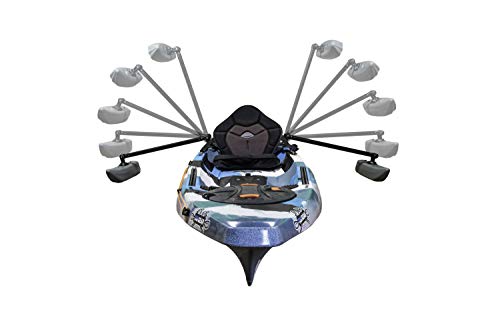
YakGear 01-0096 Standncast Outriggers (Gen II)
- Comes with 2 outriggers, meaning one for each side of the boat
- Outriggers provide added stability to any vessel
- Adjustable outrigger arms are 30" long and connect to the boat with a RAILBLAZA StarPort HD (included)
Primary stability is how stable the kayak feels when it’s flat on the water. A wide, flat-bottomed boat has high primary stability. It sits still like a dock. That’s why most fishing kayaks feel rock-solid when you first sit down.
Secondary stability is how the kayak behaves when it leans. A kayak with good secondary stability will resist tipping as you edge it onto its side. A kayak with poor secondary stability will suddenly roll over once you pass a certain angle. Think of a V-hull canoe versus a flat barge. The barge feels stable until it doesn’t. The V-hull feels tippy but recovers.
For fishing, you want both. You want that initial solid feel, but you also want the kayak to catch you when you lean to land a fish or reach for a tackle box.
Hull Shapes Decoded: Why Pontoon Beats Rounded for Anglers
The hull shape is the single biggest factor in how stable a kayak is. There are three main types you’ll see on fishing kayaks:
- Flat-bottom (pontoon): This is the most stable for calm water. It has a wide, flat base that sits on the surface. Perfect for standing and casting in lakes. The downside is it doesn’t track well and gets pushed around by wind.
- Rounded (V-hull): This cuts through water better and is faster to paddle. But it has less primary stability. You’ll feel every little shift. It’s better for rivers or open water where you need to cover distance.
- Tri-hull (tunnel): This is a compromise. It has a flat center with two small tunnels on the sides. It offers decent stability and better tracking than a flat bottom. Many hybrid fishing kayaks use this design.
For most anglers, a pontoon hull is the safest bet. It’s forgiving, and you can stand up without fear. But if you plan to paddle long distances, the drag will wear you out. A tri-hull is a good middle ground.
The Width vs. Length Trade-Off: Why ‘Wide’ Isn’t Always ‘Best’
You’ll see kayaks advertised as ‘stable’ because they’re 34 or 36 inches wide. That’s true, but it comes with a cost.
A wider kayak has more initial stability. It’s harder to tip over. But it also has more drag. You’ll paddle slower, and it will be harder to keep it going straight. A 10-foot wide kayak might feel like a barge, but it’s a beast to move.
Length also matters. A longer kayak (12-14 feet) tracks better and is faster. A shorter one (10 feet) is more maneuverable but can feel twitchy. For fishing, you want a kayak that’s at least 11 feet long. That gives you enough length for tracking without sacrificing too much stability.
Here’s a quick comparison table to help you see the trade-offs:
| Feature | Wide (34+ inches) | Narrow (28-32 inches) |
|---|---|---|
| Primary stability | High | Moderate |
| Secondary stability | Often lower | Often higher |
| Paddling speed | Slow | Faster |
| Tracking | Poor | Good |
| Wind resistance | High | Lower |
| Best for | Lakes, standing | Rivers, distance |
Don’t just look at the width. Look at the hull shape and the secondary stability rating. A kayak that’s 32 inches wide with good secondary stability can feel more stable than a 36-inch flat barge when the water gets rough.
Standing Up: The Ultimate Stability Test (And How to Pass It)
Standing up in a kayak is the ultimate test. It’s also the most common way people flip. Here’s how to do it safely, and how to test a kayak’s stability before you buy.
The ‘Butt Test’ and ‘Lean Test’: How to Check Stability Before You Buy
You can’t just trust the marketing. You need to test the kayak yourself. Here’s a simple method you can do at a store or at the dock:
- The Butt Test: Sit in the kayak and shift your weight from side to side. See how much it tilts. A stable kayak will resist your movement. A tippy one will lean quickly.
- The Lean Test: While sitting, lean to one side until you feel the kayak start to tip. Notice the angle at which it happens. A kayak with good secondary stability will let you lean a fair amount before it feels scary. A kayak with poor secondary stability will feel like it’s about to roll over at a small angle.
- The Stand Test: If you plan to stand, try it in shallow water with a spotter. Place your feet shoulder-width apart, keep your knees slightly bent, and hold your paddle across the boat for balance. If you can stand without grabbing the sides, that’s a good sign.
Pro tip: Always test with your gear on board. A kayak with 200 pounds of gear will sit lower and feel different than an empty one.
How Load and Accessories Shift Your Center of Gravity
Your kayak’s stability isn’t just about the hull. It’s about where you put your weight. Adding a trolling motor, a cooler, or an anchor trolley changes the center of gravity.
For example, a heavy motor mounted on the stern will make the kayak sit lower in the back. That can cause it to porpoise (bounce) in choppy water. A cooler full of ice on the bow will make the front heavy, making it harder to steer.
The rule is simple: keep heavy items low and centered. Place your battery in the front or middle, not on the side. Use a crate on the back but keep it light. And never hang a tackle box on the side of the kayak—that will cause a permanent lean.
If you want to add a motor or outriggers, do it right. Outriggers, like the YakGear Standncast Outriggers (Gen II), attach to the sides and give you a wider base. They’re not a replacement for good technique, but they help if you want to stand or if you’re carrying a lot of gear. Just remember they add drag and can make paddling harder.
Pedal vs. Paddle vs. Motor: Does Propulsion Affect Balance?
How you move the kayak changes how you balance.
Paddle kayaks are the most stable because you’re sitting low and your paddle is in your hands. You can use it as a brace if you start to tip. The downside is that paddling takes energy, and you might not have a free hand for fishing.
Pedal kayaks free your hands for fishing, but they add weight and complexity. The pedal drive sits in the middle, which lowers your center of gravity—that’s good. But the drive unit can create drag when you’re not pedaling. Also, if you stand up, you need to be careful not to step on the drive.
Motorized kayaks are the least stable because of the motor’s weight and the torque it creates. A trolling motor on the stern can cause the kayak to list to one side when you turn. You’ll need to compensate with your body weight.
My advice: if you’re new to kayak fishing, start with a paddle kayak. It teaches you how to balance without relying on gadgets.
Real-World Tipping Scenarios: Wind, Currents, and Landing Fish
Most tips don’t happen from a sudden wave. They happen from small mistakes. Here are three common ones:
- Wind gusts: A strong gust can catch your rod or your body if you’re standing. The kayak gets pushed sideways, and you overcorrect. Solution: keep your profile low and use a drift chute to slow down.
- Current shifts: In a river, the current can suddenly change direction at a bend. If you’re leaning to one side to cast, that shift can tip you. Solution: always face upstream when fishing in moving water.
- Landing a fish: This is the classic. You’re leaning over the side to net a fish, and the kayak rolls. Solution: keep the fish on the side of your dominant hand, and lean forward instead of sideways. Use a net with a long handle so you don’t have to reach far.
One more: getting in and out of the kayak. Most flips happen at the dock or shoreline. Don’t step into the kayak with all your weight on one foot. Sit down first, then swing your legs in.
The 2026 Top 5 Most Stable Fishing Kayaks (And Why They Win)
I can’t list specific models because specs change, but I can tell you what to look for. The most stable fishing kayaks on the market share these features:
- Width over 34 inches
- Pontoon or tri-hull design
- A low seat position (adjustable height helps)
- A flat standing platform
- Scupper holes that drain quickly (so you don’t sit in water)
Brands like Hobie, Perception, and Old Town make some of the most stable models. But don’t just buy the widest one. Look for reviews that mention secondary stability. A kayak that feels stable on flat water might be scary in chop.
If you want a deeper dive, check out this list of the most stable fishing kayaks for more details.
FAQ: Your Burning Stability Questions Answered
Can a fishing kayak tip over?
Yes, any kayak can tip if you push it past its limits. But most fishing kayaks are designed to be very stable. As long as you keep your weight centered and avoid sudden movements, you’ll be fine.
Is a sit-on-top kayak more stable than a sit-inside?
Generally, yes. Sit-on-top kayaks have a wider hull and a higher center of gravity, but they’re more stable because they sit on the water rather than in it. Sit-inside kayaks are faster but feel tippier because you’re sitting lower.
How do I know if a kayak is stable enough for me?
Test it. Do the butt test and lean test at the store. If you can’t test it, look for reviews from people your size. A 250-pound angler will have a different experience than a 150-pound one.
Does adding a trolling motor make a kayak less stable?
It can, if you mount it wrong. A motor adds weight to the stern, which can cause the kayak to sit lower and feel more tippy. Use a motor mount that extends beyond the kayak’s transom, and keep the battery low and centered.
Can I stand up in any fishing kayak?
No. Only kayaks designed for standing have a flat, reinforced standing platform. Check the manufacturer’s specs. If they don’t mention standing, don’t try it.
What to Do With All This: A Quick Action Plan
You don’t need to be a physics expert to stay dry. Here’s what matters:
- Know the difference between primary and secondary stability. Test both before you buy.
- Pick a hull shape that matches your fishing style. Pontoon for lakes, tri-hull for rivers.
- Don’t obsess over width alone. A 34-inch kayak with good secondary stability beats a 36-inch barge.
- Keep your gear low and centered. A heavy side load will ruin any kayak’s stability.
- Practice standing in shallow water. Use your paddle as a brace.
- If you want extra peace of mind, add outriggers. They’re cheap insurance.
- Always wear a PFD. Even the most stable kayak can tip in a freak wave.
Take your time, test different models, and you’ll find the right balance for your fishing style.