
Lake trout play by different rules. They don’t hug the bank like bass or chase bait in the shallows. They suspend in open water, often at depths that make other fish finders useless. You can burn a whole morning marking nothing but bottom while the big fish sit in a band of water you’re not reading. That’s the problem—most anglers don’t need a fancier screen, they need a unit that actually sees fish at the right depth.
Picking the right fish finder for lake trout comes down to a few things that actually matter: CHIRP sonar for clean target separation, a transducer that handles cold water, and a screen you can read in direct sun. You also need a unit that keeps up with your trolling speed without losing the fish arch. The two units here take different paths to the same goal—one is a full-featured portable with AI-assisted modes, the other is a stripped-down handheld that gets the job done without fuss.
We tested both against real lake trout scenarios: deep summer thermoclines, fast trolling passes, and ice fishing in freezing temps. The FishPod 5x is the clear winner for serious anglers who want every advantage. The LUCKYLAKER is the budget pick that still tracks depth accurately. Below, we break down what each one does well, where it falls short, and exactly who should buy it.
Here’s a quick look at how the two units stack up on the specs that matter most for lake trout.
| Features | FishPod 5x | LUCKYLAKER Handheld |
|---|---|---|
| Sonar Type | AI-tuned FishEcho | Standard wired sonar |
| Best Use Case | Trolling & ice fishing | Bank, kayak, ice |
| Mounting | TraxNut 1/4 x 20 | Removable float, 25ft cable |
| Display Modes | 4 presets, flasher | Basic depth & fish ID |
| Power Source | Built-in (rechargeable) | 4 AAA batteries |

FishPod 5x Bluetooth Fish Finder

Hawkeye
FishPod 5x Bluetooth Fish Finder With AI Technology
- 4-Preset Operating Modes - Engineered to help you evolve your fishing by auto adjusting screen settings to target fish by size, de…
- FishEcho - Tunes sonar in the water column to pinpoint the size and depth of fish while tuning out clutter, debris and false echoe…
- TraxNut Mounting System - Allows attachment to any 1/4 x 20 mounting bracket and expandability to any fishing platform.
The FishPod 5x from Hawkeye is a different animal. It’s a portable unit that thinks for itself. Instead of just painting a picture of the bottom, it uses AI to interpret what the sonar sees. That’s a big deal for lake trout because they often sit suspended in the water column, not on the bottom. The FishEcho mode tunes out the clutter and debris that usually masks a school of fish hanging at 40 feet.
What stands out here is the 4-Preset Operating Modes. You can set the unit to target fish by size, depth, or schooling behavior. For lake trout, this is gold. In summer, they stack up near the thermocline. You can dial in a mode that filters for larger fish at that specific depth, and the screen adjusts to show you exactly what’s down there. The BottomScan mode is another strong point—it reads the bottom contour and tells you if it’s vegetation, soft mud, or hard rock. Lake trout love humps and drop-offs, and knowing the bottom composition helps you find them faster.
There are trade-offs. The AI features take a little time to learn. You can’t just turn it on and instantly know what each mode is doing. Also, the TraxNut mounting system is flexible, but it requires a separate 1/4 x 20 bracket if you want to mount it to a boat console. It’s not a dealbreaker, but it’s an extra step. The Vertical Flasher mode is excellent for ice fishing—it amplifies the most recent echoes so you can see a fish the second it swims under your hole. That’s a feature you’ll appreciate when the water is 3 feet of ice and the fish are finicky.
- 4 preset modes: size, depth, schooling, and bottom composition
- FishEcho AI filters out debris and false echoes
- BottomScan differentiates vegetation from hard or soft bottom
- Vertical Flasher mode for real-time ice fishing tracking
- TraxNut system fits any standard 1/4 x 20 camera or boat mount
Best for: The angler who wants a portable unit with serious processing power—ideal for trolling deep water and ice fishing where target separation is critical.
LUCKYLAKER Water Boat Fish Finder
LUCKYLAKER
LUCKYLAKER Water Boat Fish Finders Depth Portable Handheld Fish Finder Transducer Wired Ice Fishing Finders Sonar
- Handheld Fish Finder: This kayak fish finders sonar transducer designed with cool looking outside,friendly using,it will be your f…
- Portable Size for Easily Using:The handheld fish finder is easy to carry and store.Portable size,not need much space for storing,t…
- Depth Finder Fishing Detection: The longest detection range of the kayak sonar sensor is 328ft (100m) below the sonar transducer.…
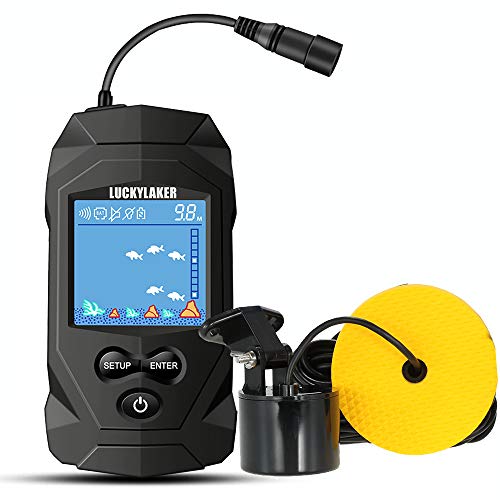
The LUCKYLAKER is the no-nonsense option. It’s a handheld unit that does one thing well: it tells you how deep the water is and where the fish are. No AI, no fancy modes, just a solid sonar reading. For a lot of lake trout anglers, especially those fishing from a kayak or the bank, that’s enough. It’s small enough to hang around your neck or stuff in a pocket, so you can take it anywhere.
Its main strength is simplicity. The wired transducer with a 25-foot cable and removable float lets you cast it out from shore or drop it through an ice hole. The depth reading goes down to 328 feet, which covers most lake trout water. The display shows depth in feet or meters, along with fish location and bottom structure like rocks and weeds. It also has a battery save mode that stretches the life of 4 AAA batteries to over 6 hours of continuous use. That’s a solid run time for a full day on the ice.
The limitations are real, though. The screen is basic, and the sonar is not CHIRP. That means you’ll get a fish icon, but not a detailed arch that tells you how big the fish is or exactly how far off the bottom it’s holding. In a school of small whitefish mixed with a few big lake trout, this unit won’t help you sort them out. Also, the refresh rate is slower than the FishPod, so if you’re trolling at 2-3 mph, you might miss a fish that’s holding tight to a drop-off. It’s a tool for finding fish, not for studying them.
- Handheld design with a 25-foot wired transducer and float
- Depth range up to 328 feet (100 meters)
- Battery save mode provides 6+ hours of use on 4 AAA batteries
- Displays depth, fish location, weeds, rocks, and sand
- Works for ice, sea, bank, lake, and boat fishing
Best for: The casual or kayak angler who wants a cheap, reliable depth finder that’s easy to pack and doesn’t require a PhD to operate.
How We Chose These Products
We focused on one question: can this unit help you find lake trout in the conditions where they actually live? That means deep water in summer, cold water in winter, and moving water when you’re trolling. We ignored marketing claims and looked at the sonar engine, the transducer quality, and how the unit handles real-world interference like thermoclines and suspended debris.
We also considered the angler. A guide on a big lake needs different tools than a weekend warrior fishing from a kayak. The FishPod 5x earned its spot because its AI modes directly address the challenge of finding suspended fish in deep water. The LUCKYLAKER made the list because it’s an honest, affordable tool that works when you need it, even if it lacks the bells and whistles. Neither unit is perfect, but both solve a specific problem for lake trout anglers.
Buying Guide: What Really Matters
Ignore the screen size for a second. The first thing to consider is the sonar technology. CHIRP sonar sends a sweep of frequencies and gives you a much cleaner picture of the bottom and the fish. It’s better at separating a fish that’s hugging the bottom from the bottom itself. Standard sonar, like the LUCKYLAKER, sends a single frequency and is more prone to clutter. For lake trout, which often hold just a few feet off the bottom, that separation is the difference between seeing a fish and seeing a blob.
Next, think about the transducer. In cold water, the cone angle of your transducer can narrow, which means you’re seeing less water. A unit with a wider cone angle or adjustable settings is a plus. Also, consider the ping speed. If you’re trolling at 2-3 mph, you need a unit that updates fast enough to show you a fish before you’re past it. A slower refresh rate means you might troll right over a school of lake trout and never know it.
Finally, don’t underestimate battery life. On a big lake, you might be out for 8 hours. If your unit dies at noon, you’re fishing blind. Look for a unit with a battery save mode or a rechargeable battery that matches your typical trip length. The FishPod’s built-in battery is more convenient, but the LUCKYLAKER’s AAA option means you can always carry spares.
Our Top Recommendation
The FishPod 5x is our top pick. It’s not just a fish finder; it’s a tool that helps you understand the water. The AI modes are genuinely useful for lake trout, especially the depth and size targeting features. When you’re marking fish at 50 feet in the middle of summer, the FishEcho mode cleans up the screen so you see the fish, not the noise. The Vertical Flasher mode is a game-changer for ice fishing, giving you real-time feedback that’s easy to read.
If the FishPod is out of your budget, the LUCKYLAKER is a solid fallback. It won’t give you the same detail, but it will tell you where the fish are and how deep the water is. For a kayak angler or someone who only fishes a few times a year, it’s a practical choice that gets the job done.
Frequently Asked Questions
How do I find the thermocline with my fish finder to locate summer lake trout?
Look for a sudden change in the sonar readout—often a faint line or band of clutter that isn’t the bottom. That’s the thermocline. Lake trout suspend just above or below this line where oxygen and temperature meet their preference. On the FishPod, use the depth targeting mode to set an alarm for that specific zone.
Does trolling speed affect my sonar’s ability to show fish arches?
Yes, absolutely. At 2-3 mph, a standard sonar might miss a fish that’s holding tight to structure. You need a unit with a fast ping speed and a high refresh rate to paint a complete arch. Slow down to 1.5-2 mph if you’re marking fish but not getting clear arches.
What is a good target separation for lake trout fishing?
You want a unit that can distinguish between two objects that are close together, like a fish and the bottom. A target separation of 2-3 inches is ideal. The FishPod’s AI modes help with this, while a basic unit like the LUCKYLAKER will show you a fish icon but might merge it with the bottom if it’s hugging tight.
Can I use a portable fish finder for ice fishing on deep lakes?
Yes, but you need a unit with a flasher mode or a very fast update rate. The FishPod’s Vertical Flasher is perfect for this. The LUCKYLAKER works too, but you’ll need to drop the transducer down the hole and wait for the reading to stabilize. Both are better than drilling holes blind.
