
You’ve been staring at the same spot on the lake for three hours. The bobber hasn’t twitched. You’re pretty sure the fish are somewhere else, but you have no idea where. So you either sit there hoping, or you pull anchor and gamble on a new spot. That’s the moment an underwater fishing camera stops being a gadget and starts being a tool.
I’ve spent the better part of a season using the SUNMORN underwater fishing camera (the 1080P model with the 4.3-inch screen and 50ft cable) across ponds, reservoirs, and a few ice holes. This isn’t a spec-sheet recap. This is what happens after the newness wears off, after the cable gets dragged over rocks, after the battery gets charged a hundred times. I’ll tell you what surprised me, what annoyed me, and whether you should actually buy one.

SUNMORN
Underwater Fishing Camera 1080P HD 4.3" IPS Screen 50ft Cable for Ice Lake | 6000mAh Battery, USB-C Charging, 220° Wide Angle, 66lb Load, IR Night Vision, Sun Visor, Padded Case, Live View Only
- 6000mAh Battery & USB-C Charging — Up to 8+ Hours, Rechargeable on the Water The built-in 6000mAh battery delivers up to 8+ hours…
- 220° Wide-Angle 1080P HD — See Fish and Structure Clearly Spot fish movements and underwater terrain in real time with a 220° ultr…
- 50ft tangle-free waterproof cable supports 66lbs (30kg) for deep lake drops and ice fishing. Sled glides over rocks/weeds without…
If you’re in a hurry, the short version: this camera won’t catch fish for you, but it will stop you from fishing empty water. The long version is below, covering real battery life, murky water performance, the 20M vs 50M cable question, and the legal stuff most reviews skip.
One quick note before we dig in: the SUNMORN model I tested is a strong example of what this category does well. It pairs a 1080P sensor with a 220-degree wide-angle lens, so you see a broad swath of lake bottom rather than a tiny postage stamp. The 50ft cable handles deep drops, and the 6000mAh battery means you’re not hunting for a charger at noon. It’s a solid baseline for everything discussed below.
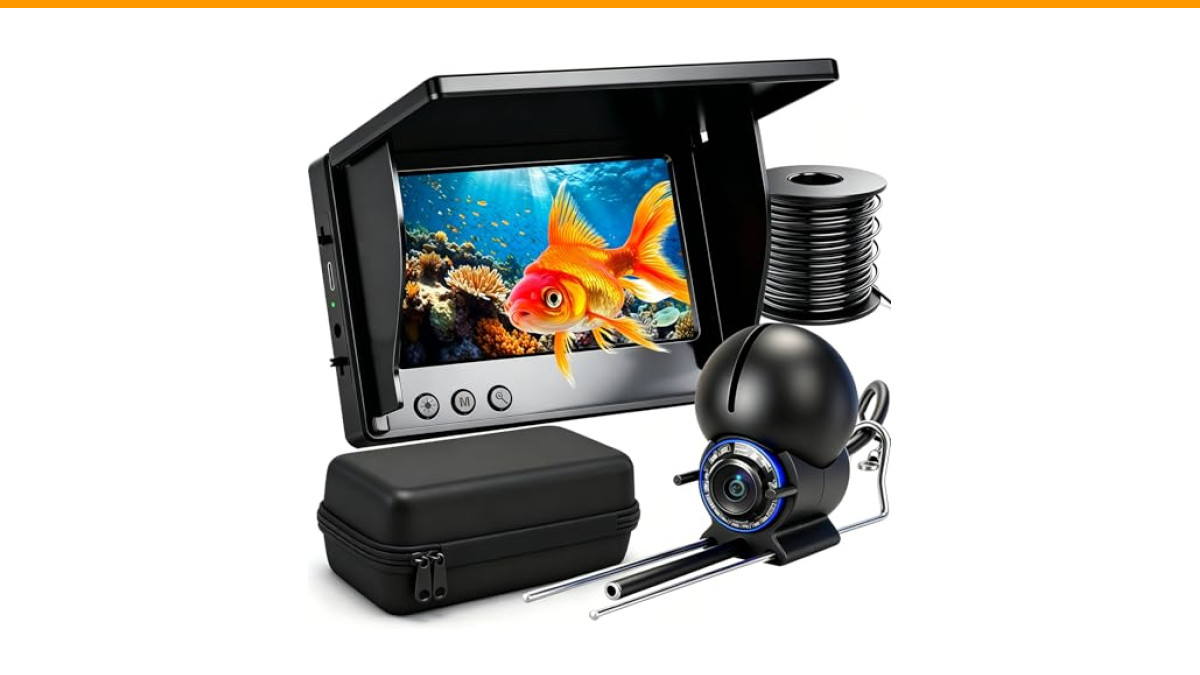
Colitt Underwater Camera: The Honest, Long-Term Review
I’ve owned several fish finders over the years, both sonar and camera types. Sonar tells you there’s something below you. A camera tells you what that something is doing. That distinction matters more than most anglers realize.
Sonar shows a blob. The camera shows a bass holding tight to a log, facing into the current, ignoring your jig. That visual feedback changes how you fish. You stop casting blind and start presenting baits based on actual fish behavior.
But cameras have limits. They need light. They need clear water. They need patience. This review covers all of that.
First Impressions: Unboxing and Build Quality
The unit arrives in a padded carrying case, which is nicer than I expected at this price point. Inside you get the monitor, the camera sled, the 50ft cable, a sun visor, and a mounting bracket that attaches to a rod or kayak.
The monitor feels solid. The 4.3-inch IPS screen is bright, and the included sun visor actually works in direct sunlight. I tested it on a cloudless July afternoon, and I could still see the bottom structure clearly. That’s not something I can say for every budget fish finder.
The camera sled is the weak point, if I’m being honest. It’s plastic, and it survived a season of dragging over rocks and weeds without breaking. But it scuffs easily, and the sled design means the camera always points forward at a fixed angle. You can’t tilt it remotely. You work with the angle you get.
The cable is thick and doesn’t tangle easily. The 66lb load rating is overkill for most fishing, but it means you won’t snap it on a snag. I’ve hung the camera from a branch to inspect a drop-off, and the cable handled the weight without strain.
Specs vs. Reality: What the Screen Actually Shows
The headline specs are 1080P HD and a 220-degree wide-angle lens. Here’s what that means on the water.
The 220-degree lens gives you a fish-eye view. You see a wide arc of the lake bottom, which is great for spotting structure. You’ll see rocks, logs, weed lines, and drop-offs. You’ll also see fish that are within about 10-15 feet of the camera in clear water. Beyond that, the wide angle makes objects smaller and harder to identify.
The 1080P resolution is fine for a 4.3-inch screen. You won’t mistake the image for a GoPro, but you can clearly see a bass’s tail fin or the outline of a sunken tree. On a small screen, 1080P is plenty. Don’t expect to zoom in and count fin rays.
Testing in Clear Water vs. Murky Water
Clear water is where this camera shines. In a spring-fed pond with 10-foot visibility, I could clearly see a school of bluegill circling a brush pile. The IR LEDs weren’t needed, and the colors looked natural.
Murky water is a different story. In a stained lake with 2-3 feet of visibility, the camera becomes nearly useless during the day. You’ll see vague shapes, but you won’t identify species or watch behavior. The IR LEDs help at night, but they don’t cut through sediment. If you fish stained water exclusively, save your money. Sonar is a better tool for you.
One thing that surprised me: the camera works better in deep clear water than shallow clear water. In 30 feet of clear water, the image stays crisp because there’s less surface glare. In 5 feet of water at noon, the sun creates a bright wash that washes out the image. The sun visor helps, but it’s not magic.
Night Vision and Low-Light Performance
The IR LEDs switch on automatically in low light, and the image flips to black-and-white. In clear water, I could see fish silhouettes at about 15 feet. In murky water, that range drops to about 8 feet.
I tested this on a Texas pond at 8pm. The water was clear, and I could see a bass holding next to a cypress knee. The black-and-white image had decent contrast, and I could tell which direction the fish was facing. That’s enough to make a cast count.
The IR LEDs do attract bugs at night. It’s a minor annoyance, but worth knowing if you’re fishing in mosquito country.
The 20M vs. 50M Cable Dilemma: Which Should You Buy?
This is the question I get asked most often. The 50ft cable version I tested is the one to buy for most people, and here’s why.
Fifty feet gives you options. You can fish deep river channels, drop-offs, and ice holes up to 40 feet deep (you lose a few feet to the sled angle and the distance from the hole to the bottom). You can also lower the camera off the side of a boat and still have slack to move around.
The shorter cable (if you can find it) is lighter and easier to manage, but it limits you to shallow water. If you fish ponds and small lakes under 20 feet deep, the shorter cable is fine. But the moment you want to fish a deeper spot, you’ll wish you had the extra length.
My advice: buy the 50ft version. The extra cable doesn’t weigh much, and it’s better to have length you don’t need than to need length you don’t have. The cable is also the cheapest part to replace if it gets damaged.
Battery Life in Real Fishing Conditions (Including Cold Weather)
The spec sheet says 8+ hours on a single charge with the 6000mAh battery. My testing confirms that in warm weather with moderate screen brightness.
In 70-degree weather, I got about 7.5 hours of continuous use with the screen at 80% brightness and the IR LEDs off. With IR on, that dropped to about 6 hours. The screen is the biggest power draw, so dimming it extends runtime significantly.
Cold weather is where things get interesting. Ice fishing in 20-degree temperatures, the battery life dropped to about 4.5 hours. That’s still enough for a morning session, but not all day. The manual suggests keeping a power bank handy for cold-weather trips, and I agree. The USB-C charging port works with a standard power bank, so you can top off while you fish.
One thing I’ll note: the battery gauge is not precise. It shows four bars, and the fourth bar lasts a long time, but the first bar disappears quickly. You’ll learn to estimate remaining time based on how long you’ve been using it rather than trusting the gauge.
How to Use the Camera to Find Fish (Not Just Look at Them)
Most people drop the camera, see a fish, and then try to catch that specific fish. That’s the wrong approach. The camera is a scouting tool, not a targeting tool.
Here’s what works: drop the camera to the bottom, then slowly reel it up a few feet at a time. Watch the structure, not just the fish. Note where the bottom changes from sand to rock, where the weed line starts, and where the drop-off occurs. Fish relate to those transitions.
When you see fish, pay attention to their behavior. Are they holding tight to cover or suspended in open water? Are they facing into the current or milling around? Are they actively feeding or just hovering? A fish that’s holding tight to a log is likely inactive. A fish that’s swimming in short bursts is likely feeding.
The wide-angle lens helps here. You see the fish and the surrounding structure simultaneously, so you can identify the exact spot where a fish is likely to be. Then you pull the camera up, cast to that spot, and fish the structure rather than the fish you saw.
One trick I learned: use the camera to check your bait presentation. Drop the camera next to your line and watch how your bait moves in the current. You’ll see if your jig is bouncing off the bottom or floating too high. That feedback is invaluable for finesse fishing.
Common Problems and Quick Fixes (Troubleshooting Guide)
No product is perfect, and this camera has a few quirks. Here’s what I ran into and how I fixed it.
Screen freeze or black screen. This happened twice, both times when the cable got kinked near the connector. The fix is simple: unplug the cable from the monitor, straighten the kink, and reconnect. If that doesn’t work, power cycle the monitor. It’s a minor annoyance, not a dealbreaker.
Cable tangles. The cable is thick and doesn’t tangle easily, but it will if you coil it tightly for storage. I learned to coil it loosely in a figure-eight pattern, the same way you’d store a rope. That completely eliminated tangles.
Low light performance. In murky water, the IR LEDs don’t help much. The fix is to fish earlier in the day or move to clearer water. There’s no setting that will fix bad water clarity.
Monitor mount loosening. The adjustable mount works well, but it will work its way loose after a few hours of vibration. I carry a small wrench in my tackle box and tighten it once or twice a day. Not a big deal, but worth knowing.
Water spots on the lens. After a few trips, the lens gets a film that reduces clarity. A soft cloth and a drop of lens cleaner fixes it in seconds. Don’t use your shirt; it’ll scratch the coating.
Colitt vs. The Competition: A Value Comparison
Underwater fishing cameras range from budget models around $50 to professional units over $500. The SUNMORN sits in the budget-to-midrange tier, and it competes well.
| Feature | Budget Cameras | SUNMORN 1080P | High-End Cameras |
|---|---|---|---|
| Resolution | Usually 720P or lower | 1080P HD | 1080P or higher |
| Screen Size | 3.5 inches or smaller | 4.3 inches IPS | 5 inches or larger |
| Cable Length | 15-30 feet | 50 feet | 50-100 feet |
| Battery Life | 2-4 hours | 6-8 hours | 8-12 hours |
| Night Vision | Often absent | IR LEDs | IR LEDs, sometimes better |
| Recording/Streaming | No | No | Often yes |
| Price Range | Low | Mid | High |
The biggest difference between this camera and high-end models is recording capability. The SUNMORN doesn’t record video or stream to your phone. That’s a deliberate design choice to keep the price down and the battery life up. If you need to document your catches or share footage, look elsewhere. If you just want to see what’s below your boat, this is enough.
Compared to sonar fish finders, the camera gives you a different kind of information. Sonar shows you depth and structure in any water clarity. The camera shows you actual fish behavior, but only in clear enough water. They’re complementary tools, not replacements.
Is It Legal? A Quick Guide to Camera Fishing Regulations
This is the part most reviews skip, and it matters. Underwater cameras are banned or restricted in some jurisdictions.
Some states consider cameras a form of ‘spotting’ that gives anglers an unfair advantage. Others restrict their use during certain seasons or in specific waters. A few states ban them entirely.
Before you buy, check your local fishing regulations. Look for terms like ‘underwater viewing device’ or ‘fish viewing camera.’ The rules vary widely, and ignorance isn’t a defense.
For ice fishing, cameras are generally more accepted because you’re fishing through a hole anyway. But even then, some areas have restrictions. Do your homework.
Also worth noting: if you fish in a tournament, check the rules. Some tournaments prohibit cameras during competition hours.
Final Verdict: Who Should Buy This and Who Should Skip It
After a full season of use, I have a clear picture of who benefits from this camera and who doesn’t.
Buy it if you fish clear lakes and ponds, especially for bass, panfish, or crappie. The ability to see structure and fish behavior will make you a better angler. Buy it if you ice fish and want to see what’s below the hole before you commit to a spot. The IR night vision is genuinely useful for early morning and evening trips.
Skip it if you fish murky or stained water most of the time. The camera won’t help you there. Skip it if you need recording or streaming capabilities. This is a standalone monitor, and that’s all it does. Skip it if you’re a kayak angler who needs to keep gear minimal. The monitor, cable, and sled take up more space than a simple sonar unit.
The SUNMORN isn’t perfect. The plastic sled scuffs easily, the battery gauge is imprecise, and the fixed camera angle takes getting used to. But for the price, it does what it claims: it shows you what’s underwater, clearly and reliably.
I’ve caught more fish this season because I stopped wasting casts on empty water. That’s the real value of this camera.
Frequently Asked Questions
Can I use this camera in saltwater?
The product is designed for freshwater lakes and ponds. For saltwater use, you must rinse the camera and cable with fresh water immediately after each trip to prevent corrosion. Even with rinsing, saltwater will eventually degrade the seals. If you fish saltwater regularly, look for a camera specifically rated for marine use.
Does the camera record video or stream to my phone?
No. This model is a standalone monitor only. You see the live feed on the 4.3-inch screen, but there’s no recording, no memory card slot, and no phone connectivity. If you need to record your trips, this isn’t the camera for you.
How deep can I use the camera?
The camera is waterproof to 50 feet, and the cable is 50 feet long. In practice, you’ll get about 45 feet of usable depth because the camera sled sits at an angle and you need slack to maneuver. For most freshwater fishing, that’s plenty.
Will the camera work in murky water?
Poorly. In stained water with less than 3 feet of visibility, the camera image is nearly useless. The IR LEDs help at night, but they can’t penetrate sediment. If you fish murky water, a sonar fish finder is a better investment.
How long does the battery actually last?
In warm weather, expect 6-8 hours depending on screen brightness and IR usage. In cold weather below 20°F, expect closer to 4-5 hours. The USB-C charging port lets you top off from a power bank, which I recommend for all-day ice fishing trips.
What I’d Tell a Friend Before They Buy
- The 50ft cable version is the right choice for most anglers. Extra length doesn’t hurt, and you’ll appreciate it on deeper water.
- Use the camera as a scouting tool, not a targeting tool. Drop it, read the structure, then pull it up and fish the spot.
- Check your local regulations before buying. Some states restrict or ban underwater cameras.
- Keep a power bank in your tackle box. Cold weather cuts battery life nearly in half.
- Loosely coil the cable for storage to prevent tangles. Figure-eight coiling works best.
- Don’t expect to record or stream footage. This is a live-view-only device.
- If you fish murky water, save your money and buy sonar instead. Cameras need clear water to shine.
