You are bobbing in a fog bank off the coast, and the radio crackles with static. The Coast Guard is asking for your position, but the transmission keeps breaking up. You have a good radio, you think. So why can’t anyone hear you? The answer is usually not the radio. It is the antenna.


A marine VHF antenna is the difference between a clear mayday call and a garbled mess. It is the part of your setup that actually sends and receives the signal. Most boaters spend hundreds on a radio and then bolt on the cheapest antenna they can find. That is backwards. The antenna is the most important part of your VHF system, and choosing the right one takes more than picking the longest whip on the shelf.
This guide breaks down five solid options, from a compact 4-foot fiberglass model to a serious 8-foot performer. We will look at real-world performance, cable loss, and mounting trade-offs. You will leave knowing exactly which antenna fits your boat, your budget, and your cruising style.
Here is a quick look at how the main contenders stack up.
| Features | Arridioter 48in | Shakespeare 4′ Centennial | Retevis MA06 | HYS Low-Profile | Shakespeare 5206-N 8′ |
|---|---|---|---|---|---|
| Material | Fiberglass | Fiberglass | Fiberglass | Rubber | Fiberglass |
| Gain | 3.5 dBi | 3 dBi | 3.5 dBi | 2 dBi | 6 dBi |
| Cable Length | 22.9 ft RG58 | Not specified | 23 ft RG58 | 16.4 ft | Not specified |
| Mount Type | Adjustable Ratchet | Standard | 180° Mount Base | Integrated Clip | Standard |
| Best For | Center Consoles | Bay Boats | Fishing Boats | Portable Radios | Offshore Cruising |
Arridioter VHF Antenna Ma…

Arridioter
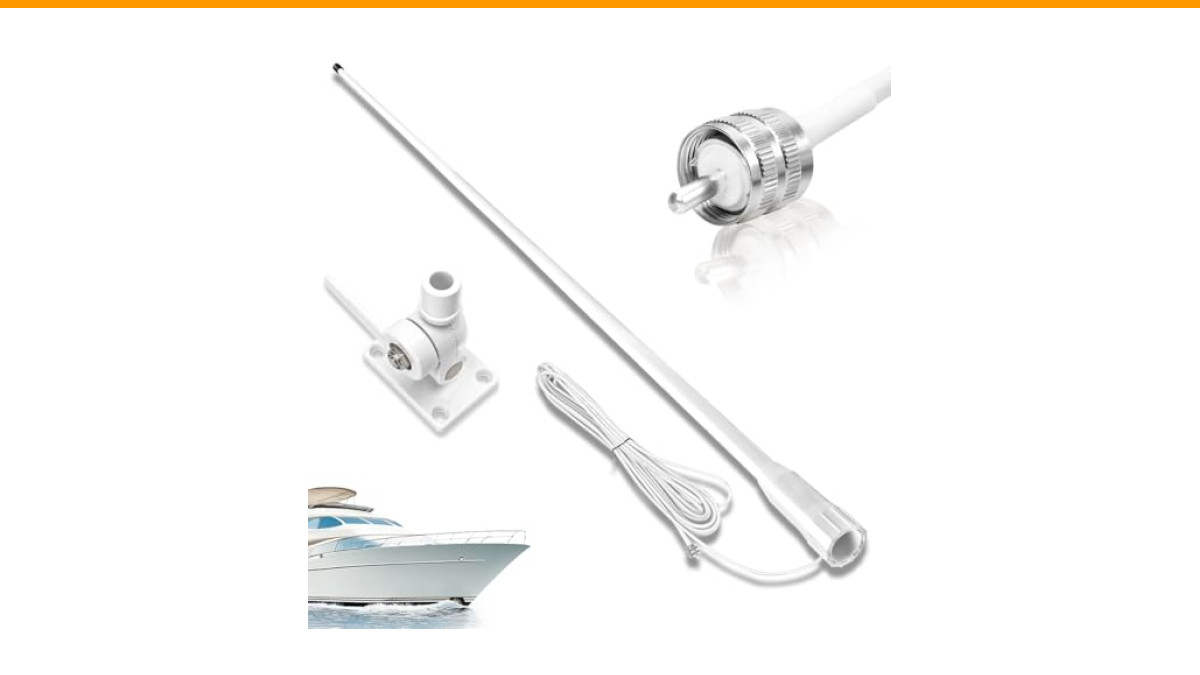
Arridioter VHF Antenna Marine Radio Antenna Boat Fiberglass Waterproof 156-163MHz 48in 3.5dBi with 22.9ft/7m RG58 Cable,PL259 Adapter,Adjustable Ratchet Fixed Mount Base Compatible for Cobra Uniden
- FREQUENCY RANGE: Operates in the marine VHF band of 156-163 MHz, perfect for ship-to-ship and ship-to-shore communications
- CONSTRUCTION: 48 inch fiberglass antenna Kit with base(antenna 43.5inch), provides durability and reliable performance in marine e…
- CABLE INCLUDED: Comes with 23-foot (7m) RG-58U coaxial cable for flexible installation options
The Arridioter 48-inch antenna is a complete kit aimed at the weekend angler or the day cruiser who wants a simple, dependable install. It comes with the antenna, a 23-foot RG-58 cable, a PL-259 connector, and an adjustable ratchet mount. You can buy this and have it mounted in an afternoon without hunting for extra parts.
What stands out is the kit’s completeness. The 23-foot cable gives you real flexibility to route the line to a radio mounted under a console or in a cabin. The ratchet mount lets you lower the antenna for bridges or storage, which is a feature usually found on more expensive models. The fiberglass construction is waterproof and built to shrug off salt spray.
Honest trade-off: the RG-58 cable is fine for runs under 25 feet, but it has higher signal loss than a thicker RG-8X cable. On a longer run, you will lose a bit of performance. Also, 3.5 dBi gain is modest. It is a solid all-rounder, not a long-range champion.
- 48-inch fiberglass whip with 3.5 dBi gain
- Includes 22.9-foot RG-58U coax cable with PL-259 connector
- Adjustable ratchet mount for lowering and positioning
- Operates across the full marine band from 156 to 163 MHz
- Waterproof construction rated for harsh marine conditions
Best for: The boater who wants one box with everything needed for a clean, simple installation on a center console or small cruiser.
Shakespeare 4′ Centennial…
The Shakespeare 4-foot Centennial is a name you can trust. Shakespeare has been making marine antennas for decades, and this model is a direct replacement for the aging stock whips on many older boats. It is a no-nonsense fiberglass antenna that just works. If you are replacing a broken 3-foot antenna on a small runabout, this is your default choice.
Its strength lies in its simplicity and brand reliability. Shakespeare antennas are the standard against which others are measured. The 4-foot length is a good compromise for boats with limited mounting space, like bass boats or small bowriders. It offers enough gain for clear harbor and inshore communication without the wind load of a longer antenna.
The problem here is the lack of detail. Shakespeare does not publish a lot of specs for this model, so you are buying on reputation. You will likely need to purchase a mount and cable separately, which adds to the total cost. It is a solid, no-surprises antenna, but not a bargain.
- 4-foot fiberglass whip from a trusted marine brand
- White finish that resists UV fading
- Designed for standard 1-inch marine mounts
- Good for inshore and harbor use
- Reliable performance without extra features
Best for: Owners of small powerboats who want a trusted, direct replacement antenna without overthinking the specs.
Retevis MA06 Marine VHF A…

Retevis
Retevis MA06 Marine VHF Antenna,3.5dBi,Fiberglass,Waterproof Boat Antenna | 43.3Inch,23 Ft/7 m RG-58 Coaxial Cable with PL-259 Connector Adjustable Ratchet Mount,for Retevis RA27 RM20 Marine Radio
- Marine vhf antenna; 3.5dbi gain; 156-163 MHz; 43.3inch/1.1m; coaxial feeder 275.5inch/7m(PL-259 connector); sufficient length of c…
- Fiberglass marine vhf antenna; the vhf antenna is made of fiberglass, which is waterproof; durable and has a long life; IP66 water…
- VHF boat antenna; compatible with Uniden UM385 UM385BK UM435BK/Standard Horizon/Cobra MR F45-D/Retevis RA27 RM20 and other brands…
The Retevis MA06 is a 43-inch fiberglass antenna that comes with a generous 23-foot cable. It is designed for the angler who needs a reliable workhorse for fishing trips. The antenna includes a 180-degree mounting base, which is a nice touch for adjusting the angle on a leaning post or a hardtop edge.
Retevis claims a 4.6km extra-long range, which is optimistic in real-world conditions, but the antenna does have a pure copper vibrator inside. That copper element helps with receiving sensitivity and accurate impedance matching. The IP66 waterproof rating means it can handle a serious downpour or a washdown without issue.
The trade-off is the same as the Arridioter: the included RG-58 cable is not the lowest-loss option. Also, the 180-degree mount is not a full ratchet mount, so you cannot lay the antenna completely flat. It is a good antenna, but the claimed range figures should be taken with a grain of salt.
- 43.3-inch fiberglass whip with 3.5 dBi gain
- Includes 23-foot coax cable with PL-259 connector
- 180-degree adjustable mounting base
- IP66 waterproof and corrosion-resistant construction
- Pure copper vibrator for better signal sensitivity
Best for: Inshore and nearshore anglers who want a durable, corrosion-resistant antenna that is easy to install on a variety of boat surfaces.
HYS VHF Marine Antenna Lo…

HYS
HYS VHF Marine Antenna Low-Profile 156-163MHz w/16.4ft(5m) Cable with PL259 | Brass&Copper, RG58 Low Loss Premium Coaxial Cable, for Uniden UM385BK Garmin 215 VHF (AIS-capable) Cobra Icom marine radios
- Marine VHF Frequency Range: VHF Marine Antenna operates at 156-163MHz with 2 dBi signal gain and supports up to 50W of power for r…
- Enhanced Signal Performance: VHF rubber antenna designed for any 156-163MHz device receivers to improve signal quality in both rec…
- The HYS antenna (156-163Mhz)operates on the full VHF marine band (156-158 MHz) plus marine weather frequencies (162 MHz). As long…
The HYS low-profile antenna is a different beast. It is a short rubber antenna, not a fiberglass whip. It is designed for portable radios and small boats where a long antenna is impractical. If you have a handheld VHF or a small inflatable, this is the antenna that will not get in the way.
Its main advantage is its size and flexibility. The rubber construction is nearly indestructible. You can bend it, knock it, and it will spring back. It includes an integrated cable and clip, so you can mount it to a rail or a grab bar in seconds. It is perfect for a dinghy, a kayak, or as a backup antenna stashed in a ditch bag.
But the low profile means low gain. At 2 dBi, it offers the least performance of any antenna on this list. It also only supports up to 50 watts of power, which is fine for most marine radios but limits its use with a high-power amplifier. This is a niche tool, not a primary antenna for a serious offshore boat.
- Short rubber design with 2 dBi gain
- Includes 16.4-foot cable with PL-259 connector
- Supports up to 50W of input power
- Integrated clip for quick mounting on rails
- Works with standard SO-239 radio connectors
Best for: Dinghy owners, kayakers, and boaters who need a tough, compact antenna for a handheld radio or as an emergency backup.
Shakespeare 5206-N 8′ VHF…
The Shakespeare 5206-N is the big gun. This 8-foot fiberglass antenna is for serious offshore cruisers who need maximum range. The longer length translates into higher gain, which means your signal travels further and your receiver picks up weaker signals. This is the antenna you want when land is a speck on the horizon.
Shakespeare’s 8-foot design is a proven performer. It offers roughly double the gain of a 4-foot model, which is a significant difference in the real world. It is built to handle the pounding of open ocean running. The fiberglass whip is stiff and durable, and it holds up well to constant vibration and salt exposure.
There are real drawbacks. An 8-foot antenna creates significant wind load. At high speeds, it can stress your mount and your boat’s structure. You need a heavy-duty mount, and you need to remember to lower it for bridges. Also, availability can be spotty, so you may have to wait for a restock. This is not a beginner’s antenna.
- 8-foot fiberglass whip with high gain
- Designed for maximum offshore range
- Requires a heavy-duty mounting bracket
- Built to withstand rough ocean conditions
- Best for long-range communication with the Coast Guard
Best for: Offshore cruisers and serious anglers who run far from shore and need every watt of signal they can get.
How We Chose These Products
We started with the basic physics of VHF radio. The antenna is a resonant device; its length and design determine its efficiency. We looked for antennas that are properly tuned to the marine band (156-163 MHz) and that use materials capable of surviving a saltwater environment. Fiberglass beat out other materials for durability in most cases.
We then considered the practical installation challenges. A great antenna that is impossible to mount is useless. We prioritized kits that included essential parts like cable and mounts, because those are the pieces that often get overlooked. We also weighed the reputation of the brand against the value of the included accessories. The final list includes options for different boat types and budgets, from a compact rubber duck to a long-range fiberglass whip.
Buying Guide: What Really Matters
Gain is the number you will see on the box, but it is not the whole story. A 6 dBi antenna is not twice as good as a 3 dBi antenna. The relationship is logarithmic. In plain terms, a 3 dBi antenna is about the minimum for decent performance. A 6 dBi antenna will give you a noticeable boost in range, but it comes with a longer whip and more wind resistance. For most boaters, a 3 to 4 dBi antenna is the sweet spot.
The cable is the hidden killer. RG-58 is the cheap standard, but it loses about 0.4 dB per foot at VHF frequencies. On a 20-foot run, that is 8 dB of loss. That is a huge chunk of your signal. If you have a long cable run, you need a thicker cable like RG-8X or LMR-400. The included cable on many budget antennas is a place where corners are cut.
Height is might. The VHF radio wave travels in a straight line, so the higher your antenna, the further you can see and be seen. A 3-foot antenna on a T-top will often outperform an 8-foot antenna mounted on a gunwale. Think about where you can mount the antenna to get it as high as possible before you worry about the length of the whip.
Our Top Recommendation
The Arridioter 48-inch antenna is our top pick for most boaters. It offers the best combination of performance, features, and value. The included ratchet mount, long cable, and fiberglass construction cover all the essentials. It is a complete kit that you can install in an afternoon, and the 3.5 dBi gain is more than enough for inshore and coastal cruising.
For the offshore crowd, the Shakespeare 5206-N 8-foot antenna is the clear winner. It offers the range you need when you are far from shore. If you are on a strict budget or have a small boat, the HYS low-profile antenna is a smart, cheap option for a dinghy or as a backup. The Retevis MA06 is a fine alternative to the Arridioter if you find it at a better price, and the Shakespeare 4-foot Centennial is the go-to for a simple replacement.
Frequently Asked Questions
What does dBi actually mean for my radio?
dBi measures the antenna’s ability to focus energy in one direction. A higher dBi means a flatter, wider radiation pattern, which pushes signal toward the horizon instead of up into the sky. For a boat, you want that horizontal focus. Going from 3 dBi to 6 dBi does not double your range; it roughly increases it by a factor of 1.4, which is still a significant improvement.
Why does my new antenna still get a weak signal?
Check the cable and connectors first. Corrosion on the PL-259 connector is a common culprit. Use a multimeter to test for continuity and shorts between the center pin and the shield. If the cable is fine, check the mount for a good ground. A poor ground plane can kill an antenna’s performance. Finally, check the SWR with a meter. A high SWR means the antenna is not tuned or the cable is damaged.
Can I use a longer cable if I move my radio?
You can, but you will pay for it in signal loss. RG-58 loses roughly 0.4 dB per foot. If you add 10 feet of cable, you lose 4 dB of signal. That is a significant amount. If you need a long run, switch to RG-8X or LMR-400, which have much lower loss per foot. It is better to move the radio closer to the antenna than to run a long, lossy cable.
Is a metal mount necessary, or will a fiberglass mount work?
A metal mount is better because it provides a counterpoise, or ground plane, for the antenna. A fiberglass mount will work, but the antenna may not perform as efficiently. If you have a fiberglass boat, you often need to add a ground plate or a copper strap to create a decent ground plane. The mount is not just a holder; it is part of the antenna system.