You’re fighting a big fish, the line starts to bunch up on the spool, and suddenly your cast turns into a bird’s nest. That’s the moment you wish you had a level wind reel. The level wind mechanism lays line evenly across the spool, so you get longer casts, fewer tangles, and more time actually fishing.
But not all level wind reels are created equal. Some are built for heavy saltwater trolling, others for casting in freshwater. The key specs to watch are gear ratio, drag max, and frame material. A graphite frame keeps weight down, while aluminum spools handle braided line without flexing.
We’ve picked three Penn reels that cover the spectrum. The Squall II is our top choice for saltwater, the Rival is the versatile all-rounder, and the Rival Combo is perfect for beginners or anyone who wants a ready-to-go setup. Each one has trade-offs, and we’ll be honest about what they are.
Here’s a quick look at how they stack up on the specs that matter most.
| Features | Penn Squall II | Penn Rival | Rival Combo |
|---|---|---|---|
| Frame Material | Graphite | Graphite + aluminum rings | Graphite |
| Gear Ratio | Not specified | 3.9:1 | 5.1:1 |
| Max Drag | HT-100 carbon fiber | 15 lb | 15 lb |
| Bearings | 3+1 shielded SS | 2 shielded SS | 2 sealed SS |
| Best Use | Saltwater, heavy duty | Nearshore, lake | Freshwater, all-round |

Penn Squall II Level Wind

PENN
Penn Squall II Level Wind Conventional Fishing Reel, Black Gold, 15
- Fast Gear Access Side Plate
- 3+1 shielded stainless steel ball bearings
- HT-100 carbon fiber drag washers
The Penn Squall II is a conventional reel built for saltwater. It’s the kind of reel you want when you’re chasing striped bass in the surf or dropping bait for grouper offshore. The graphite frame keeps it light enough for a long day of casting, but the forged aluminum spool gives it the strength to handle big fish.
What stands out here is the fast gear access side plate. You can pop it open without tools, which makes cleaning and maintenance a breeze. The 3+1 shielded stainless steel ball bearings keep things smooth even after splashes of saltwater. And the HT-100 carbon fiber drag washers — that’s the same drag technology Penn uses in their premium reels. It’s smooth, it’s strong, and it won’t seize up under pressure.
The trade-off? The gear ratio isn’t specified, which suggests it’s not built for speed. This is a power reel, not a fast-retrieve reel. If you’re fishing for species that need a quick retrieve, like tuna or wahoo, you might want something with a higher gear ratio. Also, the graphite frame, while light, isn’t as rigid as full aluminum — so if you’re cranking on a 50-pound fish, you might feel a little flex.
- Fast gear access side plate for quick maintenance
- 3+1 shielded stainless steel ball bearings
- HT-100 carbon fiber drag washers
- Lightweight graphite frame and sideplates
- Forged and machined aluminum spool
Best for: Saltwater anglers who need a durable, low-maintenance reel for heavy line and big fish.
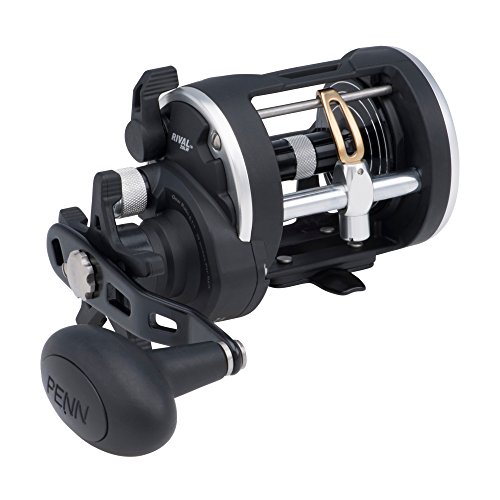
PENN Rival Level Wind Con
PENN
PENN Rival Level Wind Conventional Nearshore/Lake Fishing Reel, HT-100 Star Drag, Max of 15lb | 6.8kg, Forged and Machined Aluminum Spool
- LIGHTWEIGHT GRAPHITE FRAME AND SIDEPLATES with aluminum frame rings. The ultralight and versatile PENN Rival Level Wind also featu…
- AUTO-ENGAGING GEARS with marine-grade bronze alloy main and machine-cut brass pinion gears. Recovers at the rate of 27” | 69cm wit…
- MULTI-STOP BEARING SYSTEM: Time-tested shielded 2-ball bearing system offers control in the heat of battle.
The PENN Rival is the workhorse of the lineup. It’s a nearshore and lake reel that handles everything from catfish to redfish. The graphite frame with aluminum rings gives it a nice balance of weight and strength. You can cast all day without your arm falling off, but it still has the backbone to muscle fish out of structure.
The standout feature here is the line capacity rings on the spool. They let you see at a glance how much line you have left — a small touch that makes a big difference when you’re fighting a fish that’s running deep. The auto-engaging gears are another nice touch. They engage smoothly when you start cranking, no grinding or hesitation. With a gear ratio of 3.9:1, it’s not the fastest retrieve, but it’s got plenty of torque for pulling fish away from rocks or docks.
But here’s the honest downside: the 2-ball bearing system is a step down from the Squall II. It’s not as smooth, and you’ll feel a little more vibration when you’re reeling in a fish. Also, the star drag maxes out at 15 pounds, which is fine for most nearshore species, but you’ll want something beefier if you’re targeting big sharks or giant tuna.
- Lightweight graphite frame with aluminum rings
- Auto-engaging gears with marine-grade bronze alloy main gear
- Line capacity rings show remaining line at a glance
- HT-100 star drag with carbon fiber washers
- Gear ratio of 3.9:1 recovers 27 inches per crank
Best for: Anglers who fish both lakes and nearshore saltwater and want a versatile reel that won’t break the bank.
PENN 5′ Rival Level Win

PENN
PENN 5’ Rival Level Wind Fishing Rod and Reel Conventional Combo, 5’, 1 Tubular Fiberglass Fishing Rod with 2 Reel, Durable, Break Resistant and Lightweight
- PENN RIVAL LEVEL WIND 5’ FISHING ROD AND REEL CONVENTIONAL COMBO: A versatile all-rounder made for winning battles with crappie, b…
- SUPERIOR CONSTRUCTION: 1-piece, Tubular Fiberglass rod provides superior durability and break resistance. 6 stainless steel guides…
- RECOVERY RATE: Recovers at the rate of 29” | 74cm with every turn of the crank. Gear ratio of 5.1:1. Machined brass and main pinio…
The PENN 5′ Rival Combo is the complete package. It comes with a 5-foot tubular fiberglass rod and the Rival level wind reel, so you’re ready to fish right out of the box. This is the perfect setup for beginners, kids, or anyone who wants a simple, reliable rig for crappie, bass, and catfish.
The rod is 1-piece fiberglass, which is nearly indestructible. You can bend it, beat it up, and it won’t break. The 6 stainless steel guides with aluminum oxide inserts handle both mono and braid without wearing out. The reel has a 5.1:1 gear ratio, which is faster than the standalone Rival, so you can retrieve lures quickly. And the HT-100 star drag gives you smooth, consistent pressure on the fish.
Now for the honest criticism: the rod is only 5 feet long, which limits your casting distance. If you’re fishing from a pier or a boat, that’s fine. But if you’re casting from the surf, you’ll want a longer rod. Also, the EVA handle is designed for right-handed anglers, so lefties will have to hold it awkwardly or swap the reel (which isn’t easy on this combo).
- 1-piece tubular fiberglass rod for durability
- 6 stainless steel guides with aluminum oxide inserts
- Gear ratio of 5.1:1 recovers 29 inches per crank
- HT-100 star drag with 15 lb max drag
- Medium-heavy power, moderate action
Best for: Beginners or casual anglers who want a durable, ready-to-fish combo for freshwater species.
How We Chose These Products
We started by looking at what real anglers complain about: tangles, line management, and reels that seize up after a season of saltwater. The level wind mechanism is the heart of these reels, so we focused on reels with a proven track record for smooth, even line lay. Penn has been making conventional reels for decades, and their level wind designs are among the most reliable in the industry.
We also compared gear ratios, drag systems, and frame materials. We wanted reels that cover different use cases — from heavy saltwater trolling to light freshwater casting. And we made sure to include options at different price points, so there’s something for every budget. We didn’t just look at specs on paper; we considered how each reel performs in real-world conditions, like casting into the wind or fighting a fish that runs deep.
Buying Guide: What Really Matters
Gear ratio is the first thing to check. A lower ratio (like 3.9:1) gives you more cranking power, which is great for pulling fish out of heavy cover or fighting strong fish. A higher ratio (like 5.1:1) lets you retrieve lures faster, which is better for reaction bites. Think about what you fish for most and pick accordingly.
Drag max is another critical spec. The drag is what slows the fish down when it runs. A 15-pound drag is enough for most nearshore and freshwater species, but if you’re targeting big game like tuna or sharks, you’ll want 20 pounds or more. Also, look for carbon fiber drag washers — they’re smoother and more consistent than felt washers.
Frame material matters for weight and corrosion resistance. Graphite is light and affordable, but it’s not as rigid as aluminum. Aluminum frames are stronger and more durable, but they add weight. If you’re fishing in saltwater, look for reels with stainless steel bearings and corrosion-resistant coatings. And don’t forget the level wind mechanism itself — make sure it’s made of brass or another durable material, because that’s the part that wears out first.
Our Top Recommendation
If you can only buy one level wind reel, get the Penn Squall II. It’s the most durable and has the best drag system of the three. The fast gear access side plate makes maintenance simple, and the shielded bearings handle saltwater better than the Rival’s standard bearings. It’s a reel you can trust for years, whether you’re fishing the surf or the deep sea.
If you’re on a budget, the PENN Rival is a solid choice. It’s lighter and cheaper, and the line capacity rings are a handy feature. Just be aware that the drag is lower and the bearings aren’t as smooth. And if you’re a beginner, the Rival Combo is the easiest way to get started — you get a rod and reel that work together, no guesswork required.
Frequently Asked Questions
Can I use braided line with a level wind reel?
Yes, but you need to be careful. Braid is thinner and can dig into the spool if you set the drag too tight. Use a monofilament backing to fill the spool, then tie on your braid. The level wind mechanism will lay the braid evenly, but you should check the line guide for wear — braid can cut into the pawl over time.
How do I clean the level wind mechanism?
Take off the side plate (on the Squall II, it’s tool-free). Remove the pawl and the gear. Rinse them with fresh water, dry them, and apply a light coat of reel oil. Reassemble and test the movement. Do this after every saltwater trip, and your reel will last much longer.
What’s the difference between a level wind reel and a baitcaster?
A level wind reel has a mechanism that moves the line guide back and forth as you crank, so the line lays evenly on the spool. A baitcaster doesn’t have this — you have to control the spool with your thumb to prevent tangles. Level wind reels are easier to use, but they can’t cast as far as a baitcaster with a free-spooling spool.
Is a higher gear ratio always better?
No. Higher gear ratios (6:1 and up) are faster but sacrifice torque. A lower ratio (3.9:1) gives you more cranking power, which is better for heavy fish or deep cranking. For most anglers, a ratio between 4:1 and 5.5:1 is a good balance. Think about what you’re fishing for and choose accordingly.