You’ve tied the perfect Spey fly. The proportions are right, the hackle is neat, and the wing sits exactly where it should. Then you get to the river, make a beautiful cast, and the fish turns away at the last second. Or worse, you get a take, set the hook, and it pulls free after two head shakes. Nine times out of ten, the problem isn’t your pattern or your casting. It’s the hook size.
Choosing the right hook size for a salmon fly isn’t about following a rigid chart. It’s a decision that hinges on the fly’s profile, the water conditions, and the fish’s mood. A hook that’s too large makes the fly look bulky and unnatural. A hook that’s too small can make the fly look sparse and weak. The best anglers treat hook selection as a framework, not a fixed rule.
This guide breaks down that framework. We’ll look at how hook dimensions change the fly’s action, how water temperature and flow should influence your choice, and we’ll review five hook assortments that cover everything from delicate dry flies to heavy streamers. Our top pick, the XFISHMAN assortment, offers the best balance of variety and strength for most anglers. But the right choice depends on what you’re tying and where you’re fishing.
Here is a quick look at how the five products stack up against each other.
| Features | XFISHMAN Assortment | Maxcatch Barbless | Dr.Fish Streamer 1/0 | Dr.Fish Streamer 2/0 | Region Fishing Flies |
|---|---|---|---|---|---|
| Material & Build | 2X-heavy wire, strong | Carbon steel, black nickel | High carbon steel, black nickel | High carbon steel, black nickel | Mustad Signature hooks |
| Key Specification | 240 hooks, 8 sizes | 100 hooks, 5 styles | 100 pack, 1/0 size | 100 pack, 2/0 size | 6 pre-tied streamers |
| Main Feature | Versatile all-rounder | Barbless, catch & release | Offset point, wide gap | Offset point, wide gap | Professional tied flies |
| Performance | Sharp, low profile barbs | Easy penetration | Deep penetration | Deep penetration | Ready to fish |
| Best Use Case | Dry, wet, nymph patterns | Competition, small flies | Bass, streamers | Large streamers, saltwater | Trout, quick box fill |
XFISHMAN Fly Hooks for Fl…
XFISHMAN
XFISHMAN Fly Hooks for Fly Tying Dry Wet Nymph Flies Curved Fishing Hooks 10# ~16# Assortment Pack of 240 Hooks with Box…
- EASY TO USE-- Clearwater fly tying hook assortments come packaged in an 8-compartment (magnetic bottom with foam dividers) hook pa…
- 240-Hook Assortment---- Total of 240 hooks per assortment (30 of each size). This versatile set can meet most of your needs for ty…
- POPULAR SIZES-- The most popular sizes and styles of each variety of hook. Example: selection you would receive sizes 10, 12, 14,…
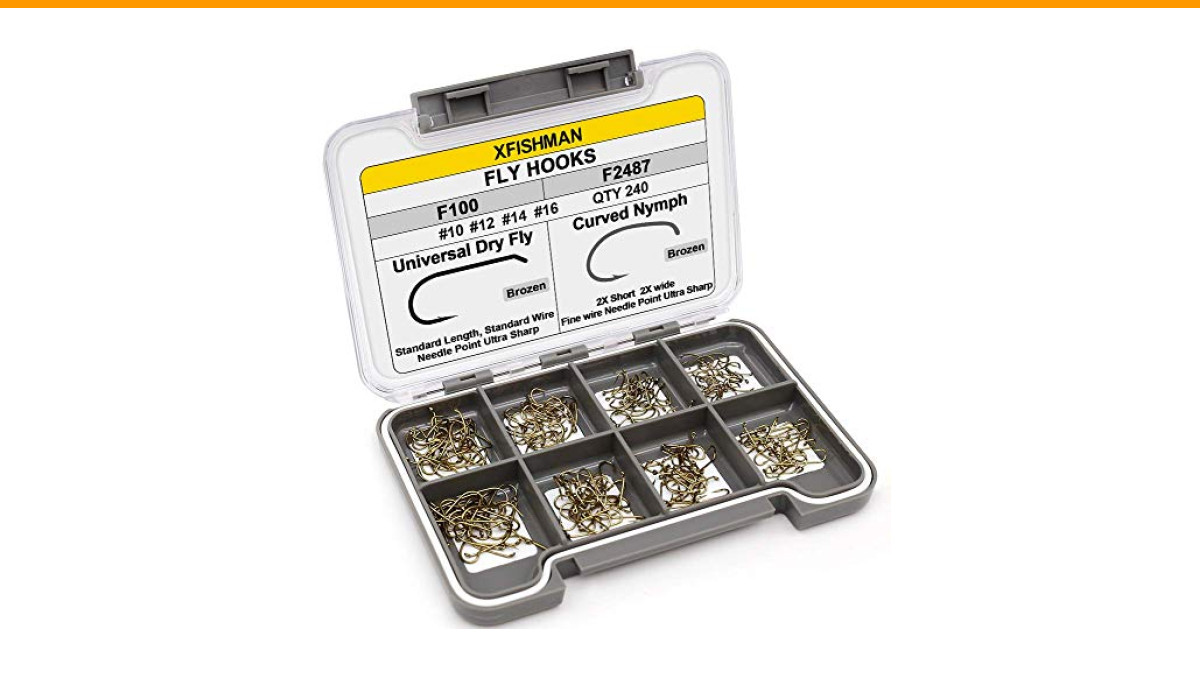
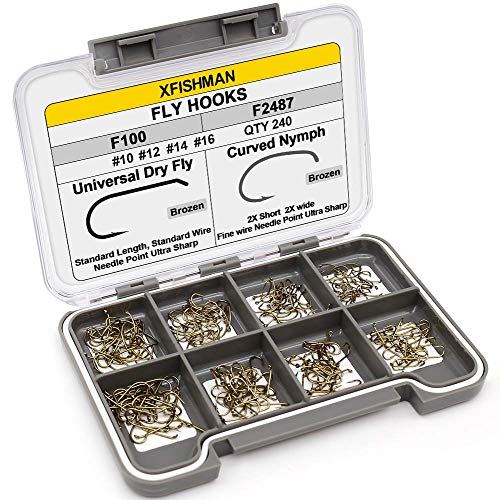
This is the set most fly tyers should start with. The XFISHMAN assortment gives you 240 hooks across eight compartments, with 30 hooks per size. You get sizes 10 through 16 in both dry fly and wet nymph styles. It’s a complete foundation for trout and grilse fishing without breaking the bank.
What stands out here is the 2X-heavy wire. Most hooks in this price range feel flimsy, but these have real substance. They hold up well when you’re fighting a fresh fish in fast water. The points are chemically sharpened and come with low profile barbs, which means you get solid hook sets without needing excessive force. The magnetic bottom in the storage box is a thoughtful touch—it keeps the hooks organized and prevents them from spilling when you knock the case over on your tying desk.
There are some limitations. The sizes stop at 16, so you won’t find anything for larger salmon patterns or tube fly adaptations. The barbs, while low profile, are still there. If you fish in catch-and-release-only water, you’ll need to pinch them down yourself. Also, the hook eyes are standard, not tapered, which can be a minor issue when you’re trying to thread heavy tippet through quickly in low light.
- 240 hooks total: 30 each of sizes 10, 12, 14, and 16 in dry and wet styles
- 2X-heavy wire adds strength for fighting larger fish
- Chemically sharpened points with low profile barbs
- Comes in an 8-compartment magnetic storage box
- Best for trout, grilse, and smaller summer salmon patterns
Best for: The angler who wants one reliable box of hooks for tying a wide range of dry flies, nymphs, and smaller wet flies for Atlantic salmon and sea trout.
Maxcatch 100pcs Barbless…
The Maxcatch set is built for a specific kind of angler: the one who values catch and release and fishes small, technical patterns. This package includes 100 hooks spread across five different styles—dry, wet, nymph, jig, and shrimp/caddis pupa. The sizes run from 6 all the way down to 20, giving you excellent coverage for tiny flies.
The barbless design is the main selling point here. These hooks are chemically sharpened and slide into a fish’s mouth with minimal resistance. Hook penetration is noticeably faster than with barbed hooks, which makes a real difference when you’re fishing a dry fly for fussy summer salmon. The black nickel plating offers solid corrosion resistance, so you don’t have to panic if you’re fishing a coastal river with a slight salt influence.
You should know that barbless hooks require a different hook set. You need to keep constant tension on the line because the hook can work itself loose during the fight. The smallest sizes in this set, particularly the 18 and 20, are incredibly fine. They’re perfect for tiny flies but they will bend out if you try to horse a large fish in heavy current. This is a specialist tool, not a general-purpose box.
- 100 hooks total, 20 per style, with sizes from 6 to 20
- Includes jig hooks with a 90-degree eye for balanced nymphing
- Barbless design for easy penetration and clean release
- Black nickel plating resists corrosion in fresh and saltwater
- Plastic storage box fits easily in a vest pocket
Best for: The catch-and-release purist who ties small, precise patterns for low, clear water conditions and wants a variety of hook styles in one compact kit.
Dr.Fish 100 Pack Fly Hook…
This Dr.Fish pack is all about power. It contains 100 size 1/0 hooks with a wide gap and an offset point. These are not subtle hooks for delicate presentations. They are built for streamers, Woolly Buggers, and Clouser Minnows that need to punch through wind and move water.
The offset point is the defining feature. It creates a slight camber that helps the hook point bite into the fish’s mouth on the strike. This design improves your hooking ratio, especially on short strikes from aggressive fish. The high carbon steel with black nickel coating is tough and won’t rust easily, even after a season of saltwater fishing for bass or pike.
Here’s the trade-off: these hooks are heavy. A size 1/0 hook with a wide gap will sink fast, which means you need to tie your streamers with enough buoyancy to keep them in the strike zone. The offset point also means the hook spins slightly in the water, which can twist your tippet if you’re not careful. You’ll want to use a quality swivel or a heavy leader to manage this.
- 100 hooks in size 1/0, ideal for large streamer patterns
- Offset point design increases hook-up ratio on short strikes
- Wide gap allows for bulky flies with lots of material
- High carbon steel with black nickel coating for durability
- Suitable for both freshwater bass and saltwater species
Best for: The streamer angler who targets aggressive predators like bass, pike, and big trout with bulky, fast-sinking flies.
Dr.Fish 100 Pack Fly Hook…

Dr.Fish
Dr.Fish 100 Pack Fly Hooks Streamer Stinger Wide Gap, Offset Saltwater Bass Fly Tying Hooks Wooly Bugger Clouser Minnow 2/0
- Made of high carbon steel with black nickel coating, the fly hook features reassuring durability and corrosion resistance, while b…
- Barb design makes sure deeper penetration, keeping the fish firmly planted when it tries to make the escaping strikes. It will enc…
- With offset point design. the hook easily slides deep into fish mouths, helping anglers everywhere catch more fish.
This is the bigger brother to the previous Dr.Fish pack. You get the same wide gap, offset point, and black nickel construction, but in a larger 2/0 size. This is the hook you reach for when you need to tie flies that imitate large baitfish or when you’re fishing for species with big mouths.
The 2/0 size shines in saltwater situations or when you’re throwing big, articulated streamers for musky or large brown trout. The wide gap gives you room to tie in bulky materials like rabbit strips, bucktail, and synthetic fibers without crowding the hook point. The offset design still helps with hook sets, but the larger size provides more holding power once the fish is on.
The downside is that this hook is overkill for most salmon fishing. A 2/0 hook is too large for classic Spey flies or wet flies meant for grilse. It also requires a heavy rod and line to cast effectively. If you’re only fishing for Atlantic salmon on a 6-weight or 7-weight rod, this is too much hook. Save it for the big game situations.
- 100 hooks in size 2/0 for large streamers and saltwater flies
- Offset point for aggressive hook sets
- Wide gap accommodates bulky materials
- Rugged black nickel finish resists corrosion
- Best paired with 7-weight or heavier rods
Best for: The angler chasing large predatory fish in saltwater or big rivers, where a heavy, durable hook is necessary to land trophy-sized specimens.
Region Fishing Woolly Bug…

Region Fishing
Region Fishing Woolly Bugger and Streamer Assortments Tied on Mustad Signature Fly Hooks use for Trout and More (6ct - Hook #8)
- Fill your fly box with an assortment of some of the most productive streamers
- Great for all varieties of fish year round
- Mustad Signature Hooks
This pick is different. Instead of loose hooks, you get six professionally tied Woolly Buggers on Mustad Signature hooks in size 8. It’s a great way to fill your fly box quickly with proven patterns without spending hours at the tying vise.
The quality is genuinely good. These flies are tied by professionals with premium materials, and it shows. The hackle is dense, the chenille is even, and the proportions are correct. The Mustad Signature hooks are sharp and strong, a solid choice for a versatile pattern like the Woolly Bugger. You can fish these in slow pools, fast riffles, and everything in between.
The obvious limitation is that you get six flies, not a box of hooks. Once they’re gone, they’re gone. The size 8 hook is a good middle ground, but it’s not ideal for very small trout flies or very large salmon streamers. This is a convenience product, not a long-term supply. But for the price, it’s a smart way to test the waters and see what works on your local river.
- 6 pre-tied Woolly Buggers on Mustad Signature hooks
- Size 8 hook, a versatile choice for trout and salmon
- Professionally tied with premium materials
- Works year-round for a variety of fish species
- Perfect for filling gaps in your fly box quickly
Best for: The angler who wants immediate, effective streamers without tying their own, or the traveler who needs a reliable backup box.
How We Chose These Products
We started by looking at what actually matters on the water. Hook sharpness, strength, and the variety of sizes were the primary criteria. We didn’t just look at the product pages; we considered how each hook performs in real fishing scenarios based on its design and materials.
We also weighed the value proposition. A box of 240 hooks is a better deal for a beginner than a box of 100, even if the individual hook quality is slightly lower. For the expert, the barbless design of the Maxcatch hooks or the heavy-duty build of the Dr.Fish streamer hooks might be worth the premium. We balanced these factors to give you a range of options for different needs and budgets.
Buying Guide: What Really Matters
Forget the brand name for a second. The hook size is the first thing to consider. The size dictates the fly’s profile. A size 10 hook with a long shank will give you a slim, streamlined fly. A size 10 with a wide gap will give you a bulkier, more aggressive profile. Match the hook to the natural insect or baitfish you’re trying to imitate.
Wire gauge matters more than most anglers think. A standard wire hook is fine for dry flies. It’s light, so it floats well. But for streamers and wet flies, you need a heavier wire. A 2X-heavy hook, like the XFISHMAN, will hold up against strong fish and fast currents without straightening. The trade-off is weight, which affects how fast the fly sinks.
Finally, think about the hook point. Chemically sharpened points are sharp out of the box and stay sharp longer. Barbless hooks penetrate easier but require constant line tension. Offset points improve hook sets but can cause line twist. There’s no perfect hook; there’s only the right hook for the specific job.
Our Top Recommendation
The XFISHMAN Fly Hooks Assortment is our top pick. It offers the best combination of variety, strength, and value for the majority of salmon and trout anglers. The 2X-heavy wire gives you confidence against larger fish, and the range of sizes covers most patterns you’ll tie in a season.
If you’re a dedicated catch-and-release angler fishing small, technical flies, the Maxcatch Barbless set is the better choice. For those who primarily throw big streamers for bass or pike, the Dr.Fish 1/0 pack is a solid, heavy-duty option. And if you just want to get on the water quickly, the Region Fishing Woolly Buggers are a reliable, convenient stopgap.
Why Hook Size is the Silent Killer of Salmon Fly Success
Most anglers obsess over the pattern. They spend hours matching the wing color and the hackle length. Then they tie that perfect fly on the same hook size they’ve always used. That’s a mistake. The hook size determines how the fly sits in the water, how it moves, and how it looks to a fish.
A hook that’s too large makes a size 12 fly look like a size 8. The proportions are off, and the fly doesn’t move naturally. A hook that’s too small makes the fly look thin and weak. Fish can tell the difference. They see thousands of flies a season. If yours doesn’t look right, they’ll refuse it.
Getting the hook size right is the difference between a fly that looks good in the vise and a fly that catches fish. It’s the foundation of the entire pattern.
How Hook Sizing Works (And Why It’s Confusing)
Hook sizing is backwards. A size 16 hook is smaller than a size 10 hook. The number goes up as the hook gets smaller. Once you get to size 1, the sizing switches to 1/0, 2/0, and so on, where the hook gets larger as the number increases. It confuses everyone at first.
The size numbers refer to the gap between the shank and the point. A size 10 hook has a wider gap than a size 14. But the shank length can vary. You can have a size 10 hook with a standard shank, a long shank, or an extra-long shank. The size number only tells you part of the story.
For salmon flies, you’ll mostly use sizes 10 down to 2 for wet flies and streamers. Dry flies for summer salmon might go down to size 12 or 14. The key is to look at the specific hook model, not just the number.
The Golden Rule: Matching Hook Size to Fly Pattern Profile
The fly’s profile is the most important thing. The hook must match the overall shape and size of the fly you’re creating. If the hook is too small, the fly will look top-heavy. If it’s too big, the fly will look clunky.
Streamers and Spey Flies
These flies are long and bulky. They need a hook with a long shank and a wide gap. A size 6 or 8 hook is a common starting point for Spey flies. For larger streamers, you might go up to a size 2 or 1/0. The wide gap gives the fly a big profile and ensures the hook point is exposed enough to get a solid set.
Wet Flies and Soft Hackles
These are more delicate. They need a standard or slightly longer shank with a lighter wire. Sizes 10, 12, and 14 are the workhorses here. The lighter wire helps the fly sink slowly and move naturally in the current. A heavy hook would ruin the action.
Dry Flies and Bombers
These need to float. You want a light wire hook, usually in sizes 8 to 14. The hook gap should be wide enough to support the hackle and body materials without making the fly unstable. A hook that’s too heavy will sink the fly.
Water Conditions: The Overlooked Variable in Hook Choice
Most size charts ignore the water. That’s a huge oversight. The river’s flow and temperature should change your hook selection more than any pattern book.
High, Cold Water vs. Low, Warm Water
In high, cold water, the fish are aggressive. They’re holding in deeper runs and need a bigger meal to move for. You can upsize your hook one or two sizes from your standard. A size 6 instead of a size 8, for example. The bigger profile gets their attention.
In low, warm water, the fish are lethargic. They won’t chase a big fly. You need to downsize to a size 10 or 12. The smaller fly looks like an easy meal. The lighter wire also sinks slower, which keeps the fly in the fish’s face longer.
Hook Gap, Shank Length, and Wire Gauge: The Holy Trinity
These three dimensions work together. The hook gap determines how much material the fly can carry. The shank length sets the overall length of the fly. The wire gauge controls the sink rate and strength.
A wide gap with a long shank is for bulky streamers. A narrow gap with a short shank is for small, precise dry flies. A heavy wire is for deep, fast water. A light wire is for slow, shallow water. Change one variable, and you change the fly’s entire behavior.
The Field Test: How to Check Sharpness Before Every Cast
You can test a hook’s sharpness in seconds. Hold the hook point against your thumbnail. Don’t press hard. Just drag it lightly across the surface. A sharp hook will catch the nail and stick slightly. A dull hook will slide right off.
Do this before you tie on every fly. It takes two seconds and saves you from losing a fish. If the hook is dull, you can sharpen it with a fine file. But it’s often easier to just switch to a fresh fly.
Matching Hook Size to Tippet Strength (The Safety Ratio)
Your tippet must match your hook size. A large hook on a light tippet is a recipe for disaster. The hook will act as a lever and snap the line on the cast or the hook set.
A good rule is to use a tippet that’s strong enough to straighten the hook before it breaks. If you’re fishing a size 6 hook, use at least a 10-pound tippet. For a size 10 hook, an 8-pound tippet is usually fine. This ratio ensures the hook pulls free from a snag before you lose your entire leader.
Quick Reference Chart: Hook Sizes for Classic Salmon Patterns
Here’s a simple starting point. For a classic Spey fly, use a size 6 or 8. For an Ally Shrimp, use a size 8 or 10. For a small wet fly or soft hackle, use a size 12 or 14. For a dry fly or bomber, use a size 10 or 12.
These are starting points. Adjust based on water conditions. In high water, go up a size. In low water, go down a size. The fly’s profile and the water’s mood are the real guides.
Final Verdict: When to Upsize and When to Downsize
Upsize when the water is high, cold, and colored. The fish are aggressive and looking for a substantial meal. A bigger hook gives your fly a bigger profile that they can see and target.
Downsize when the water is low, warm, and clear. The fish are spooky and feeding selectively. A smaller hook makes your fly look more natural and less threatening. Trust the water conditions over the pattern book.
Frequently Asked Questions
Should I use barbed or barbless hooks for salmon?
It depends on your local regulations and your fishing style. Barbed hooks hold fish better during the fight, but they’re harder to remove and can damage the fish if you’re practicing catch and release. Barbless hooks penetrate easier and release cleanly, but they require you to maintain constant line tension. Many salmon rivers now require barbless hooks, so check the rules before you go.
How do I know if a hook is too big for a fly pattern?
Look at the proportions. The hook gap should be roughly equal to the width of the fly’s body. If the body looks skinny compared to the gap, the hook is too big. If the body looks bulky and crowds the hook point, the hook is too small. The fly should look balanced.
Can I use trout hooks for salmon flies?
You can for smaller salmon, like grilse, and for summer salmon in low water. Trout hooks are lighter and finer, which gives the fly a more delicate action. But for larger salmon or fishing in heavy current, you need a stronger hook with a heavier wire. A trout hook will straighten out under pressure.
What’s the difference between a standard shank and an extra-long shank hook?
The shank length changes the fly’s profile. A standard shank gives you a compact fly. An extra-long shank gives you a longer, slimmer fly that imitates a baitfish or a large stonefly nymph. The longer shank also provides more room for the body materials, but it can make the hook weaker if it’s not made with a heavier wire.
