You’ve spent the morning throwing every crankbait and jig in the boat, but the bass just aren’t cooperating. The fish are somewhere, holding tight to a submerged stump or a breakline you can’t see from the surface. Without side imaging, you’re fishing blind, guessing at structure that might hold bass or might hold nothing at all.
A fish finder with side scan changes that entirely. It paints a picture of what’s below and beside your boat, letting you cover water quickly and mark the exact spots where bass set up. The best units combine high-resolution screens, powerful transducers, and mapping tools that turn a day on the water into a search-and-destroy mission for productive structure.
We tested two very different approaches to side scan for bass fishing. The Lowrance Elite-12 Ti2 is a full-size chartplotter with serious power and mapping features. The LUCKY Wireless is a portable, castable unit that fits in your pocket. Both serve different anglers, and we’ll break down exactly who should buy which.
Here’s a quick look at how these two compare on the specs that matter most.
| Features | Lowrance Elite-12 Ti2 | LUCKY Wireless |
|---|---|---|
| Display Size | 12-inch SolarMAX | Handheld color screen |
| Sonar Type | CHIRP, SideScan, DownScan | Single-beam 125kHz |
| Mapping | Preloaded C-MAP, Genesis Live | None |
| Best Use Case | Bass boat, serious angler | Kayak, shore, bank fishing |
| Power Source | Boat electrical system | Built-in rechargeable batteries |

Lowrance Elite-12 Ti2 Fish Finder
Lowrance
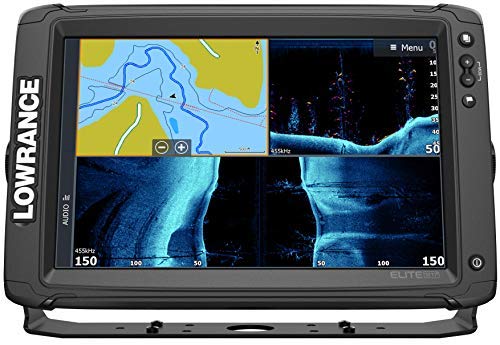
Elite-12 Ti2-12-inch Fish Finder Active Imaging 3-in-1Transducer, Wireless Networking, Real-Time Map Creation Preloaded C-MAP US Inland Mapping …
- Elite-12 Ti2 - 12-inch Fish Finder with Active Imaging 3-in-1Transducer, Wireless Networking, Real-Time Map Creation and Preloaded…
- ENHANCED DISPLAY TECHNOLOGY: High-resolution, 12-inch SolarMAX display that makes it easier to identify fish and structure with ne…
- ACTIVE IMAGING: See structure and cover with a new level of high-resolution detail and unmatched sidescan range with new, 3-in-1 A…
The Lowrance Elite-12 Ti2 is the kind of unit you bolt to the dash of a serious bass boat. It’s a 12-inch chartplotter with Active Imaging 3-in-1 sonar, which means you get CHIRP, SideScan, and DownScan from a single transducer. This is for the angler who wants to see everything around the boat and map the lake while they fish.
The screen is the first thing you’ll notice. It’s a 12-inch SolarMAX display with high resolution, and it handles direct sunlight without washing out. Target separation is excellent, so you can pick out a bass sitting tight to a brush pile instead of just seeing a blob of structure. The Active Imaging transducer delivers impressive side scan range, letting you cover a wide swath of water on each pass. That’s a huge advantage when you’re trying to locate offshore humps or ledges where bass suspend in summer.
The mapping features push this unit into a different class. It comes preloaded with C-MAP US Inland mapping that covers 4,000 lakes with 1-foot contours. You can pull up a lake you’ve never fished and immediately identify the sharp drop-offs and points that hold bass. The Genesis Live feature takes it further, creating real-time 1/2-foot contours as you drive. Run a pass over an unmapped flat, and the unit draws the bottom detail right on the screen. That’s a powerful tool for finding subtle structure that doesn’t show up on standard maps.
There are trade-offs. This is a large unit, and it needs a proper mounting location and a 12-volt power connection. It’s not something you’ll move between boats easily. The learning curve is real, especially if you’ve never used a networked chartplotter. Setting up the wireless networking and customizing the display takes time. You’ll spend an afternoon reading the manual, but the payoff is a unit that does nearly everything except cast the line.
- 12-inch SolarMAX display with high-resolution detail
- Active Imaging 3-in-1 transducer: CHIRP, SideScan, DownScan
- Genesis Live creates real-time 1/2-foot contours
- Preloaded C-MAP US Inland mapping with 4,000 lakes
- Wireless networking for sharing data between units
Best for: The serious bass angler with a dedicated boat who wants a permanent, high-powered unit with advanced mapping and wide side scan coverage.
LUCKY Wireless Kayak Fish Finder

LUCKY
LUCKY Wireless Kayak Fish Depth Finder Handheld Portable Fish Finders Transducer Bass Fishing Sonar Sensor Mount with Floating Plate for Boats MT-202PLUS
- Up to 853ft Wireless Range: This advanced fish depth finder is engineered for maximum coverage, featuring an impressive long-range…
- Portable & Castable Design: Designed for high mobility, this portable fish finder features a compact sonar transducer that is full…
- Precision Pinpointing & Wide Coverage: This portable fish finder achieves high precision in locating fish with our 125kHz single-b…
The LUCKY Wireless is the opposite of the Lowrance in almost every way, and that’s exactly why it’s valuable. This is a portable, castable fish finder designed for anglers who don’t have a hard-wired unit on their boat. If you fish from a kayak, a rental boat, the shore, or a dock, this little device gives you side-scan-like capability without any installation.
Here’s how it works. The sonar transducer is a small ball that you attach to your fishing line and cast out. It floats on the surface and sends data wirelessly to the handheld display unit. The wireless range is up to 853 feet, so you can cast well beyond the boat and still get a clear signal. That’s a game-changer for bank fishing, where you can’t move the boat to cover water. You can cast the transducer to a specific spot, see what’s down there, and then cast your bait to that same location.
The 125kHz single-beam sonar uses a wide 90-degree cone to cover a lot of water. It reads depth from 2 feet down to 147 feet, which covers most bass fishing scenarios. The display shows depth, water temperature, and bottom contours. It even distinguishes between small, medium, and large fish, showing icons at their specific depths. That’s a simple but useful feature when you’re trying to decide between a topwater frog and a deep crankbait.
Portability is the main selling point. Both the handheld unit and the sonar ball are small and lightweight. The whole system fits in a tackle box or a pocket. It’s the kind of thing you can throw in a backpack for a spontaneous trip to a farm pond. The built-in rechargeable lithium batteries mean you don’t need to wire anything to a boat’s electrical system.
You won’t get the detailed side imaging or mapping of the Lowrance. The single-beam sonar gives you a cone of information below the transducer, not a wide picture of the surrounding area. There’s no GPS, no waypoints, and no map creation. For a serious tournament angler, this is a backup tool at best. But for the casual kayak or shore angler, it solves the biggest problem: knowing what’s under the water without spending thousands on a mounted unit.
- Wireless range up to 853 feet for distant casting
- Castable, floating transducer with 90-degree beam cone
- Reads depth from 2 to 147 feet
- Shows fish size icons and depth in real-time
- Built-in rechargeable batteries in both units
Best for: Kayak, shore, and casual boat anglers who want a portable, no-install fish finder to scout structure and locate bass without permanent mounting.
How We Chose These Products
We evaluated these fish finders based on what actually matters for bass fishing, not just the spec sheet. Side scan capability was the primary filter, but we also considered screen visibility in bright sun, transducer range, mapping features, and ease of use. A unit that’s hard to operate on the water is a distraction, not a tool.
We also considered the practical realities of different fishing styles. A bass boat angler needs a large screen to see detail at speed and a powerful transducer to cover water efficiently. A kayak angler needs something light, portable, and simple to deploy. Both units here excel in their respective roles, and we matched them to the angler who would get the most value from each.
Buying Guide: What Really Matters
Screen size and resolution matter more than most people think. You’re going to be staring at this screen in direct sunlight, trying to pick out a single fish arch against a background of stumps and rocks. A larger, high-resolution screen like the Lowrance’s 12-inch SolarMAX display makes that task dramatically easier. A smaller screen works, but you’ll need to zoom in more often and you’ll miss detail at a glance.
Transducer technology is the heart of the system. CHIRP sonar sends a sweep of frequencies and gives you better target separation than a single-frequency unit. Side scan is essential for covering water quickly, and DownScan gives you a detailed view of the bottom directly under the boat. Consider how you fish. If you’re always on a big reservoir, side scan range is critical. If you fish small ponds, a simple single-beam unit might be all you need.
Mapping and GPS features are worth the upgrade if you fish unfamiliar water. Preloaded contour maps like the C-MAP data on the Lowrance help you find structure without driving around randomly. The ability to mark waypoints and create your own maps is a huge advantage for returning to productive spots. Just remember that these features add cost and complexity, so be honest about whether you’ll actually use them.
Our Top Recommendation
The Lowrance Elite-12 Ti2 is the clear winner for the dedicated bass angler. The combination of a massive, bright screen, powerful Active Imaging sonar, and the Genesis Live mapping system makes it the most complete tool for finding and catching bass. It’s an investment, but it’s one that pays off every time you find a new hump or a brush pile that holds fish.
For the kayak angler or anyone who wants a simple, portable solution, the LUCKY Wireless is the smarter pick. It won’t give you the detail of a mounted unit, but it’s affordable, it requires zero installation, and it works from any fishing platform. It’s the perfect tool for scouting a new pond from the bank or checking depth on a kayak trip without adding weight and complexity to your setup.
Frequently Asked Questions
How do I identify bass-holding structure on side imaging?
Look for hard, defined edges. Stumps, laydowns, and rocks show up as bright returns with distinct shadows. A bass holding tight to a stump will appear as a small, separate echo right next to the structure. Baitfish schools show up as fuzzy, cloud-like patches. Target the edges of those bait clouds, especially where they meet cover, because that’s where bass will be lurking.
Where should I mount the transducer to avoid signal loss?
On a bass boat, mount the transducer on the transom away from the hull step and any through-hull fittings. You want clean water flow, not turbulent water, or you’ll get noise and lost bottom readings. On a kayak, mount it near the center of the hull, well below the waterline, and route the cable away from the kayak’s keel to prevent damage. Test it at speed and adjust the angle until you get a clean return.
Is side imaging better than LiveScope for bass fishing?
They serve different purposes. Side imaging is for covering water fast and finding structure. You can drive along a bank and see 100 feet to each side, locating likely spots in minutes. LiveScope is for fishing specific cover in real-time, watching your lure and the fish’s reaction. For finding new water, side imaging wins. For finesse fishing a single brush pile, LiveScope is better. Most serious anglers want both.
What settings should I use for side imaging in clear versus muddy water?
In clear water, you can run higher sensitivity to pick out subtle details and fish arches. Back off the contrast slightly to reduce noise. In muddy water, crank the sensitivity up and increase the contrast to make hard structure stand out against the soft bottom. Play with the range. In clear water, use a wider range to cover more water. In muddy water, narrow the range because the sonar signal doesn’t travel as cleanly.