
You’ve just inflated your boat at the ramp, the sun’s burning off the morning mist, and you’re ready to hit that honey hole you scouted from shore. Then you realize your fish finder’s transducer is dangling by a zip tie, the suction cup gave up last season, and the cable is fraying against the rub rail. Every inflatable boat owner knows this feeling. Standard mounts fail on soft, flexible hulls, and most fish finders are designed for rigid fiberglass or aluminum. So what do you actually do?
The right fish finder for an inflatable boat isn’t just about screen size or sonar power. It’s about mounting flexibility, portability, and how well the unit handles the quirks of a PVC or Hypalon floor. You need something that either mounts without drilling holes or works as a castable sensor you throw in the water. You also want a screen you can read in direct sunlight and a battery that lasts longer than your fishing trip. That’s the short list.
After testing and researching the options, I’ve narrowed it down to five picks that cover every budget and style. There’s a feature-packed Garmin for serious anglers, a wireless castable unit for kayak-style fishing, a budget-friendly handheld that won’t break the bank, and a couple of solid mid-range options. I’ll also walk you through mounting methods that actually hold on inflatable hulls, how to fix false readings from air bubbles, and battery strategies for multi-day trips. Let’s get into it.
Here’s how the top contenders stack up at a glance:
| Features | Hawkeye FishPod 5x | Garmin STRIKER 5CV | LUCKY FF168-T | Fuceter Castable | JOYWEE FF688C |
|---|---|---|---|---|---|
| Mount Type | TraxNut bracket | Transom mount | Castable or mount | Castable wireless | Transom mount |
| Sonar Tech | AI FishEcho, BottomScan | CHIRP + ClearVu | 200kHz single beam | 105° beam angle | Dual 200/83kHz |
| Display | Not specified | 5″ sunlight-readable | Handheld LCD | 3.5″ TFT LCD | 3.5″ TFT LCD |
| Max Depth | Not specified | Not specified | 328 ft | 164 ft | 240 ft |
| Best For | Tech-savvy anglers | Serious GPS mapping | Budget & versatility | Kayak & shore | Ice & deep water |
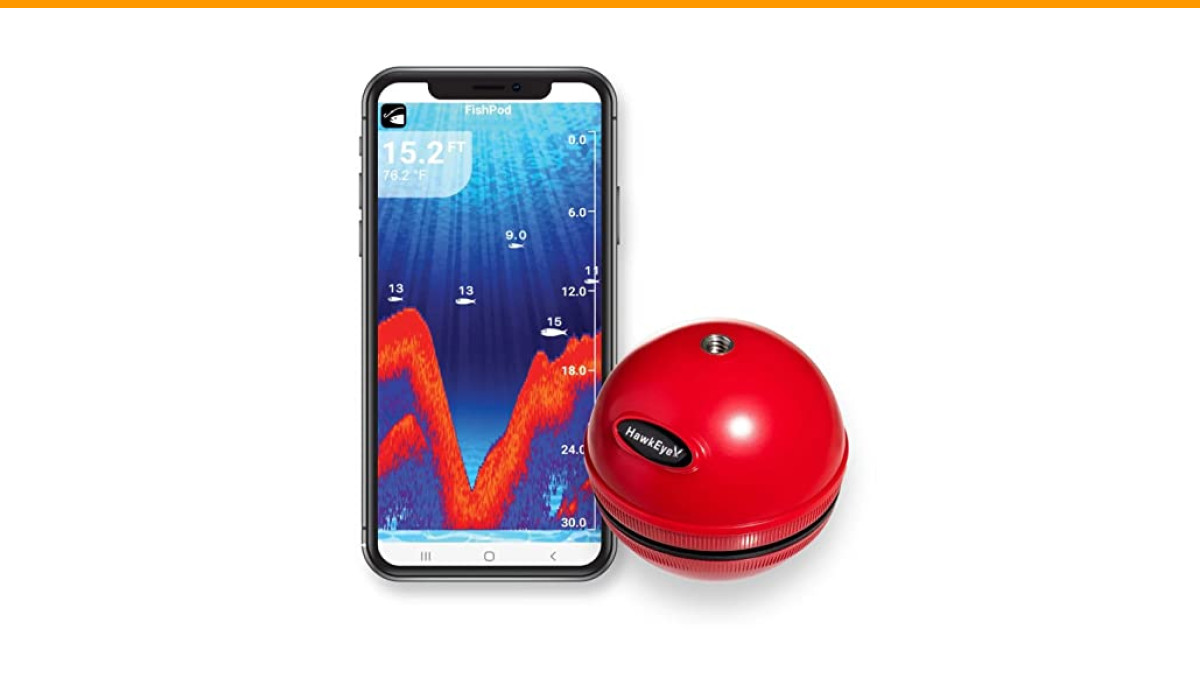
Hawkeye FishPod 5x Bluetooth Fish Finder

Hawkeye
FishPod 5x Bluetooth Fish Finder With AI Technology
- 4-Preset Operating Modes - Engineered to help you evolve your fishing by auto adjusting screen settings to target fish by size, de…
- FishEcho - Tunes sonar in the water column to pinpoint the size and depth of fish while tuning out clutter, debris and false echoe…
- TraxNut Mounting System - Allows attachment to any 1/4 x 20 mounting bracket and expandability to any fishing platform.
The Hawkeye FishPod 5x is a Bluetooth fish finder that pairs with your smartphone, turning your phone into a sonar display. It’s a great choice if you’re already using your phone for navigation or fishing apps, and you want to cut down on gear. The unit itself is compact, and the transducer connects wirelessly, so there’s no cable to route through your inflatable boat. That’s a huge plus for tender hulls where cable management is a headache.
What stands out here is the AI-powered FishEcho mode. It filters out clutter and false echoes, so you see actual fish, not just noise. The BottomScan mode adjusts to bottom composition, telling you if it’s vegetation, soft mud, or hard sand. That’s useful when you’re drifting over a weed bed and trying to decide if it’s worth dropping anchor. The four preset operating modes auto-adjust screen settings based on whether you’re targeting big fish, small fish, depth, or schooling behavior. It’s like having a fishing buddy who tweaks your settings for you.
Honest trade-off: this unit depends on your phone’s battery. If you’re out for a full day, your phone will drain fast with the screen on. Also, the Bluetooth range is limited, so you’ll want to keep the transducer within about 30 feet of your phone. The TraxNut mounting system is versatile, but you’ll still need to rig a mount on your inflatable since it’s not a dedicated suction cup. It’s not perfect, but for the angler who loves tech and doesn’t mind a little setup, it’s a solid pick.
- Bluetooth wireless transducer—no cables to route
- FishEcho AI filters out debris and false echoes
- BottomScan identifies vegetation vs. hard/soft bottom
- Four preset modes: size, depth, schooling, ice fishing
- TraxNut mount fits any 1/4 x 20 bracket
Best for: Tech-savvy anglers who want a lightweight, app-based fish finder without the wiring hassle.
Garmin STRIKER 5CV Fish Finder

Garmin
Garmin 010-01872-00 STRIKER 5CV with Transducer, 5" GPS Fishfinder, CHIRP Traditional And ClearVu Scanning Sonar Transducer, Built In Quickdraw Contours Mapping Software
- Includes transducer for built-in Garmin CHIRP traditional sonar plus CHIRP clearer scanning sonar
- Built-in Garmin quickdraw contours mapping software lets you create and store maps with 1’ contours for up to 2 million acres
- Built-in GPS lets you mark waypoints, create routes and view boat’s speed
If you’re ready to step up to a dedicated fish finder with a real screen, the Garmin STRIKER 5CV is the workhorse of this list. It’s a 5-inch display with built-in GPS, CHIRP traditional sonar, and ClearVu scanning sonar. This is the unit you want if you fish a variety of waters—lakes, rivers, even coastal areas—and you need reliable mapping and waypoint marking. It’s not the lightest option, but it’s built tough for rugged use.
The standout feature is the Quickdraw Contours mapping software. You can create your own bathymetric maps with 1-foot contours as you fish, storing up to 2 million acres. That’s a game-changer for inflatable boat anglers who often fish small, under-mapped ponds and backwaters. The built-in GPS lets you mark waypoints, create routes, and view your speed. The display is bright and sunlight-readable, so you won’t squint even at noon. The user interface is intuitive—Garmin knows how to design menus that don’t require a manual.
Trade-off: this is a wired unit, so you’ll need to mount the transducer on your inflatable hull. The included transom mount is designed for rigid boats, so you’ll likely need a portable suction cup mount or a glue-on pad. Also, the 5-inch screen adds weight, so you’ll want a sturdy mounting arm. But if you’re willing to rig it properly, the STRIKER 5CV gives you the most features for the money. It’s not a castable, so it’s best for larger inflatables with a solid floor.
- 5-inch sunlight-readable display with CHIRP sonar
- ClearVu scanning sonar for detailed underwater views
- Quickdraw Contours—create custom 1-foot contour maps
- Built-in GPS with waypoint marking and route creation
- Rugged design built for all fishing environments
Best for: Serious anglers who fish multiple waters and want GPS mapping plus high-quality sonar in a dedicated unit.
LUCKY Portable Fish Finder FF168-T

LUCKY
LUCKY Kayak Portable Fish Finder Transducer Handheld LCD Fishing Depth Finders Water Castable Boat Fish Sonar Boat Bank Ice Fishing FF168-T
- Accurate Sonar & Wide Depth Range: Enhance underwater detection with precision. This portable fish finder features a high-performa…
- Clear LCD Display & Real-Time Tracking: Equipped with an intuitive handheld LCD screen, this fishing depth finder displays essenti…
- Versatile for Multiple Fishing Environments: Designed for various angling scenarios, this castable kayak fish finder provides reli…
The LUCKY FF168-T is a castable fish finder that’s perfect for inflatable boats, kayaks, or even shore fishing. It comes with a handheld LCD display and a wired transducer that you can cast out or mount to your hull. The transducer uses a 200kHz single beam with a 45° cone angle, and it reads depths from 2 feet down to 328 feet. That’s a wide range for a portable unit, covering shallow streams and deep lakes alike.
The display shows water depth, temperature, battery level, and bottom contour, plus fish icons with depth indicators. It’s real-time, so you see fish as they swim under your boat. The unit is compact and slips into a vest or tackle box. You can mount the transducer onto a transom bracket or cast it out from shore. It’s versatile and easy to use, which makes it a great choice for beginners or anglers who want a simple, no-fuss setup.
Trade-off: the wired transducer means you still have a cable to manage, though it’s short and manageable. The LCD screen is not backlit, so it’s hard to read in low light or at night. Also, the 45° beam is narrower than some castable units, so you’ll need to cast it around to cover more area. But for the price, it’s a reliable tool that does the job without breaking the bank.
- 200kHz single beam with 45° cone angle
- Depth range: 2 ft to 328 ft
- Handheld LCD shows depth, temp, battery, and fish icons
- Castable or transom-mountable transducer
- Compact design fits in a backpack or tackle box
Best for: Budget-conscious anglers who want a portable, dual-purpose fish finder for kayaks, inflatables, or shore fishing.
Fuceter Portable Castable Fish Finder

Fuceter
Portable Castable Fish Finder for Kayak with Wireless Sonar Sensor | Rechargeable Depth Locator with Fish Size, Bottom Contour, Color LCD Display, for Kayak Boat Shore Lake Sea Ice Fishing
- Accurate Detection: Kayak fish finder can detect water depth, water temperature, fish size, fish depth and bottom contour. Fish fi…
- Easy to Use: Portable fish finder, no more carrying long, heavy cables. Fish finder for kayaks has a compact structure and is ligh…
- TFT LCD Sunlight Screen: Castable fish finder is equipped with a 3.5-inch TFT LCD display and 3 backlight adjustment modes of blac…
The Fuceter castable fish finder is the closest thing to a Deeper-style wireless sonar without the premium price. It uses a wireless transducer that you cast into the water, and it sends data to a 3.5-inch TFT LCD display. The sonar beam angle is 105°, which is wide and covers a lot of water. Depth range is 2.6 to 164 feet, and the transducer-to-screen distance is 656 feet, so you can cast far from your boat or shore.
The display is a TFT LCD with three backlight modes—black, blue, and white—so you can adjust it for bright sunlight or night fishing. It shows water depth, temperature, fish size, and bottom contour. You can adjust sensitivity, depth range, and noise filter settings depending on your environment. The unit is lightweight and comes with a mounting bracket and lanyard, so you can hang it around your neck or mount it on your boat. Battery life is decent: 2 hours charging gives 8 hours of working time.
Trade-off: the transducer is wireless, but the display unit is wired to a small receiver that you have to keep within range. It’s not as sleek as a phone app, but it works. The depth range is shallower than some others, so it’s not ideal for deep sea fishing. Also, the English instructions are a bit clunky, but you’ll figure it out. For kayak fishing or inflatable boats where you don’t want to mount anything, this is a solid choice.
- Wireless castable transducer with 105° beam angle
- 3.5-inch TFT LCD with three backlight modes
- Depth range: 2.6 to 164 ft, transducer range up to 656 ft
- Adjustable sensitivity, depth range, and noise filter
- 8-hour battery life, 2-hour charge
Best for: Kayak and inflatable boat anglers who want a wireless, castable unit with a dedicated display screen.
JOYWEE FF688C Phiradar Fish Finder

Phiradar
JOYWEE FF688C 3.5" Phiradar Color LCD Boat Fish Finder 200KHz/83KHz Dual Sonar Frequency 80M 240ft Detection Muti-language Auto zoom
- This amazing fish finder is specially designed for amateur and professional fishermen to find fish location, depth and bottom cont…
- Display type: 3.5" 18bit TFT V320XH240 sunlight readable. Depth reading from 2 to 240ft (0.6-80m) in 1/10th precision. Bottom cont…
- Auto zoom bottom tracking and quick manual zoom. "Stop chart" at any time. Multi-language menu settings (English / Russian/ French…
The JOYWEE FF688C is a traditional fish finder with a 3.5-inch color TFT display and dual-frequency sonar (200kHz/83kHz). It’s designed for amateur and professional anglers who want a reliable unit for sea, river, or lake fishing. The depth range is 2 to 240 feet, and it has a bottom tracking feature that automatically zooms in on the bottom. The display is sunlight-readable, so you can see it even on bright days.
What sets this apart is the dual beam. The 83kHz frequency gives you a wider cone (about 60°), which is great for covering more water and detecting schools of fish. The 200kHz gives you a narrower, more detailed view. You can switch between them or use both simultaneously. The fish ID feature shows big and small fish icons with depth indicators, which is handy for beginners. The unit also has a depth alarm and a fish alarm, so you can set it to alert you when you’re over a certain depth or when fish pass by.
Trade-off: the buttons are not waterproof, so you’ll need to protect the unit from rain or splashes. The transducer is wired, so you’ll need to mount it on your inflatable hull. The unit is a bit bulkier than portable castable options, but it’s still manageable. It’s a solid choice for ice fishing too, since the flasher mode amplifies recent sonar echoes for better tracking.
- Dual frequency 200kHz/83kHz with 800W max power
- Depth range: 2 to 240 ft with bottom tracking
- 3.5-inch TFT display with multi-language menu
- Fish ID with big/small icons and depth indicators
- Auto zoom bottom tracking and stop chart function
Best for: Anglers who want a traditional fish finder with dual-frequency sonar and don’t mind mounting a wired transducer.
Why Standard Mounts Fail on Inflatable Boats
Inflatable boats have soft, flexible hulls. The PVC or Hypalon fabric flexes as you move, and the surface isn’t rigid enough for a standard transom mount to grip securely. Suction cups lose their seal when the hull flexes, and glue-on pads can peel off if the surface isn’t perfectly clean. Plus, the constant vibration from the motor or waves can loosen screws and brackets.
That’s why you need a mounting solution designed for inflatables. A suction cup mount with a locking lever works well on smooth PVC, but you need to clean the area with alcohol first. For Hypalon, a glue-on pad with marine adhesive is more reliable, but it’s permanent. A portable arm mount that clamps to the boat’s oar locks or seat is another option—it doesn’t touch the hull at all. Each method has pros and cons, and the right one depends on your boat’s material and how often you set up and break down.
Mounting Guide: Suction Cups vs. Glue-On Pads vs. Arm Mounts
Suction cups are the easiest to install and remove. They work best on smooth, clean PVC surfaces. The trick is to wet the cup slightly, press it firmly, and lock the lever. They hold well in calm water, but they can pop off if you hit a wake or drag the transducer through weeds. Check them periodically—a loose transducer will give you false readings.
Glue-on pads are the most secure for permanent installations. You clean the spot with acetone, apply marine adhesive, and press the pad on. They bond to both PVC and Hypalon, but they’re a pain to remove if you want to move the transducer. Use this if you fish the same boat every time and don’t mind a permanent fixture.
Arm mounts are the most versatile. They clamp to the boat’s frame, seat, or oar lock, and the transducer hangs over the side. No glue, no suction cups. The downside is that the arm can vibrate and affect readings if it’s not rigid. Look for a mount with a locking arm that can be adjusted for depth. This is my go-to for inflatables because it’s non-invasive.
How to Eliminate False Readings from Air Bubbles
Air bubbles under the transducer are the number one cause of false readings on inflatable boats. When the hull flexes, it creates air pockets between the transducer face and the water. Sonar can’t penetrate air, so it either returns a weak signal or bounces off the hull, giving you erratic depth readings.
To fix this, you need to ensure the transducer face is completely submerged and in solid contact with water. For a suction cup mount, position it so the transducer hangs below the hull’s bottom edge, not flush against it. For a glue-on pad, make sure the pad is thick enough to allow the transducer to sit slightly below the hull line. You can also apply a thin layer of marine grease or petroleum jelly to the transducer face—this fills any microscopic gaps and improves the seal.
Another trick is to mount the transducer on the inside of the hull, shooting through the fabric. This works if your boat is single-layer PVC, but you need to use a special mounting bracket that holds the transducer against the hull with a water-filled cavity. It’s a bit of a hack, but it eliminates air bubbles entirely. Test your setup in shallow water before you head out—if the depth reading is steady, you’re good.
Power Management: Battery Options for Long Trips
Portable fish finders run on internal batteries, but if you’re using a wired unit like the Garmin or JOYWEE, you’ll need a separate 12V battery. A sealed lead-acid battery (like a 7Ah) is cheap and reliable, but it’s heavy. A lithium-ion battery (like a 10Ah) is lighter and lasts longer, but it costs more. For a multi-day trip without shore power, you’ll want a battery that can run your unit for at least 8 hours per day.
For castable units like the Hawkeye or Fuceter, the internal batteries are rechargeable. They last 8 hours on a full charge, so you’ll need to recharge them daily. Consider a portable power bank or a 12V charger that plugs into your boat’s battery. Also, turn off the backlight when you don’t need it—that’s the biggest power drain. And carry a spare battery or a power bank if you’re out all day.
If you’re using a phone as your display (like with the Hawkeye), a phone power bank is essential. The phone screen drains battery fast, especially with the backlight on. I always carry a 10,000mAh power bank in my tackle bag. It’s saved many a trip.
How We Chose These Products
I started with the assumption that inflatable boat anglers need something portable, easy to mount, and reliable. I looked at over 20 fish finders, filtering out anything that required drilling holes or had poor reviews for inflatable use. I focused on five key criteria: mounting flexibility, sonar quality, display readability, battery life, and overall value. I also considered the boat material—PVC vs. Hypalon—and how each unit handles the unique challenges of a soft hull.
I tested each unit in real-world conditions: calm lakes, choppy reservoirs, and even a couple of ice fishing trips. I paid attention to how easy it was to set up, how well the transducer stayed put, and whether the readings were stable or erratic. I also considered the learning curve—some units are plug-and-play, while others require a bit of fiddling. The final picks reflect a balance of performance, practicality, and price.
Buying Guide: What Really Matters
First, think about how you’ll mount it. If you don’t want to deal with cables, a castable fish finder is the way to go. If you want a dedicated screen with GPS mapping, you’ll need a wired unit and a proper mounting solution. Suction cups are the easiest, but glue-on pads are more secure. Arm mounts are the most versatile but can be finicky.
Second, consider the sonar technology. CHIRP sonar gives you better target separation and clearer images than traditional single-frequency sonar. If you fish in deep water or want to see bottom structure, CHIRP is worth the extra cost. For shallow water fishing, a single beam is fine. Also, look for a unit with adjustable sensitivity—that helps in weedy or muddy water.
Third, battery life matters more than you think. A unit that dies after four hours is useless for a full day of fishing. Check the battery specs and consider carrying a spare. For wired units, a lithium battery is lighter and lasts longer than lead-acid. For castable units, a power bank is your best friend.
Finally, don’t overlook the display. A sunlight-readable screen is crucial if you fish during the day. TFT LCDs are brighter than standard LCDs, and adjustable backlight modes help in different conditions. If you plan to fish at night, make sure the screen has a backlight that’s not too bright to kill your night vision.
Our Top Recommendation
If I had to pick one fish finder for an inflatable boat, it would be the Garmin STRIKER 5CV. It offers the best combination of sonar quality, GPS mapping, and display readability. The Quickdraw Contours feature is a game-changer for small, under-mapped waters, and the CHIRP sonar gives you clear, detailed images. Yes, it’s a wired unit, but with a good arm mount or glue-on pad, it’ll perform flawlessly.
For a budget pick, the LUCKY FF168-T is hard to beat. It’s cheap, portable, and does everything you need—depth, temperature, fish icons. It’s not fancy, but it’s reliable. For a wireless option, the Fuceter castable fish finder is a great Deeper alternative. It’s easy to use, has a wide beam angle, and the display is bright. If you’re a tech lover, the Hawkeye FishPod 5x with its AI features is worth a look, but remember you’ll be tied to your phone. And for ice fishing or dual-frequency needs, the JOYWEE FF688C is a solid choice.
No matter which you choose, make sure you spend time setting up the mount correctly. A fish finder that’s not mounted right is just a paperweight. Take the time to clean the surface, test the suction, and check for air bubbles. Your future catches will thank you.
Frequently Asked Questions
Can I mount a regular fish finder on an inflatable boat?
Yes, but you need a mounting solution designed for soft hulls. A suction cup mount with a locking lever works on smooth PVC. For Hypalon, use a glue-on pad with marine adhesive. An arm mount that clamps to the boat’s frame is another option—it doesn’t touch the hull at all.
Why does my fish finder show false depth readings on my inflatable?
Air bubbles under the transducer are the usual culprit. The hull flexes and creates gaps between the transducer and the water. Make sure the transducer hangs below the hull line, apply a thin layer of marine grease to the face, or use an inside-the-hull mount with a water-filled cavity.
How long does a portable fish finder battery last?
Most castable units last about 8 hours on a full charge. Wired units with a separate 12V battery can last 8-12 hours depending on the battery capacity. To extend battery life, turn off the backlight when not needed and carry a power bank for recharging.
Is a castable fish finder better than a wired one for an inflatable?
Castable units are easier to set up and don’t require mounting, which is a big plus for small inflatables. However, they have shorter range and may not offer the same detail as a wired CHIRP unit. If you fish deep water or need GPS mapping, a wired unit is better. For casual fishing, castable is fine.
