
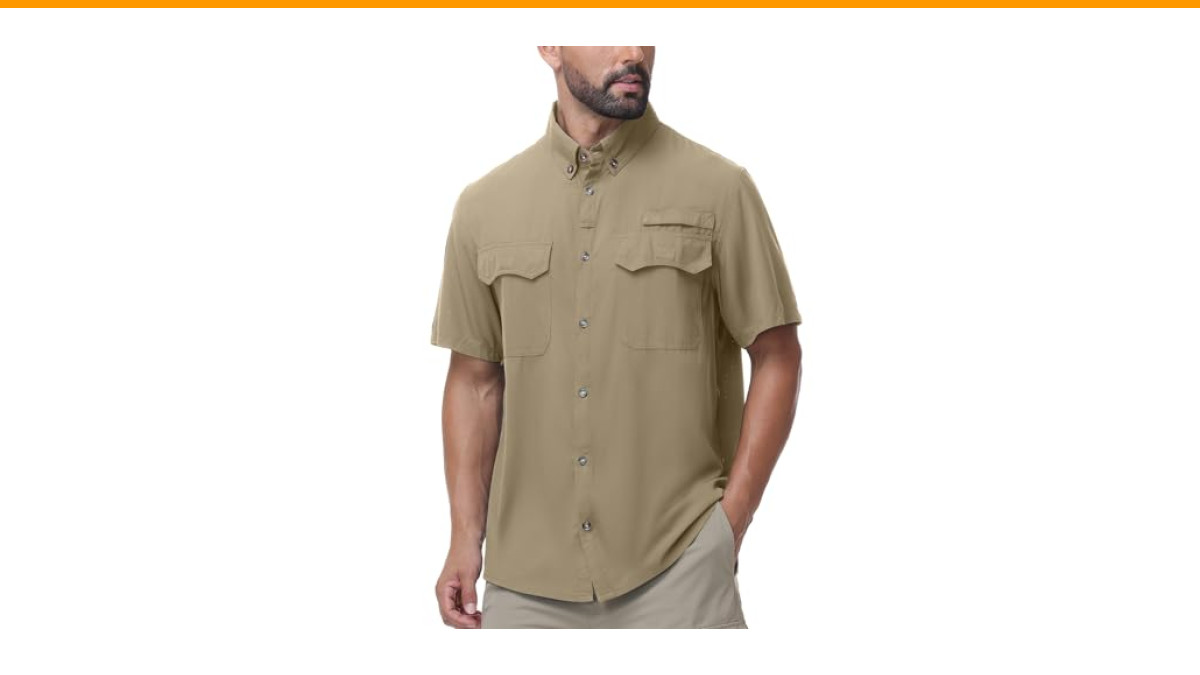
The Anatomy of a Fishing Shirt Loop: Location and Design
You’re fighting a 20-inch bass, rod bent double, and you need to grab the net. But the net is on the ground, and your rod hand is busy. That’s when the little loop on your chest becomes the most important piece of fabric you own.
Those loops aren’t just decorative. They’re a deliberate piece of gear designed by people who understand what happens on the water. Most fishing shirts place them on the left or right chest, just below the collarbone. That spot keeps tools within reach of your non-dominant hand, so your rod hand never leaves the grip.
The design is simple: a strip of hook-and-loop (Velcro) sewn flat against the chest, often with a small gap at the bottom. You slide a tool handle through that gap, then press the loop down. The tool hangs vertical, stays put, and doesn’t swing wildly when you lean over the gunwale.
Some shirts, like the Roadbox Men’s Fishing Shirt, add multiple loops and hook-and-loop chest pockets. That gives you options for where to place your gear based on the task. The Roadbox shirt also includes a built-in glasses cleaning cloth at the inner hem, which is a nice touch for salt spray and foggy lenses.
The Primary Function: Rod and Tippet Security
The main job of a chest loop is to hold your rod when you need both hands. Think about netting a fish: you slide the rod handle into the loop, let the rod hang against your body, and grab the net. The rod stays upright, the line stays tight, and the fish stays hooked.
For fly anglers, the loop is a tippet holder. You can slip a spool of tippet through the loop and pull line as needed. No more digging through a vest pocket mid-fight. The loop keeps the spool at chest height, right where your line hand naturally works.
Saltwater anglers use the loop to secure a rod while changing lures or retying. The rod hangs safely, and you have both hands free to tie a knot. It’s a simple system, but it prevents a lot of dropped rods and broken tips.
Why the Chest Placement Matters for Casting
Placement isn’t random. The loop sits high on the chest so it doesn’t interfere with your casting arm’s swing. If the loop were lower, near the waist, a hanging rod would bump your forearm on every cast. High placement keeps the rod clear of your elbow and wrist.
Left-side loops favor right-handed casters who hold the rod in their right hand. The left hand reaches across to grab the rod when needed. Right-side loops do the opposite. Some shirts, like the Roadbox, offer loops on both sides, which is rare and genuinely useful for switching hands during a long day.
Beyond Rods: Forceps, Clippers, and Sunglasses
The loop isn’t just for rods. It’s a universal attachment point for any tool with a clip or a lanyard. Forceps, hemostats, line clippers, and hook removers all hang nicely. You slide the clip through the loop, and the tool dangles at chest level, ready for use.
Sunglasses are another common item. If you’re not wearing them, slip the earpiece through the loop and let them hang. They stay secure, and you don’t have to stuff them in a pocket where they might scratch.
Some anglers use the loop for a sunglass retainer or a lanyard attached to a small flashlight. The loop is essentially a mini gear rail. It’s not designed for heavy loads, but for lightweight tools it works perfectly.
Weight Limits and Fabric Stress: What Can You Hang?
Here’s where you need to be honest about physics. A typical fishing shirt loop is made of the same nylon webbing as the rest of the shirt. It’s sewn with a few stitches, not a reinforced bar tack. That means it can handle maybe 1 to 2 pounds of static weight before the stitching starts to pull.
A rod that weighs 6 ounces is fine. A pair of forceps is fine. A heavy pair of pliers that weighs 1.5 pounds? You’re pushing it. The loop will hold for a few minutes, but if you lean over the side of a boat, the weight shifts and the stitches can pop.
Ripstop nylon, which is common in fishing shirts, resists tearing better than plain weave. But the loop itself is usually a separate piece of webbing sewn onto the fabric. The weak point is the thread, not the fabric. So keep heavy tools in a pocket or on a belt, and use the loop for light gear only.
One caveat: saltwater corrodes snaps and clips. If you hang a metal tool from a loop, the constant rubbing can wear the loop’s stitching over time. Check the loop regularly for loose threads.
The Velcro vs. Magnet Debate: Which is Safer?
Magnetic closures are popular on some newer shirts. They’re easy to use and quiet. But they have a serious flaw: they release under sudden force. If your rod snags on a branch, the magnet lets go instantly. The rod falls, and you’re left reaching for it.
Velcro, on the other hand, holds until you deliberately pull it apart. It’s not as convenient as a magnet, but it’s more secure. For a rod that costs hundreds of dollars, that security matters.
The trade-off is noise. Velcro rips loudly when you open it, which can spook fish in quiet water. But most anglers accept that because the security is worth it. If you’re wading for spooky trout, you can pre-open the loop and just slide the rod in without making noise.
Maintenance: Keeping the Loop Grip Strong in Saltwater
Saltwater is brutal on hook-and-loop. The salt crystals get into the tiny hooks, and the grip weakens. Plus, the constant moisture can cause the backing to peel.
To keep the loop working, rinse your shirt in fresh water after every saltwater trip. Just a quick rinse in the sink or a bucket. Then let it air dry. That removes the salt before it can clog the hooks.
You should also clean the loop itself occasionally. Use a toothbrush and a little mild soap to scrub out any lint or debris. Lint is the enemy of Velcro. A pocket full of lint will make the loop useless within a few weeks.
If the loop loses its grip entirely, you can replace it. Most shirts have a simple loop sewn on, and a tailor can swap it out for under $10. But that’s rare if you maintain it properly.
Kayak and Wade Fishing: Hands-Free Solutions
Kayak anglers have a unique problem: both hands are often busy with a paddle. The chest loop becomes a third hand. You can clip a net lanyard to the loop, so the net hangs within reach but doesn’t drag in the water.
Wade fishing presents a similar challenge. You’re holding a rod and a wading staff, and you need to unhook a fish. The loop lets you hang the rod while you use both hands to handle the fish. It’s not perfect, but it works.
For float tube anglers, the loop is a place to secure a fish gripper. When you land a fish, you can clip the gripper to the loop and keep it ready for the next one. No more fumbling in a vest pocket while your feet are kicking.
Frequently Asked Questions
Can I attach a phone to the loop?
Technically, yes, but it’s risky. Most phones weigh around 6 to 7 ounces, which is within the loop’s weight limit. But the phone is bulky, and it will swing around as you move. If you’re leaning over the water, the phone could slip out and into the drink. Better to use a waterproof pouch on a lanyard, and even then, keep it in a pocket.
Do all brands (Columbia, Huk, Magellan) use the same loop size?
No. Loop sizes vary widely. Columbia’s PFG shirts often have a single loop that’s about 1 inch wide. Huk uses a similar size but sometimes adds a second loop. Magellan tends to have narrower loops, around 3/4 inch. The Roadbox shirt offers multiple loops, which gives you more options. If you’re planning to hang a specific tool, check the loop width before you buy.
Conclusion: The Loop as a Lifesaver, Not Just a Convenience
You might think a loop is a minor detail. But when you’re fighting a fish and need both hands, that little strip of fabric can save your rod, your catch, and your day. It’s a safety mechanism that costs nothing but adds real value.
Here are the key things to remember:
- Use the loop for rods, forceps, clippers, and sunglasses — but keep heavy tools in a pocket.
- Placement matters: left-side loops suit right-handed anglers, and vice versa.
- Velcro is more secure than magnets for heavy or sudden loads.
- Rinse your shirt after saltwater trips to keep the hook-and-loop grip strong.
- Check the stitching regularly for wear, especially if you hang tools frequently.
- For kayak or float tube fishing, use the loop to secure a net lanyard or fish gripper.
- Not all loops are equal — check the width and number of loops before you buy.
The next time you’re shopping for a fishing shirt, look past the fabric and the sun protection. Check the loops. They might just be the most useful part of the whole shirt.
