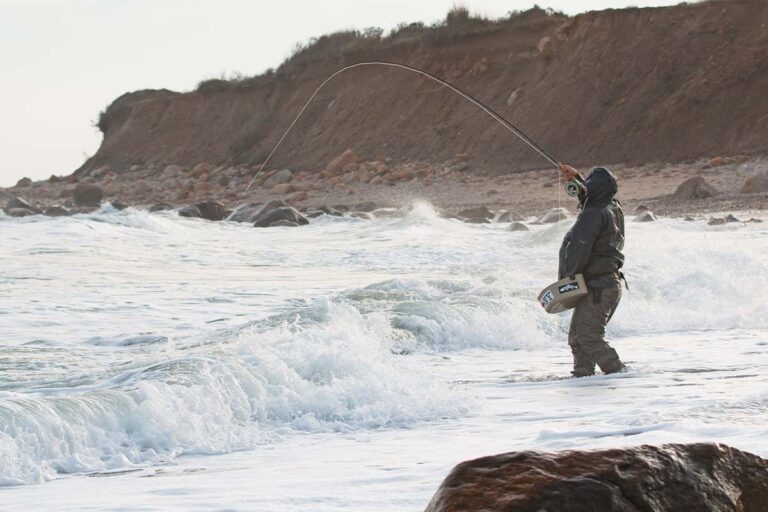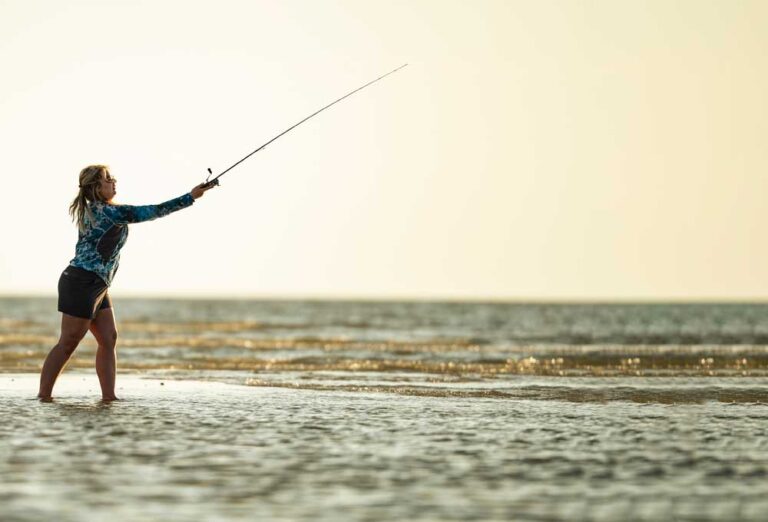
You’ve stood in the wash for three hours, casting into the same gray water, and your cooler is still empty. The guy twenty yards down the beach, though, he’s landed two stripers and a fluke. The difference isn’t luck. He’s reading the water, and you’re just fishing it.
Most surf anglers treat the ocean like a flat, featureless plane. It isn’t. The bottom is a constantly shifting landscape of holes, humps, and channels, and the fish position themselves around those features with remarkable consistency. Once you learn to see what the surface tells you about the bottom, you stop guessing and start targeting.

VEVOR
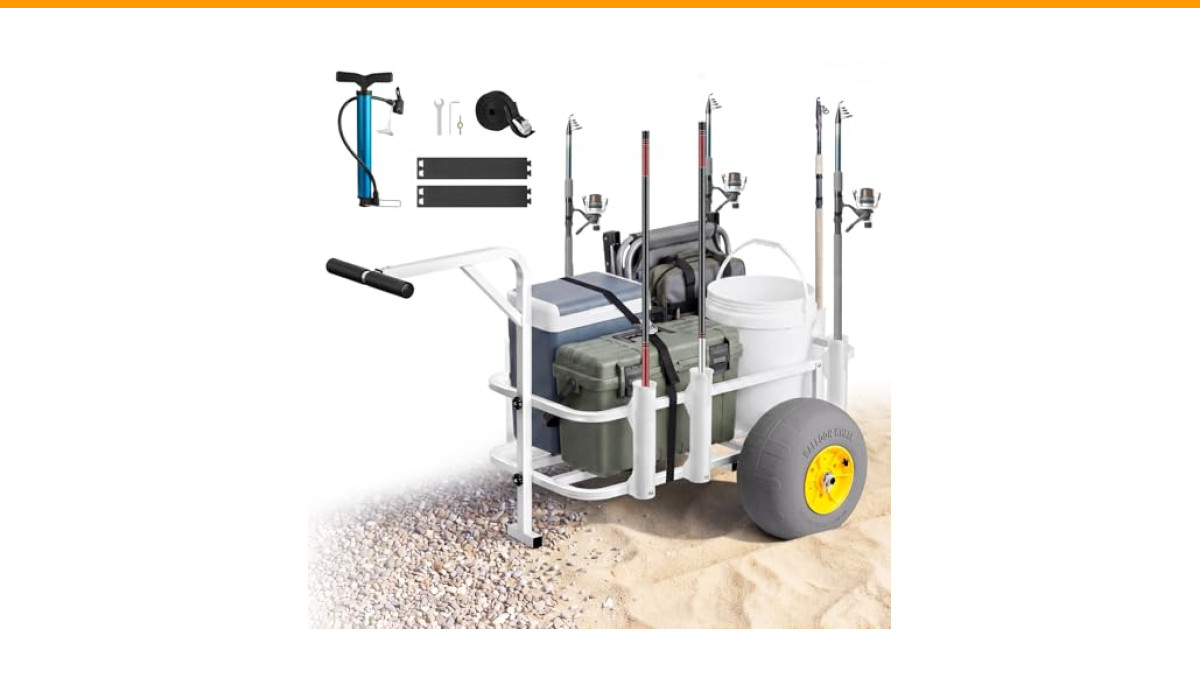
VEVOR Beach Fishing Cart, 200 lbs Load Capacity, Foldable Fishing Cart with Heavy-Duty Carbon Steel Frame, 13-Inch All-Terrain PU Balloon Tires, 7 Rod Holders, for Outdoor Activities Camping Picnic
- Durable Construction: Built to handle tough outdoor conditions, this beach fishing cart features a carbon steel frame with anti-lo…
- All-Terrain PU Wheels: Equipped with wear-resistant, shock-absorbing PU inflatable beach tires, this fishing cart rolls smoothly w…
- Load with Confidence: This fishing wagon supports up to 200 lbs and is paired with dedicated fishing rod holders, allowing you to…
This guide covers the specific visual cues that reveal structure, how to match your cast to the water in front of you, and the common mistakes that keep anglers from connecting. You’ll walk away with a system for breaking down any beach, not just a few tips.
Getting to the right spot matters, but so does getting there without wearing yourself out. A VEVOR Beach Fishing Cart with 13-inch all-terrain tires and a 200-pound capacity makes the difference between scouting a mile of beach and settling for the first open patch of sand. It holds seven rods upright and rolls over soft sand that stops standard wagons, so you can cover more ground and actually fish the spots you identify.
The Lie of the Flat Water: What the Surface Actually Tells You
Flat water is not blank water. The ocean’s surface carries a signature of what sits below, but you have to look at it the right way. Stand still for a minute. Don’t cast. Just watch.
Look for three things: color changes, wave behavior, and foam lines.
Darker water usually means deeper water or a hole. Lighter, sand-colored water means a shallow sandbar. When you see a patch of dark green or blue water sitting between two lighter, breaking waves, you are looking at a gutter—a deeper channel that runs parallel to the beach or cuts through a bar. Fish use these gutters like highways. Bait gets funneled through them, and predators wait at the ends.
Wave behavior is trickier but more reliable. A wave that stands up taller and breaks with a hard crash indicates a sandbar beneath it. A wave that rolls through without breaking, or breaks weakly, indicates deeper water. Watch a set of waves roll in. The sections that stay green and unbroken mark the deeper cuts. Those cuts are your targets.
Foam lines deserve more respect than they get. After a wave breaks, the foam doesn’t just dissipate. It drifts and collects along current seams—the boundaries where two different water masses meet. These seams concentrate bait and debris. Where you see a persistent foam line running parallel to the beach or angling out to sea, you are looking at a current edge. Cast across it, not into it, and let your bait drift through the strike zone.
The Gutter Myth: Why Deeper Isn’t Always Better
Most anglers assume the deepest hole on the beach holds the most fish. That’s wrong more often than not.
Extremely deep guts—the kind that look like a dark trench right off the beach—often hold big fish, but they also hold them in a negative, sluggish mood. The water there is calm, but it can be too calm. Baitfish don’t linger in the deepest part of a gutter. They move through it, and the predators follow the bait, not the depth.
The real sweet spot is the transition zone: the slope where the gutter shallows up onto the adjacent sandbar. Fish will sit on the deeper edge of that slope, looking up into the shallower water where crabs, sand fleas, and small baitfish get tumbled by the waves. Casting into the middle of the deep hole puts your bait behind the fish. Casting just onto the slope, where the water starts to lighten, puts it right in front of them.
Here’s a practical test. When you find a gutter, don’t cast into the darkest water. Cast to the edge where the dark water meets the lighter water. If you don’t get a hit in twenty minutes, move your cast ten yards down the beach and try again. The fish are rarely in the exact center of the hole. They’re at the edges, usually the down-current edge.
Reading the Turn: How to Find the Rips That Move Bait
Rips are the most misunderstood feature in surf fishing. A rip current looks like a danger to swimmers, but to a fish, it’s a conveyor belt of food.
A rip forms when water piled up on a sandbar finds a weakness and flows back out to sea. That outflow carries sand, dislodged crabs, and disoriented baitfish with it. Predators sit right at the mouth of the rip, or just outside the breakers, picking off whatever comes through.
How do you spot a rip? Look for a section of water that looks choppy, confused, or slightly discolored compared to the water around it. Often, a rip will have a distinct line of foam or seaweed moving steadily seaward. The surface might look like it’s boiling gently. That’s the tell.
You do not cast into the rip itself. The current will drag your sinker out and tangle your line. Instead, cast to the edge of the rip, where the outflow meets the calmer water. Let your bait sit there. The fish are holding in that calm water, watching the rip for food. Your bait, sitting just outside the flow, looks like a baitfish that escaped the current. That’s an easy meal.
One more thing about rips: they move. A rip that’s working at high tide might be dry sand at low tide. Re-check the beach every hour, especially if the tide is moving hard. The structure you fished successfully this morning may be gone by noon.
Timing the Water: When Structure Matters Most
Reading the beach is only half the equation. The same gutter that holds fish at dead low tide can be a barren wasteland two hours later. Tidal stage changes the water depth, which changes the current speed, which changes where fish position themselves.
The two most productive windows are the last two hours of the incoming tide and the first two hours of the outgoing tide. During these windows, water is moving, and moving water triggers feeding. Fish don’t have a schedule; they respond to current. When the water slows to slack tide, they often stop feeding entirely, regardless of what the structure looks like.
Match your reading to the tide. At low tide, you can see the sandbars and gutters clearly—the water is shallow, and the color differences are stark. Mark these features in your memory or take a photo from a dune. At high tide, those same features are buried under several feet of water, and the surface clues are subtler. You’re not looking for the same thing. At high tide, you’re looking for the edges of the structure you identified at low tide.
Here’s a comparison of how to approach different tidal stages:
| Tidal Stage | What You See | Where Fish Hold | Best Cast Target |
|---|---|---|---|
| Low tide (1-2 hrs after) | Exposed bars, visible guts, dark water channels | Deepest remaining water, often the outside edge of the bar | Just past the breaking waves, into the dark channel |
| Incoming (mid-tide) | Bars start to flood, water color becomes murkier | Moving up onto the bar, following bait that’s feeding on flooded sand | The slope of the bar, where the water is knee-to-waist deep |
| High tide (slack) | Structure is hidden, water looks uniform | Scattered, often holding in the wash or near structure like jetties | Directly into the wash, or along any visible current seam |
| Outgoing (mid-tide) | Water drains off bars, rips become pronounced | At the mouths of rips and the down-current ends of guts | The edge of the rip, or the shallow end of a draining gutter |
Don’t overthink the table. The core idea is simple: fish follow the water. When the water floods, they move in. When it drains, they move out. Your job is to put your bait where they are at that specific moment, not where they were three hours ago.
Common Misconceptions That Cost You Fish
Let’s clear up a few things that get repeated on every fishing forum but don’t hold up in the surf.
Misconception: You need to cast as far as possible. Most surf fish, especially in the summer, are within 50 yards of the beach. The wash—the foamy, turbulent water right at the shoreline—is often full of bait. If you’re launching bombs to the outer bar and ignoring the water at your feet, you’re missing half the action. Start close, work your way out. Only go long if the structure dictates it.
Misconception: A bigger sinker means better hold. A heavy pyramid sinker holds bottom in a strong rip, but it also kills the natural drift of your bait. In a moderate current, a lighter sinker that tumbles along the bottom looks like a crab or a shrimp moving naturally. Fish hit moving bait harder than stationary bait. Use the lightest sinker that stays in place for a slow count of ten. If it drags, go up one size. That’s the sweet spot.
Misconception: You can’t fish a flat, featureless beach. Every beach has structure, even the ones that look like a parking lot. The structure might be subtle—a slight depression, a patch of darker sand, a line of shell fragments—but it’s there. If you can’t find any obvious gutters or rips, look for the slope. Fish the trough right at the waterline where the waves break. That trough is a constant feature, and it holds fish all day.
Practical Steps for Your Next Session
Here’s a routine that takes five minutes and pays off all day.
- Arrive 30 minutes before you plan to fish. Walk the beach for 10 minutes. Look for color changes and wave breaks. Note two or three potential gutters or rips.
- Pick the most promising spot. Watch it for a full five minutes before you rig up. Watch how the waves break, where the foam lines drift, and whether birds are working the area.
- Start with your cast at the closest edge of the structure. Work your way across it methodically—short cast, medium cast, long cast—before you move to a new spot.
- If you get a hit, note exactly where your line entered the water. Cast to that exact spot again. Don’t drift.
- After 45 minutes without action, move. Don’t camp on a dead spot. The beach is long, and the fish are moving.
One honest caveat: this takes practice. The first few times you try to read the water, you’ll see nothing but waves. That’s normal. After a few sessions, the patterns start to pop out. You’ll see the gutter before you even reach the sand. It becomes automatic.
Frequently Asked Questions
What’s the single best visual cue for finding fish?
The color change between deep and shallow water. That line where dark green meets sandy water is the edge of a drop-off, and that edge is where fish hold. Look for that contrast first, before you worry about rips or foam lines.
How do I read the beach at night?
You can’t see color at night, so you rely on sound and feel. Listen for the difference in wave crash—a hard crash means shallow bar, a soft hiss means deeper water. Also, feel the bottom with your sinker. Cast out and slowly reel in, feeling for the change in bottom texture. Soft sand means the gutter; hard sand or shell means the bar.
Does the moon phase matter for beach reading?
Moon phase changes tidal range, but the reading principles stay the same. During full and new moons, the tides run harder, so rips are stronger and gutters drain more completely. That means fish are more concentrated in the deepest remaining water. During neap tides, the water moves less, and fish spread out more.
Should I fish the gutter or the sandbar?
Fish the edge of the gutter, not the middle. The sandbar itself is usually too shallow and too exposed. The slope between the two is the feeding lane. Cast so your bait lands on the slope, not in the hole and not on the flat.
How long should I fish one spot before moving?
Give it 45 minutes to an hour with no action. If you’ve covered the structure with short, medium, and long casts and haven’t had a bump, the fish aren’t there. Move down the beach and re-read the water. It’s better to cover a mile of beach than to sit on one unproductive hole all day.
What to Do With This Tomorrow
You don’t need a boat or a guide to find surf fish. You need eyes and patience.
- Walk the beach before you fish. Ten minutes of observation saves two hours of blind casting.
- Target color changes. The edge between deep and shallow water is your primary strike zone.
- Cast to the edges of rips, not into them. The fish sit in the calm water, watching the current.
- Match your sinker size to the current. Light enough to drift, heavy enough to hold on a slow count.
- Move after 45 minutes of no action. Don’t marry a spot.
- Re-read the beach every hour. The tide changes the structure faster than you think.
- Use a cart that lets you cover ground. The best spot is often a half-mile down the beach, and carrying 50 pounds of gear keeps you from finding it.
The ocean isn’t a blank canvas. It’s a map written in waves and color, and it changes every day. Learn to read it, and you’ll stop hoping for fish and start knowing where they are.