You just found a great deal on a used bass boat. The hull looks clean, the motor runs, and the price is right. Then you ask the seller how much it weighs, and they shrug. You check the manufacturer spec sheet online, but it only lists a dry weight that doesn’t include the motor, fuel, or trailer. Now you are stuck guessing whether your truck can actually haul it home without straining.
That guess can cost you. Overloaded trailers cause sway at highway speeds, blow tires, and burn out brakes. In some states, you can get a ticket for exceeding your vehicle’s gross vehicle weight rating (GVWR). This guide gives you real numbers for every common fishing boat type, plus a simple formula to calculate your exact package weight. You will leave with a personalized number, not just a chart.
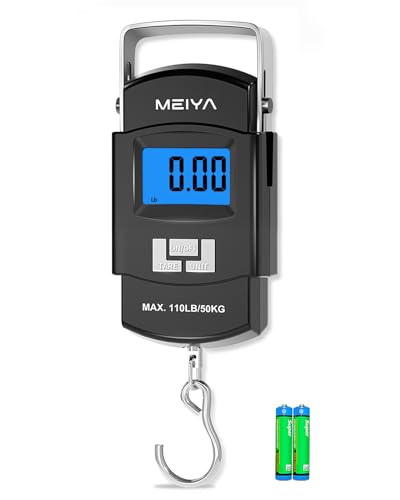
MEIYA
MEIYA Fish Scale 110lb/50kg Digital Fishing Scale with Backlit LCD, Portable Handle, Stainless Steel Hook & 2 AAA Batteries – Reliable Fishing Gear & Great Fishing Gifts for Men
- Accurate & Reliable Performance: Weigh up to 110lb/50kg with confidence. This fishing scale features advanced fish scales digital…
- Compact & Travel-Ready: Lightweight and portable, this fishing accessories item fits easily into tackle boxes, backpacks, or carry…
- Heavy-Duty Hook & Durable Build: Featuring a sturdy stainless steel hook and reinforced frame, this essential fishing gear withsta…
Before we get into the math, a quick tool worth having on the water: the MEIYA Fish Scale 110lb/50kg Digital Fishing Scale. It has a backlit LCD and a stainless steel hook, so you can weigh your catch accurately and then convert that number to your boat’s payload. It is a handy piece of gear for anyone who wants precise numbers, whether you are weighing a bass or a cooler full of ice.
The Short Answer: Average Fishing Boat Weights
Here are the baseline numbers you will see most often. These are dry weights, meaning the boat hull alone with no motor, no fuel, no gear, and no trailer.
- Aluminum jon boat (12-16 ft): 150 to 400 lbs
- Aluminum deep V (16-18 ft): 500 to 900 lbs
- Fiberglass bass boat (17-21 ft): 1,200 to 2,200 lbs
- Center console (18-24 ft): 2,000 to 4,500 lbs
- Pontoon boat (20-24 ft): 1,800 to 3,200 lbs
- Bay boat (18-22 ft): 1,500 to 2,800 lbs
Those ranges are wide because hull material and construction matter a lot. A 16-foot aluminum jon boat is light enough for two people to lift onto a trailer. A 22-foot fiberglass center console will crush a small SUV’s payload capacity before you even add the motor.
Keep in mind that dry weight is almost never the number you actually tow. The motor alone on a 20-foot bass boat adds 400 to 600 lbs. Fuel adds about 6.3 lbs per gallon. Add a trolling motor, two batteries, tackle boxes, rods, and a cooler, and you are looking at 700 to 1,000 lbs on top of the hull weight.
Dry Weight vs. Package Weight vs. Loaded Weight
Manufacturers list dry weight because it is a consistent baseline. It helps you compare hulls from different brands. But it does not tell you what your tow vehicle will feel.
You need to know three separate numbers:
- Dry weight: The bare hull, as it leaves the factory. No motor, no fluids, no batteries, no trailer.
- Package weight: Dry weight plus the outboard motor, fuel tank (full), batteries, and the trailer itself. This is what you tow to the ramp.
- Loaded weight: Package weight plus all your gear: tackle, rods, coolers, anchors, life jackets, and passengers. This is the real-world number that affects your axle ratings and tires.
Most people only check dry weight and assume they are fine. That is a mistake. A typical bass boat package weighs 1.5 to 2 times its dry weight. A pontoon package can be even heavier because the trailer for a pontoon is a heavy beast on its own.
For example, a 20-foot fiberglass bass boat with a dry weight of 1,800 lbs will usually have a package weight around 3,200 lbs. Loaded with gear and a full tank, you are closer to 3,700 lbs. That is a big difference from the 1,800 lb number on the spec sheet.
Weight Breakdown by Boat Type
Let us get specific. Here is what you can expect for each popular fishing boat category, including the motor and trailer weights you need to add.
Aluminum Jon Boats
These are the lightest options you will find. A 14-foot flat-bottom jon boat weighs around 200 lbs. A 16-foot model with a V hull pushes closer to 350 lbs. The outboard is usually a 15 to 25 hp motor, which adds 80 to 120 lbs. A small galvanized trailer weighs about 300 lbs.
Full package weight: roughly 600 to 800 lbs. You can tow this with almost any car or small SUV. The tongue weight is light, usually under 80 lbs, so you will not even feel it behind you.
Bass Boats
Bass boats are where weights start to climb. A modern 18-foot fiberglass bass boat has a dry weight around 1,400 lbs. The 150 hp outboard adds another 450 lbs. Full fuel tank (30 gallons) adds 190 lbs. Add the trailer at 700 lbs, and you are at 2,740 lbs before any gear.
Loaded with two anglers, tackle, and livewell water, you will be near 3,200 lbs. That is why you see so many bass boats towed by half-ton trucks or large SUVs. A midsize crossover is not going to cut it.
Center Consoles
Center consoles are built for offshore or large-lake use, so they are heavier. A 20-foot center console has a dry weight around 2,200 lbs. The 150 hp motor adds 450 lbs. A 60-gallon fuel tank adds 380 lbs. The trailer alone weighs 900 lbs. That puts the package at nearly 4,000 lbs.
Loaded with gear and a second battery, you are at 4,500 lbs or more. You need a tow vehicle with a towing capacity of at least 6,000 lbs to be safe, plus a proper trailer brake controller.
Pontoons
Pontoons are deceptively heavy. The aluminum tubes, crossmembers, and deck add up fast. A 22-foot pontoon has a dry weight around 2,500 lbs. The motor is usually a 90 to 150 hp, adding 400 lbs. Fuel adds another 200 lbs. The trailer for a pontoon is heavier than a standard boat trailer, often weighing 1,000 lbs or more.
Total package weight: around 4,100 lbs. Loaded with furniture, a bimini top, and people, you are pushing 5,000 lbs. Pontoon trailers also have a higher tongue weight because the boat sits flat on the bunks, so check your hitch rating carefully.
The Hidden Weight: Motor, Fuel, and Batteries
Here is where most people get caught off guard. The motor is not part of the dry weight, and it is often heavier than you think.
Outboard motor weights vary widely:
- 9.9 hp: 80 lbs
- 25 hp: 120 lbs
- 50 hp: 250 lbs
- 90 hp: 350 lbs
- 150 hp: 450 lbs
- 250 hp: 600 lbs
Fuel weighs 6.3 lbs per gallon. A 30-gallon tank is 190 lbs. A 60-gallon tank is 380 lbs. That is like carrying two or three extra passengers.
Batteries are another silent weight. A standard marine cranking battery weighs 40 to 50 lbs. A deep-cycle trolling motor battery weighs 60 to 70 lbs. Most bass boats carry two or three of them. That is 150 to 200 lbs of pure lead and acid.
Do not forget the trailer. A single-axle aluminum trailer for a jon boat weighs 300 lbs. A tandem-axle galvanized trailer for a 22-foot center console weighs 1,200 lbs. The trailer is a huge part of your total towing weight, and it is easy to overlook.
How to Weigh Your Exact Boat (Without a Scale)
You do not need a boat scale to get an accurate number. Here is a step-by-step method that works with any tow vehicle.
- Drive your truck to a public scale. Most landfill or recycling centers have them, and some truck stops do too. The fee is usually $10 to $15.
- Weigh the tow vehicle alone, with a full tank of gas and no trailer attached. Write down that number.
- Hook up the boat and trailer, but do not load any gear yet. Weigh the combination again.
- Subtract the first weight from the second. That is your package weight (boat, motor, fuel, batteries, and trailer).
- Now load all your gear, fill the cooler, add your passengers, and weigh again. Subtract the unloaded package weight. That is your gear weight.
This method gives you the exact numbers for your rig. You also get your tongue weight for free. Head to the scale, unhitch the trailer, and put only the trailer jack on the scale platform. The reading is your tongue weight. It should be 10 to 15 percent of your total trailer weight.
If a public scale is not convenient, you can use a load cell or a tongue weight scale. These are affordable and accurate enough for a weekend angler. Just remember that the load cell only measures the tongue, not the whole trailer.
Towing Math: GVWR, Tongue Weight, and Payload
Your tow vehicle has two limits that matter: towing capacity and payload capacity. Towing capacity is the maximum weight of the trailer and boat. Payload capacity is the maximum weight of everything in the truck, including passengers, gear, and tongue weight.
Most people check towing capacity and ignore payload. That is a common mistake. A half-ton truck might have a towing capacity of 9,000 lbs, but its payload capacity is often only 1,500 lbs. If your boat has a tongue weight of 500 lbs, you only have 1,000 lbs left for passengers, gear, and the dog. That goes fast.
Here is the formula to check yourself:
- Find your truck’s GVWR (on the door jamb sticker).
- Weigh your truck loaded with passengers and gear, but without the trailer.
- Subtract that weight from the GVWR. The remainder is your available tongue weight.
- Compare that to your boat’s actual tongue weight (10-15% of total trailer weight).
If your tongue weight exceeds the available payload, you are overloading the truck’s rear axle. That causes poor steering and brake performance. You need to move some gear to the boat, or get a weight-distributing hitch.
Trailer brakes are also tied to weight. Most states require brakes on any trailer over 3,000 lbs. Some require them at 1,500 lbs. Check your state’s rules. If your package weight is over 3,000 lbs, you should have brakes on at least one axle. Over 5,000 lbs, you need brakes on all axles.
Legal Limits: Axle Ratings and State Towing Laws
Your trailer has its own weight limit, called the gross vehicle weight rating (GVWR). This is stamped on the trailer’s VIN plate. Do not exceed it. Trailer axles, springs, and tires are rated for a specific maximum load. Exceeding that causes bearing failure and tire blowouts.
Trailer tires are also speed-rated and load-rated. Most boat trailer tires are rated for 65 mph max. If you tow at 75 mph on the highway, you are asking for a blowout. Check the tire sidewall for the load index and speed rating.
State towing laws vary. Some states require a separate trailer license plate and registration. Others have specific speed limits for trailers. A few states have bridge and ferry weight restrictions that apply to recreational boats. If you plan to cross a large bridge or take a ferry, look up the weight limit first. A 5,000 lb package is usually fine, but a loaded 26-foot center console might not be.
Boat registration is separate from trailer registration. The boat itself needs a registration number in most states, and the trailer needs its own title and plate. The weights on these documents are often the dry weight, not the package weight. Keep your scale receipts so you know the real numbers.
The Loaded Weight Checklist for Your Next Trip
Here is a practical checklist to estimate your loaded weight before you hit the road. Fill this out once, and you will never have to guess again.
- Dry hull weight (from spec sheet)
- Outboard motor weight
- Fuel weight (gallons x 6.3 lbs)
- Battery weights (count every battery)
- Trailer weight (from trailer VIN plate)
- Tackle boxes and rods
- Coolers (empty weight plus ice and drinks)
- Anchors and ropes
- Life jackets and safety gear
- Electronics and trolling motor
- Water in livewells (8.3 lbs per gallon)
- Passengers and gear in the tow vehicle
Add the first six items to get your package weight. Then add the rest to get your loaded weight. Write these numbers down and keep them in your glove box. You will need them the next time you check your trailer tires or plan a long trip.
One more thing: a digital fish scale like the MEIYA Fish Scale is great for weighing your catch, but it is not meant for boat weights. Use it to track how much weight you are adding in the cooler. A 30 lb king mackerel is a good story, but it is also 30 lbs of payload. Every pound counts when you are near your limits.
Frequently Asked Questions
What is the average weight of a 16-foot fishing boat?
A 16-foot aluminum deep V boat has a dry weight around 500 to 700 lbs. With a 25 hp motor (120 lbs), a small trailer (300 lbs), and 10 gallons of fuel (63 lbs), the package weight is roughly 1,000 to 1,200 lbs. A 16-foot fiberglass boat will be heavier, closer to 1,200 lbs dry.
Can I tow a fishing boat with a small SUV or crossover?
It depends on the boat. A jon boat or small aluminum boat under 1,500 lbs total is fine for most crossovers rated to tow 3,500 lbs. A fiberglass bass boat or center console will exceed the towing capacity and payload rating of most crossovers. Check your owner’s manual for the exact towing capacity and tongue weight limit.
How much does a bass boat weigh with a trailer?
A typical 18 to 20-foot fiberglass bass boat with a 150 hp motor, full fuel, and a tandem-axle trailer weighs between 2,800 and 3,400 lbs. Loaded with gear and two anglers, you are at 3,500 to 4,000 lbs. Aluminum bass boats are lighter, usually 1,500 to 2,000 lbs total.
Does boat weight affect fuel economy when towing?
Yes, significantly. Towing a 3,000 lb boat will cut your fuel economy by 30 to 50 percent compared to empty driving. A 5,000 lb pontoon can cut it by 50 percent or more. Wind resistance from a tall boat or pontoon also hurts mileage more than weight alone.
How do I find the dry weight of my boat?
Check the manufacturer’s spec sheet or the owner’s manual. The hull identification number (HIN) can help you look up the model year and original specs online. If you cannot find it, use the boat’s length, beam, and hull material to estimate from the ranges in this article. Remember that dry weight excludes the motor, trailer, fuel, and gear.
Final Verdict: Why Weight Matters More Than You Think
Knowing your boat’s weight is not about bragging rights. It is about safety on the highway and avoiding expensive repairs.
- Always use package weight (boat + motor + fuel + batteries + trailer), not dry weight, when checking your tow vehicle’s capacity.
- Weigh your actual rig at a public scale once, and write down the numbers.
- Keep tongue weight between 10 and 15 percent of total trailer weight.
- Check your trailer’s GVWR and tire load ratings before every long trip.
- Add trailer brakes if your package weight exceeds 3,000 lbs, and check your state’s legal requirement.
- Account for every pound of gear, water, and fuel before you leave the driveway.
- Use a reliable digital scale for your catch and cooler weight so you know exactly what you are carrying.
Now you have the formula and the numbers. Go weigh your rig, do the math, and tow with confidence.