You’ve got the light, you’ve found the spot, and you’re ready to drop it over the side. Then the question hits: how deep do I actually put this thing? Too shallow and you light up nothing but the surface. Too deep and you might as well be fishing in a closet. Most anglers guess, and most guesses are wrong.
This guide gives you a working depth calculator, not vague ranges. You’ll learn a simple wattage-to-depth formula, a species-by-species chart, and how to adjust for water clarity, thermoclines, and whether you’re anchored or drifting. You’ll walk away knowing exactly where to hang your light for the best bite.
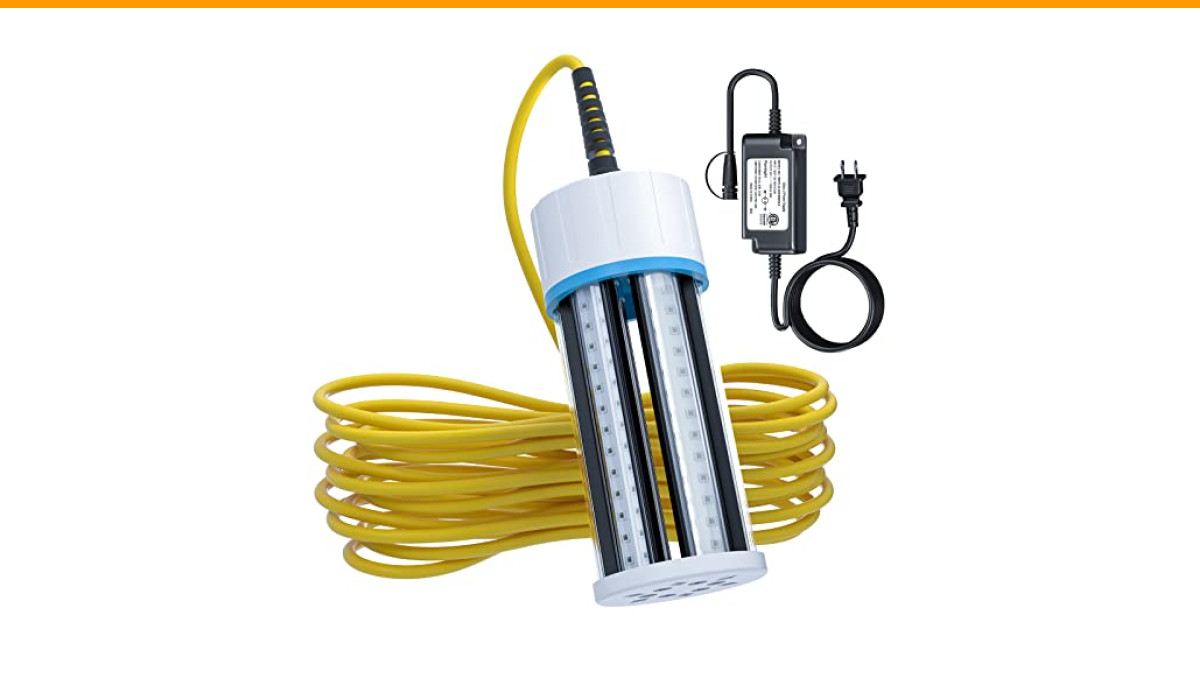
If you’re still shopping, a solid option is the Tendelux Underwater Fishing Light. It pushes 2300 lumens at just 23 watts and comes with both 110V and 12V power options, so it works from a dock or a kayak battery. The 30-foot cable gives you plenty of room to experiment with depth.
Why Depth Matters More Than Light Color
Everyone obsesses over green versus white versus blue. That’s the wrong argument. The depth at which you hang the light determines whether the beam reaches the plankton layer where the baitfish feed. If the light is too shallow, the beam spreads across the surface and never penetrates the strike zone. If it’s too deep, the beam gets absorbed before it can attract anything.
Green light is the best all-around choice because water absorbs it less than red or yellow, and it penetrates better than blue in most freshwater. But even the perfect wavelength fails if it’s hanging in the wrong place. Depth is the variable you control, and it’s the one that makes the difference between a dead stick and a bent rod.
The Science of Green Light Penetration in Fresh and Saltwater
Water filters light fast. Clear freshwater lets green light reach maybe 30 to 40 feet before it’s mostly gone. Murky water cuts that down to 10 feet or less. Saltwater is even more punishing because dissolved salts and organic matter scatter the beam quickly.
You don’t need a degree in optics to use this. You just need to know that your light creates a cone of visibility, not a laser beam. The effective zone—where plankton actually gather—is usually within the top half of that cone. So if your light is at 15 feet, the action is happening between 7 and 15 feet. Factor that in when you pick your depth.
One more thing: green light at 520 nanometers is the sweet spot. It triggers the phototactic response in zooplankton, which is what starts the food chain. But that response only happens if the light is bright enough at the depth where the plankton live.
Depth-by-Species Quick Reference Chart
Here’s the practical chart. These are starting points based on a 20-30 watt LED light in average clarity water. Adjust up or down based on the factors in the next sections.
| Target Species | Ideal Depth Range | Best Water Type | Notes |
|---|---|---|---|
| Bass (Largemouth/Spotted) | 2–6 ft | Shallow lakes, docks | They cruise the edges of the light, not the center. Keep it shallow so the beam spreads wide. |
| Crappie | 8–15 ft | Clear lakes, brush piles | Suspend above the light. Find the baitfish depth first, then match it. |
| Bluegill/Sunfish | 4–10 ft | Ponds, shallow flats | They come in tight. A shallower light pulls them away from cover. |
| Catfish | 10–20 ft | Rivers, deep holes | They patrol the bottom edge of the light zone. Go deeper than you think. |
| Trout (Lake) | 15–25 ft | Cold, clear lakes | Follow the thermocline. They won’t come up past it. |
| Walleye | 12–20 ft | Deep, clear lakes | Low light conditions. Use the light to attract bait, then fish the edges. |
| Saltwater (Snook/Redfish) | 5–12 ft | Bays, passes | Tidal movement matters more than depth. Adjust for current. |
Shallow Water Species (2–8 ft)
Shallow species like bass and bluegill are ambush predators. They don’t want to sit in the bright center of the beam. They want the shadows on the edge. Hanging the light at 3 to 5 feet creates a wide, dim perimeter that feels safe to them. If you drop it to 10 feet in a shallow lake, you’re lighting up a small circle of mud and scaring the fish off the bank.
Mid-Depth Species (8–15 ft)
Crappie and sunfish suspend. They’ll hold at the depth where the light intensity feels comfortable, usually right at the edge of the visible beam. Start at 10 feet and watch your sonar. If you see baitfish marks but no crappie, drop the light 2 feet deeper. The bait will follow, and the crappie will follow the bait.
Deep Water Species (15–30+ ft)
Lake trout and walleye relate to the thermocline in summer. The light needs to sit just above that temperature break, not below it. In winter, they’re deeper but the water is clearer, so light penetration is better. A 25-foot depth with a 30-watt light is often the sweet spot for these fish.
How to Calculate the Perfect Depth for Your Light’s Wattage
Here’s the formula I use. It’s not scientific gospel, but it works across most conditions. Start with 1 foot of depth for every 1 watt of LED power. A 20-watt light starts at 20 feet. A 10-watt light starts at 10 feet. This gives you a baseline for clear water.
Then adjust for conditions. Murky water? Cut the depth in half. Clear, cold water? Add 25 percent. You’re not looking for a perfect number—you’re looking for a starting point that puts the beam’s most intense zone in the middle of the water column where baitfish roam.
Here’s a quick example. You have a 23-watt light (like the Tendelux FG20H). Baseline depth is 23 feet. You’re fishing a murky lake with 3 feet of visibility. Cut that in half to about 11 or 12 feet. You’re fishing a clear mountain lake? Push it to 25 feet. That’s your starting point. Drop it, wait 20 minutes, and check your sonar for bait activity. If nothing shows, move it up or down in 5-foot increments.
Adjusting Depth for Water Clarity and Thermoclines
Water clarity is the single biggest variable. In clear water (10+ feet visibility), light travels further and you can fish deeper. In stained water (2-4 feet visibility), the beam gets scattered fast. The plankton won’t gather at 20 feet because they can’t see the light. Keep it shallow—5 to 10 feet—and let the light do its work near the surface.
Thermoclines are the other factor. In summer, a lake stratifies into warm surface water and cold deep water. The line between them is the thermocline. Fish won’t cross it because the oxygen levels drop below. Your light needs to be above that line, not below it. If the thermocline is at 18 feet, hang the light at 12 to 14 feet. The beam will illuminate the zone just above the break, which is exactly where baitfish hold.
You can find the thermocline with a simple thermometer on a rope, or just watch your sonar for the distinct line of marks. It’s worth the effort. Fishing 5 feet below the thermocline with a light is a waste of battery.
Seasonal Shifts: When to Go Deeper or Shallower
Spring is the easiest. The water is still mixing and there’s no thermocline yet. Fish are shallow and active. Keep the light at 5 to 10 feet. The water is also cooler, which holds more oxygen, so baitfish are comfortable higher in the column.
Summer is when you need to think. The thermocline sets up around 15 to 20 feet in most lakes. The surface water gets too warm and the oxygen gets depleted below the break. Your light belongs right at the top edge of the thermocline. That’s where the baitfish are, and that’s where the predators will be hunting.
Fall is a transition. The thermocline breaks down as the surface cools. Fish start feeding aggressively to prepare for winter. They’ll roam more, so you can move your light shallower and cover more area. Try 8 to 12 feet.
Winter is a different animal. The surface is freezing, but the bottom water stays around 39°F. Fish are sluggish but they’ll still come to a light. The water is at its clearest, so light penetration is at its best. You can fish deeper—15 to 25 feet—and the beam will still reach the bait. Just remember that the fish are moving slow, so give them more time to find the light.
Rigging for Anchor vs. Drift Fishing
Most people hang a light straight down and call it a day. That works when you’re anchored. But if you’re drifting, you need to think differently.
When anchored, you have one shot. The light is stationary, so the food chain builds in one spot. Hang it at the calculated depth and let it sit for 30 minutes. The plankton will gather, then the baitfish, then the predators. Patience is key.
When drifting, the light is moving, so the food chain never fully builds. You need to drag the light just above the bottom structure to provoke a reaction strike. Drop it to 2 to 3 feet off the bottom, regardless of the wattage formula. The goal isn’t to attract plankton—it’s to mimic a fleeing baitfish. The flash of green bouncing off the bottom is enough to trigger a strike from fish holding tight to cover.
One more tip: in current, the light will swing downstream. Use a heavier weight on the line below the light to keep it vertical. If it’s swinging at a 45-degree angle, you’re not lighting the spot you think you are.
Common Depth Mistakes and How to Fix Them
The most common mistake is hanging the light too deep. Anglers assume deeper means better. It doesn’t. If your light is below the thermocline or below the baitfish layer, you’re attracting nothing but turtles. Check your sonar. If you see no bait marks around the light, it’s too deep. Pull it up 5 feet.
The second mistake is using too much light for the depth. A 50-watt light at 5 feet will blind the fish. They’ll stay out of the beam entirely. If you’re fishing shallow, use a lower wattage or hang the light deeper to diffuse the beam. The Tendelux at 23 watts is a good middle ground—bright enough for deep water but manageable for shallow.
The third mistake is not moving the light. Fish aren’t static. They move with the bait. If the bite dies after 45 minutes, the baitfish have likely moved. Raise the light a few feet or drop it a few feet to reposition the beam. A 5-foot adjustment often restarts the food chain.
Final Checklist Before Dropping Your Light
- Check your sonar for the thermocline depth. Keep the light above it.
- Calculate your baseline depth using the 1-watt-per-foot formula.
- Adjust for water clarity: murky water means shallower, clear water means deeper.
- Know your target species and set the depth within the chart ranges.
- If drifting, drop the light 2-3 feet off the bottom instead of using the formula.
- Wait 20 minutes after deployment before judging the spot. The food chain takes time to build.
- Move the light in 5-foot increments if you see no activity. Don’t pull the whole rig out and start over.
- Clean the light lens every few trips. Algae and grime cut light output dramatically.
Depth isn’t a one-and-done setting. It’s a live variable you adjust based on conditions. Start with the formula, confirm with your sonar, and trust the fish. They’ll tell you if you’re wrong.