
Why Baitcasters Intimidate (And Why You Should Persist)
You’ve seen it happen. A friend picks up a baitcaster, makes one cast, and suddenly the line explodes into a mess that takes ten minutes to untangle. The reel gets tossed back into the tackle bag with a few choice words. That scene plays out on every lake in America, and it’s the reason so many anglers stick with spinning gear.
The truth is, a baitcaster isn’t harder to use because it’s poorly designed. It’s harder because it works on different physics than a spinning reel. Once you understand that physics, the backlash problem becomes predictable, and predictable problems are fixable. This guide explains the mechanics, the braking systems, and the thumb technique that turns a bird’s nest machine into a precision casting tool.

KastKing
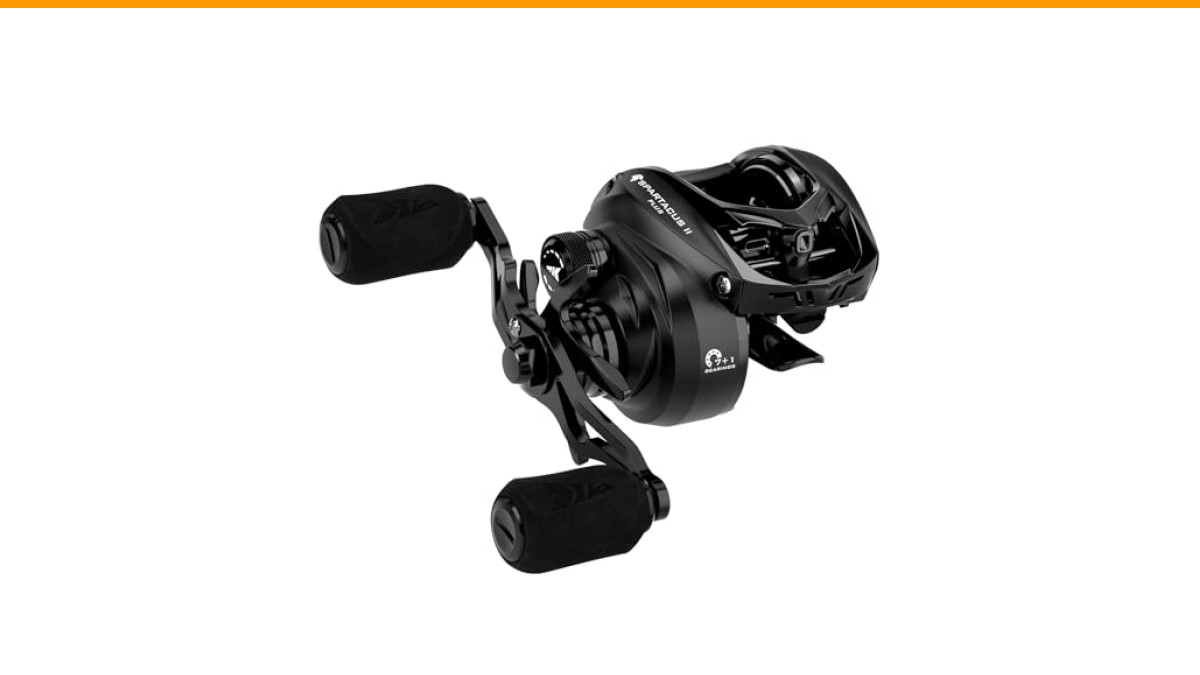
KastKing Spartacus II Plus Baitcasting Reels with 8.0:1 Gear Ratio, Right
- DualBalance Magnetic Braking System: The DualBalance Magnetic Braking System is engineered with evenly balanced magnetic engagemen…
- High-Speed 8.0:1 Hybrid Gear System: Featuring an 8.0:1 high-speed gear ratio, this Spartacus II Plus Baitcasting Reel provides ra…
- Ultra-Lightweight Nylitech Frame with Short Shaft Spool: Constructed with a Nylitech frame and side cover, this baitcasting reel d…
You’ll walk away knowing exactly why spool overrun happens, how to set your brakes for wind and lure weight, and how to feather the spool with your thumb like someone who’s been doing it for years.
If you’re shopping for your first reel, the KastKing Spartacus II Plus is a solid example of a modern low-profile baitcaster. It packs a dual magnetic braking system and an 8.0:1 gear ratio into a 6-ounce frame, which gives you room to learn without fighting heavy equipment.
The Anatomy of a Baitcaster: Key Parts Explained
Every baitcaster has the same core components, and each one plays a role in whether your cast ends clean or tangled.
The Spool and Pinion Gear
The spool holds your line and spins during the cast. It sits directly on the drive shaft, and here’s the critical detail: when you press the thumb bar to free spool, the spool disengages from the pinion gear. Nothing stops it from spinning except your brakes and your thumb.
The pinion gear is what transfers power from the handle to the spool when you reel. During a cast, it slides away from the spool so the spool can rotate freely. That free-spinning spool is the source of all your joy and all your misery. It’s also why lighter lures cause problems, which we’ll get to in a moment.
The Braking System (Magnetic vs. Centrifugal)
Brakes are the only thing between you and a backlash, besides your thumb. Two main types exist, and some reels use both.
Magnetic brakes use stationary magnets positioned near the spool. As the spool spins, it generates eddy currents in the aluminum or copper spool cup, which creates resistance. The closer the magnets are to the spool, the stronger the braking force. You adjust them with a dial on the side plate, usually numbered from 1 to 10. The beauty of magnetic brakes is adjustability mid-cast. You can’t change them while casting, but you can dial them in for different conditions without opening the reel.
Centrifugal brakes use small plastic blocks or pins that fly outward as the spool spins. They press against a brake ring inside the frame, creating friction. The faster the spool spins, the harder the blocks push outward, and the more braking force they apply. This creates a natural self-regulating effect. Centrifugal systems are typically adjusted by opening the side plate and moving the blocks in or out. It’s less convenient than a dial, but the braking curve is often smoother.
Which one should you choose? If you cast into wind often, magnetic brakes give you finer control at the end of the cast. If you’re throwing heavy lures in open water, centrifugal brakes feel more consistent. Many high-end reels combine both, which gives you the best of both worlds.
The Physics of Casting: Why Backlash Happens
Here’s the simple version: when you cast, the rod accelerates the lure. The lure pulls line off the spool. The spool spins faster and faster, trying to keep up with the line leaving. The problem starts when the lure slows down in the air, but the spool doesn’t.
The spool has inertia. It wants to keep spinning at the speed it was spinning. When the lure loses velocity, it stops pulling line, but the spool keeps rotating. That extra line comes off the spool in loose loops, and the next cast wraps around those loops. That’s your backlash, also called a bird’s nest.
Think of it like a car on ice. The wheels are spinning fast, but the car isn’t moving forward. In a baitcaster, the spool is the wheel, and the lure is the car. When they stop matching speed, you get a pileup.
Lighter lures make this worse because they accelerate quickly but lose speed fast. A 1/4-ounce lure will slow down rapidly at the end of a cast, while a 1-ounce lure carries its speed longer. That’s why beginners are told to start with heavier lures. They’re easier to control because the spool speed more closely matches the lure speed throughout the cast.
The solution isn’t to tighten the spool tension knob until the lure barely falls. That kills casting distance. The real solution is a combination of brakes, spool tension, and thumb control.
Step-by-Step: How to Cast a Baitcaster Without Bird’s Nests
Let’s walk through a proper cast, starting with the setup.
Setting the Spool Tension Knob
The spool tension knob is the small knob on the side opposite the handle. It applies pressure to the spool shaft, creating friction. Here’s how to set it correctly.
- Attach your lure and hold the rod tip at about 10 o’clock.
- Press the thumb bar to free spool and hold the spool with your thumb.
- Release your thumb and watch the lure fall.
- The lure should fall slowly and stop when it hits the ground, with only a few inches of line overrunning.
If the lure drops like a rock, tighten the knob. If it barely falls, loosen it. This setting changes with lure weight, so adjust it every time you switch lures. Most anglers set it slightly loose and rely on their thumb for control, but as a beginner, err on the tighter side.
The Thumb Feather Technique
Your thumb is the most important brake on the reel. No mechanical system can match the feedback your thumb gives you. Here’s the technique.
Place your thumb flat on the spool before you cast. Press the thumb bar and start your forward motion. As the rod comes through the cast, ease your thumb off the spool gradually. Don’t lift it completely. Let the line start pulling, then reduce thumb pressure as the spool speeds up.
Here’s the key moment: when you feel the lure reach its peak velocity, apply slight thumb pressure. As the lure starts to slow, increase that pressure smoothly. The goal is to feather the spool so it slows down at the same rate as the lure. Right before the lure hits the water, press your thumb down firmly to stop the spool completely.
This takes practice. Expect to backlash a few times while you learn. Start with a heavier lure, like a 3/8-ounce spinnerbait, and cast into open water. Don’t try to bomb it 50 yards. Focus on smooth, controlled casts of 20 to 30 feet. Accuracy comes before distance.
Brakes, Drag, and Gear Ratio: Tuning for Conditions
Your brake setting isn’t a set-and-forget deal. It changes with wind, lure weight, and casting style.
Here’s a rough guide for magnetic brakes. Start with the dial at 6 or 7 for a new reel. If you’re casting into a headwind, turn it up to 8 or 9. Wind pushes against the lure and slows it down faster, which makes spool overrun more likely. A tailwind allows the lure to travel farther, so you can turn the brakes down to 4 or 5 for more distance.
For centrifugal brakes, start with two blocks engaged. Add more blocks for windy conditions or lighter lures. Remove blocks for heavy lures and open water.
| Condition | Magnetic Setting | Centrifugal Blocks | Spool Tension |
|---|---|---|---|
| Heavy lure (3/4 oz+), no wind | 3-4 | 1-2 | Loose, lure falls freely |
| Medium lure (1/4-1/2 oz), calm | 5-6 | 2-3 | Moderate, slight resistance |
| Light lure (1/8 oz), calm | 7-8 | 3-4 | Tighter, slow fall |
| Any lure, headwind | 8-9 | 4-6 | Tighter than normal |
| Any lure, tailwind | 4-5 | 2-3 | Loose to moderate |
Gear ratio matters too, but not for casting. It affects your retrieve speed. An 8.0:1 ratio, like the one on the KastKing Spartacus II Plus, means the spool turns 8 times for every handle turn. That’s a fast retrieve, great for burning a buzzbait or working a frog. A 6.4:1 ratio is better for cranking deep divers where you want a slower, steady retrieve. Don’t buy a reel based on gear ratio alone. Match it to your primary fishing style.
Drag is often overlooked by beginners, but it’s your safety net. A properly set drag lets line peel off when a fish makes a hard run, preventing breakoffs. The Spartacus II Plus has a carbon fiber drag system rated up to 17.6 pounds, which is plenty for bass and pike. Set your drag so it slips at about one-third of your line’s breaking strength. If you’re using 12-pound test, set the drag around 4 pounds.
Baitcaster vs. Spinning Reel: When to Use Each
This isn’t a competition. Both reel types have their place, and serious anglers own both.
Baitcasters excel at accuracy and power. Because the spool is aligned directly with the rod guides, the line comes off straight, reducing friction. That means you can cast heavier lures farther and more accurately. Once you master the thumb, you can drop a lure into a coffee cup-sized pocket between lily pads.
Baitcasters also handle heavy line better. Braided line in the 30- to 50-pound test range lays flat on a baitcaster spool. On a spinning reel, heavy braid tends to coil and twist. If you’re throwing frogs in heavy cover or punching through mats, a baitcaster is the right tool.
Spinning reels have their own strengths. They handle light lures better, from 1/16-ounce finesse jigs to drop shot rigs. They’re also easier to cast into wind with light line, simply because there’s no free-spinning spool to overrun. For finesse fishing, spinning gear is the standard.
Here’s a practical rule: if you’re throwing anything over 1/4 ounce and need accuracy, use a baitcaster. If you’re throwing light finesse presentations or fishing with 6-pound test line, use a spinning reel. The beginner-focused guide on baitcasting reels covers this trade-off in more detail.
Common Mistakes and How to Fix Them (Troubleshooting Table)
Even experienced anglers hit snags. Here’s a quick reference for the most common issues.
| Symptom | Likely Cause | Fix |
|---|---|---|
| Backlash on the first cast | Spool tension too loose, brakes set too low | Tighten spool tension, increase brake setting |
| Line loops on the spool when casting | Line is too loose on the spool from a poor wind | Re-spool with line under tension, or use a line winder |
| Lure drops too fast, hits water hard | Spool tension knob too loose | Tighten knob until lure falls slowly |
| Short casting distance | Brakes set too high, or spool tension too tight | Reduce brake setting, loosen spool tension slightly |
| Line constantly twists and curls | Line was spooled on wrong, or using old line | Re-spool with the line coming off the filler spool in the correct direction |
| Reel makes grinding noise when reeling | Gears are dry or dirty | Clean and lubricate the gears with reel oil and grease |
One mistake I see constantly is anglers over-tightening the spool tension to stop backlashes. They crank it down until the lure barely moves, then wonder why they can’t cast 30 feet. The spool tension knob isn’t a brake. It’s a starting point. Your thumb and the braking system do the real work.
Maintenance: Keeping Your Baitcaster Smooth
A baitcaster is a precision instrument, and it needs regular care. Saltwater is especially harsh. If you fish salt, rinse the reel with fresh water after every trip and dry it with a soft cloth.
Every few months, open the side plate and check the brake system. Magnetic brakes accumulate dirt and metal shavings from the spool. Wipe the magnets with a dry cloth. Don’t oil them. Oil attracts dust and turns into a paste that reduces braking efficiency.
Centrifugal brake blocks wear out over time. If the blocks look cracked or worn down, replace them. They’re cheap and available from most reel manufacturers. A set of new blocks can restore a reel that’s been losing casting distance.
Lubricate the main gear and pinion gear with a light reel grease. Use a thin oil on the spool bearings. Don’t over-oil. One drop per bearing is enough. Too much oil makes the spool spin slower and attracts grit.
The thumb bar and clutch mechanism can also wear. If the thumb bar sticks or doesn’t engage smoothly, clean the area and apply a tiny amount of oil to the pivot points. The KastKing Spartacus II Plus has a dual-spring thumb bar rated for high cycle counts, so it should hold up well, but no mechanical part is immortal.
Choosing Your First Baitcaster: Features That Matter
Don’t buy the cheapest reel you can find. You’ll fight poor braking, rough gears, and inconsistent drag, and you’ll blame yourself instead of the equipment. A mid-priced reel from a reputable brand is the sweet spot for learning.
Look for these features:
- A reliable braking system. Magnetic brakes are easier for beginners because they’re adjustable with a dial.
- A comfortable frame. The reel should sit low in your palm. A compact body, like the 39mm frame on the Spartacus II Plus, reduces fatigue during long sessions.
- A high gear ratio isn’t necessary for learning, but an 8.0:1 ratio is versatile enough to cover most techniques.
- At least 6 bearings. More bearings generally mean smoother operation, but quality matters more than quantity.
- A carbon fiber drag system. It provides smoother pressure than felt washers and holds up better under heavy loads.
You’ll also want to match the reel to your rod. A baitcasting rod has smaller line guides than a spinning rod, and they’re positioned closer to the blank. Using the wrong rod makes casting difficult and can damage the line. Pair your reel with a medium-heavy, 7-foot baitcasting rod for the most versatile setup.
If you’re wondering whether the baitcasting reel is the right choice for bass fishing, the answer is almost always yes. The control and power you gain are worth the learning curve.
Final Verdict: Is It Worth the Learning Curve?
Yes, but with a caveat. You will backlash. You will spend frustrating minutes picking out tangles. That’s part of the process. But once the thumb feathering clicks, you’ll never want to go back to spinning gear for most bass techniques.
The difference is control. A baitcaster lets you put a lure exactly where you want it, every time. It gives you the power to turn a fish’s head before it reaches cover. It feels like an extension of your arm in a way a spinning reel never does.
Start with the right setup, set your brakes conservatively, and practice the feathering technique in an open field or pond. Give it a month of regular casting, and you’ll be surprised at how natural it feels. The bird’s nests become rare, and the casts become surgical.
Here’s what to remember:
- Backlashes happen because the spool spins faster than the line leaves. Brakes and thumb pressure prevent that.
- Set your spool tension so the lure falls slowly. That’s your baseline, not your final adjustment.
- Use magnetic brakes for fine-tuning in wind. Use centrifugal brakes for consistent, self-regulating control.
- Feather the spool with your thumb throughout the cast, especially at the end when the lure slows down.
- Match your gear ratio to your retrieve style. Fast for topwater, slow for deep cranking.
- Maintain your brakes and gears regularly. Clean reels cast farther and last longer.
- Invest in a mid-priced reel with good brakes and a carbon drag. It’s worth the extra money over a budget model.
Now go tie on a practice plug and make some casts. The only way to learn is to do it.
