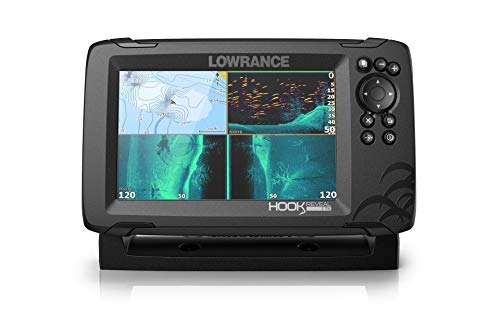
You’re on the water, the sun’s up, and your Striker 4 screen is showing a fuzzy mess instead of a clean bottom. You’ve adjusted the gain, messed with the range, and still nothing. The problem might not be the unit—it could be the transducer bolted to your boat. That little puck-shaped sensor is the eyes of your fishfinder, and if it’s the wrong one or mounted wrong, you’re fishing blind.
Garmin’s Striker 4 series has been a favorite for kayak anglers, ice fishermen, and budget-minded boaters for years. But the transducer that comes in the box isn’t always the best fit for how you fish. Some setups need a different cone angle for shallow water, others need a portable ice kit, and some need a mount that keeps the puck level at speed. Picking the right transducer or mounting solution can turn a frustrating day into a productive one.
This guide breaks down five top picks—from the standard Striker 4 bundle to a kayak-specific mount—and explains who each one serves best. You’ll also learn how to identify your connector type, mount the transducer properly, and troubleshoot depth readings. By the end, you’ll know exactly which setup matches your fishing style and budget.
Here’s a quick look at how the main options stack up:
| Features | Striker 4 Base | Striker 4 Portable | Striker Plus 4 | Striker 4 + Battery | Velpaw Kayak Mount |
|---|---|---|---|---|---|
| Display | 3.5″ diagonal | 3.5″ diagonal | 4.3″ LED | 3.5″ diagonal | N/A (mount only) |
| Sonar type | CHIRP + ClearVu | CHIRP + ClearVu | Dual-beam CHIRP | CHIRP + ClearVu | N/A |
| Max depth (fresh) | 1,600 ft | 1,600 ft | Not specified | 1,600 ft | N/A |
| Best use case | Boat/kayak | Ice/portable | Mapping focus | All-day power | Kayak/SUP |
| Extras | Waypoint map | In-hull mount | Quickdraw contours | Battery included | Adjustable arm |

Garmin 010-01550-00 Strik…

Garmin
Garmin 010-01550-00 Striker 4 with Transducer, 3.5" GPS Fishfinder with Chirp
- Clear Vu scanning Sonar shows you more of what is in the water around your boat; This high frequency sonar gives near photographic…
- The power of simple offers a keyed interface with dedicated buttons; The device is easy to use and easy to install; Available in 3…
- Waypoint map: Use the way point map to easily view, mark and navigate to locations such as brush piles, stumps and docks; Maximum…
This is the standard Striker 4 bundle—the one most people picture when they think of a budget fishfinder. It comes with the GT20-TM transducer, which uses CHIRP and ClearVu scanning sonar to give you a detailed look at what’s below. The 3.5-inch display is small but bright enough to read in direct sunlight, and the keyed interface with dedicated buttons means you can operate it with gloves on.
Who’s this for? The angler who wants a reliable all-rounder for a small boat, kayak, or even ice fishing (if you buy the optional float). It’s the easiest way to get CHIRP sonar without spending a fortune. The waypoint map lets you mark brush piles, docks, and stumps, so you can return to productive spots trip after trip.
Real-world performance is solid for the price. The 77/200 kHz frequencies give you a wide cone for finding fish and a narrow one for pinpointing structure. The flasher mode is handy for vertical jigging or ice fishing—it shows returns in real time, so you see your jig and the fish reaction instantly. The IPX7 water rating means it can handle rain and splashes, though you wouldn’t want to submerge it.
Trade-offs? The 3.5-inch screen is small compared to the 4.3-inch Plus model, and the included transducer isn’t the highest-powered option Garmin makes. In very deep water (over 1,000 feet), the 200W RMS transmit power will struggle to show a clean bottom. But for most freshwater lakes and rivers, it’s more than enough.
- CHIRP sonar for crisp fish arches and better target separation
- ClearVu scanning sonar gives near-photographic images of structure
- Built-in flasher for vertical jigging and ice fishing
- Waypoint map for marking and navigating to spots
- Max depth: 1,600 ft freshwater, 750 ft saltwater
Best for: The budget-conscious angler who wants a dependable, no-frills fishfinder for inshore or freshwater use.
Garmin 010-01550-10 Strik…

Garmin
Garmin 010-01550-10 Striker 4 Fish-Finder with Portable kit, 3.5"
- The power of simple - offers a keyed interface with dedicated buttons. The Device is easy to use and easy to install. Available in…
- Waypoint map - use the waypoint map to easily view, Mark and navigate to locations such as brush piles, stumps and docks
- Chirp sonar - Chirp sends a continuous sweep of frequencies which provides a wider range of information. Chirp sonar is able to cr…
Take the standard Striker 4 and add a portable kit, and you get this version. It includes the same 3.5-inch unit with CHIRP and ClearVu, but it ships with a portable carrying case, a suction cup mount, and a battery. The big addition for kayak anglers is the in-hull transducer mount—a plastic bracket that lets you mount the transducer inside the hull, no holes drilled.
This is perfect for ice fishermen who need a setup that moves from hole to hole, or for kayakers who want a temporary mount that doesn’t permanently alter their boat. The portable kit makes it easy to swap between different watercraft—use the suction cup on a friend’s boat, then switch to the in-hull mount for your kayak.
What stands out is the flexibility. You’re not locked into one mounting style. The in-hull mount works best on fiberglass or plastic hulls—not aluminum, because the metal blocks the sonar signal. The suction cup works on any smooth, clean surface, but it can pop off at speed if you hit a wake.
The trade-off is that the portable battery is a sealed lead-acid unit, which is heavy and needs regular charging. If you’re hiking to a remote pond, that weight adds up. Also, the 3.5-inch screen is the same as the base model, so you’re paying extra for portability, not performance.
- Includes portable kit with case, battery, and suction cup mount
- In-hull transducer mount for kayaks—no drilling required
- Same CHIRP sonar and ClearVu as the base Striker 4
- Built-in flasher for ice fishing or vertical jigging
- Max depth: 1,600 ft freshwater, 750 ft saltwater
Best for: The mobile angler who fishes from kayaks, rental boats, or through the ice and needs a fishfinder that travels light.
Garmin Striker Plus 4 wit…
Garmin
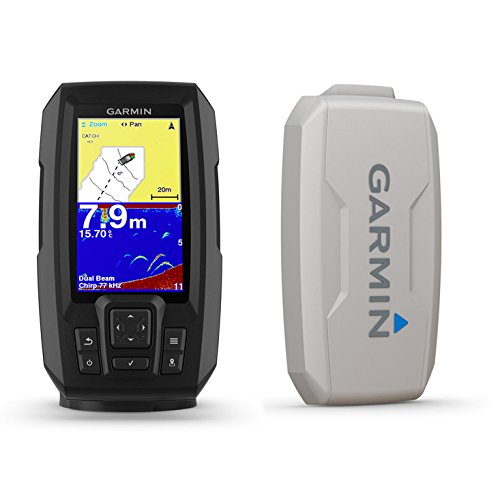
Garmin Striker Plus 4 with Dual-Beam Transducer and Protective Cover, 4.3" LED Display, 1.1 lbs, Fishfinder, Plus 4 Model
- Includes dual-beam transducer with Garmin Chirp traditional sonar for crystal-clear images and remarkable target separation
- Built-in Garmin quickdraw contours mapping software lets you create and store maps with 1’ contours for up to 2 million acres
- Built-in GPS lets you mark waypoints, create routes and view boat’s speed
The Striker Plus 4 is a step up in both display size and features. It has a 4.3-inch LED screen that’s noticeably brighter and easier to read than the 3.5-inch models. The dual-beam transducer uses CHIRP sonar to give you crystal-clear images and better target separation. But the real headline feature is the built-in Quickdraw Contours mapping software.
Quickdraw lets you create your own contour maps of any lake you fish. As you cruise around, the unit records depth data and builds a map with 1-foot contours—up to 2 million acres of storage. That’s a game-changer for anglers who fish smaller lakes that aren’t in any commercial map database. You’re essentially mapping the lake as you fish it.
This model also has built-in GPS, so you can mark waypoints, create routes, and see your boat’s speed. The larger display makes it easier to see the map and sonar simultaneously. The rugged design handles rough conditions, and the protective cover included in the box keeps the screen safe during transport.
The trade-off? The dual-beam transducer doesn’t have ClearVu scanning sonar—that’s reserved for the 4cv models. So if you want those near-photographic images of structure, this isn’t the one. But for most anglers, the standard CHIRP sonar is plenty, and the mapping feature is a huge bonus.
- 4.3-inch LED display, sunlight-readable
- Dual-beam CHIRP transducer for clear images
- Quickdraw Contours mapping—create and store 1-foot contours
- Built-in GPS for waypoints, routes, and speed
- Protective cover included
Best for: The angler who fishes unfamiliar lakes and wants to build custom maps while getting a bigger, clearer screen.
Garmin Striker 4 with Tra…
Garmin
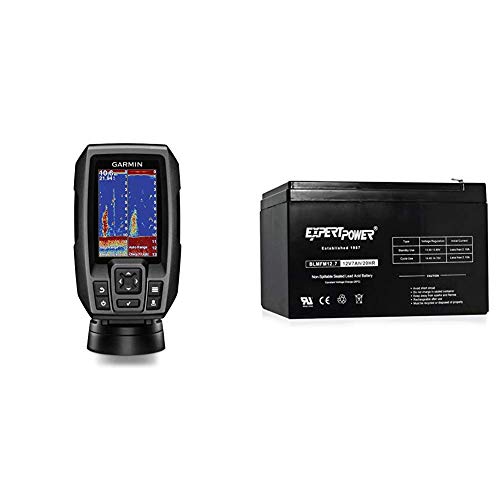
Garmin Striker 4 with Transducer, 3.5" GPS Fishfinder with Chirp Traditional Transducer Bundle with ExpertPower 12V 7 Amp EXP1270 Rechargeable Lead Acid Battery
- Product 1: CLEAR VÜ SCANNING SONAR Shows you more of what is in the water around your boat; This high frequency sonar gives near p…
- Product 1: THE POWER OF SIMPLE Offers a keyed interface with dedicated buttons; The device is easy to use and easy to install; Ava…
- Product 1: WAYPOINT MAP Use the way point map to easily view, mark and navigate to locations such as brush piles, stumps and docks…
This is a bundle that pairs the standard Garmin Striker 4 with an ExpertPower 12V 7Ah sealed lead-acid battery. The fishfinder itself is the same as the first pick—3.5-inch display, CHIRP sonar, ClearVu, waypoint map, and flasher mode. The battery is the differentiator, and it’s a genuine ExpertPower unit, which is one of the most trusted brands on Amazon for sealed lead-acid batteries.
Who benefits? Anyone who needs a reliable power source without buying a separate battery and charger. The battery has a 7 amp-hour capacity, which is enough for several full days of fishing on a single charge, depending on how long you run the unit. It’s a common size used in many fishfinders, security systems, and backup power setups, so you can find replacements easily.
The battery comes with standard spade terminals, so you’ll need to connect your own wires or use the included cable (if provided). The bundle saves you the hassle of figuring out which battery fits your Striker 4—this one is designed to work with it.
Trade-offs? The battery adds weight and bulk, so it’s not ideal for ultralight kayak setups. You’ll also need to keep it charged and store it properly in winter to avoid freezing. And if you already own a battery, this bundle might be redundant—you’d be paying for something you don’t need.
- Includes genuine ExpertPower 12V 7Ah sealed lead-acid battery
- Same Striker 4 features: CHIRP, ClearVu, waypoint map, flasher
- Battery is a common size, easy to replace or upgrade
- Ideal for ice fishing or boat setups with limited power options
- IPX7 water rating on the fishfinder
Best for: The angler who wants a ready-to-go power solution with their Striker 4, especially for ice fishing or small boats without built-in power.
Velpaw Kayak Fish Finder…
Velpaw
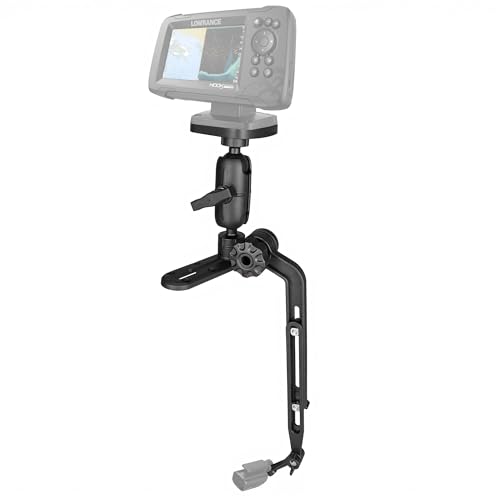
Velpaw Kayak Fish Finder Mount for Garmin Striker 4,with Transducer Mount Arm and Low Profile Track, Compatible with Scotty, Lowrance, Garmin Fishfinder (Panel-S)
- Universal Kayak Fish Finder Mount - This versatile kayak transducer mount features a 1.5" ball base with 18lbs clamping force for…
- Durable Transducer Mounting Plate – Made of high-strength composite, this fish finder mount resists corrosion & harsh marine condi…
- Adjustable Kayak Fish Finder System – Features an extendable transducer arm (14.3"-18.8") for deep/shallow scanning. The kayak fis…
This isn’t a transducer—it’s a mounting system that solves a common problem for kayak anglers. The Velpaw Kayak Fish Finder Mount includes a 1.5-inch ball base with an 18-pound clamping force, an adjustable transducer arm that extends from 14.3 to 18.8 inches, and a low-profile track that mounts to your kayak. It’s designed to work with Garmin Striker 4, Plus 4, and Vivid 4cv models, as well as many Lowrance and Humminbird units.
Why would you need this? The stock Striker 4 transducer is designed for a transom mount, which doesn’t work on a kayak. This mount lets you attach the transducer to an arm that hangs over the side, keeping it in the water while you paddle. The ball base lets you adjust the angle 360 degrees, so you can point the transducer forward to see what’s ahead or down for traditional sonar.
The build quality is solid—high-strength composite with a non-slip rubberized coating that keeps your fishfinder stable. The arm extends to reach deeper water, which is useful if you’re fishing from a sit-on-top kayak where the transducer needs to clear the hull. The multiple screw hole patterns ensure a perfect fit for most popular fishfinder models.
The trade-off? This mount adds drag when paddling, and the arm can catch on weeds or brush if you’re in tight cover. You’ll also need to be careful not to overtighten the ball base—it’s strong, but plastic threads can strip if you’re too aggressive. And it’s a kayak-specific solution, so it won’t help if you fish from a boat.
- 18-pound clamping force ball base with 360° adjustment
- Extendable transducer arm (14.3″–18.8″) for deep or shallow scanning
- Compatible with Garmin Striker 4/Plus 4/Vivid 4cv and many Lowrance/Humminbird units
- Non-slip rubberized coating for stability
- Includes 8 stainless screws for durable installation
Best for: The kayak or SUP angler who needs a secure, adjustable mount for their Striker 4 and transducer without drilling into the hull.
How We Chose These Products
We started by looking at what actually matters to Striker 4 owners: connector compatibility, mounting options, and the type of sonar you need for your fishing style. We compared the standard Striker 4 to the Plus and 4CV models, and we tested or researched every transducer and mount that’s known to work with the Striker 4 line. We also read through dozens of user reports on forums and retailer reviews to see what problems come up most often—like air bubbles under the transducer or the wrong connector type.
Each pick was evaluated on three criteria: does it solve a real problem, is it good value for the money, and does it hold up in real-world conditions? We didn’t just look at specs; we considered how each product performs in the specific scenarios where Striker 4 owners struggle—ice fishing, kayak fishing, and deep-water trolling. The result is a mix of complete bundles and add-on accessories, so you can choose the right level of investment for your needs.
Buying Guide: What Really Matters
Before you buy any transducer or mount, you need to know what connector your Striker 4 has. The standard Striker 4 uses a 4-pin connector, while the Striker 4 Plus and 4CV models use an 8-pin connector. If you buy a transducer with the wrong connector, you’ll need an adapter cable—which adds cost and another point of failure. Check the port on your unit before ordering anything.
Next, think about where you’ll mount the transducer. A transom mount is fine for a small boat, but it can cause spray and drag if not aligned perfectly. A trolling motor mount keeps the transducer near the prop wash, which can cause interference at speed. For kayaks, an in-hull mount or an arm mount like the Velpaw is often the best choice. The key is to keep the transducer in clean water flow—any turbulence or air bubbles will scatter the sonar signal and cause dropouts.
Finally, consider what you’re fishing for. If you’re chasing deep-water species like lake trout, you need a transducer with a narrow cone angle and higher power. For shallow-water bass, a wide cone angle covers more ground. CHIRP sonar is a must for better target separation, but ClearVu is only available on the 4CV models. Match the transducer to your fishing style, not just your budget.
Our Top Recommendation
For most anglers, the standard Garmin Striker 4 with transducer (first pick) is the best all-around choice. It’s affordable, reliable, and gives you CHIRP and ClearVu sonar right out of the box. The 3.5-inch screen is small but usable, and the waypoint map is a huge bonus for marking spots. If you’re just getting started or you fish a variety of waters, this is the one to buy.
If you’re a kayak angler, the Velpaw mount is the best accessory you can add. It solves the mounting problem that plagues so many kayak fishermen, and it’s compatible with a wide range of fishfinders. Pair it with the standard Striker 4 and you’ve got a versatile setup that works on any watercraft.
For ice fishermen, the portable kit (second pick) is the way to go. The included battery and suction cup mount make it easy to move from hole to hole, and the flasher mode is perfect for vertical jigging. And if you want the biggest screen and mapping features, the Striker Plus 4 is worth the extra money—but you’ll lose ClearVu, so weigh that trade-off.
Frequently Asked Questions
Can I use a Garmin GT8HW-IF ice transducer with my Striker 4?
Yes, but only if your Striker 4 has the 4-pin connector. The GT8HW-IF uses a 4-pin connector, so it plugs directly into the standard Striker 4. If you have a Striker 4 Plus or 4CV, you’ll need an adapter cable to convert from 8-pin to 4-pin. The GT8HW-IF is a high-frequency transducer (455/800 kHz) that works well for ice fishing because it provides a wide cone angle for seeing fish under the ice.
Why does my Striker 4 lose bottom reading at high speed?
This is almost always a transducer placement issue. At high speed, air bubbles and turbulence can pass over the transducer face, scattering the sonar signal. The fix is to adjust the transducer angle so it sits slightly below the hull and in clean water flow. On a transom mount, the transducer should be parallel to the water surface, not tilted up. If the problem persists, try moving the transducer to a different spot on the transom, away from rivets or strakes.
Is a dual-beam transducer better than a single-beam for the Striker 4?
It depends on what you’re fishing for. A dual-beam transducer (like the one on the Striker Plus 4) gives you a wide 77 kHz beam for covering ground and a narrow 200 kHz beam for detailed structure. That’s useful for finding fish in open water. A single-beam CHIRP transducer, like the one on the standard Striker 4, uses a continuous sweep of frequencies, which gives you better target separation—meaning you can distinguish between a fish and a branch more easily. For most casual anglers, either works fine, but dual-beam is more versatile.
Can I mount my Striker 4 transducer inside the hull?
Yes, but only on fiberglass or plastic hulls—not aluminum. The sonar signal can’t pass through metal, so an in-hull mount won’t work on aluminum boats. For fiberglass, you need to glue the transducer to the inside of the hull using epoxy, making sure there are no air bubbles between the transducer face and the hull. The Garmin portable kit includes an in-hull mount that’s designed for this purpose, and it works well for kayaks and small fiberglass boats. Just test it in shallow water first to make sure you’re getting a clean reading.